





Online Course Sales Funnel: Stages, Examples & Tips
Sales Funnel : How to Build One That Converts for Online Courses
Most online courses creators make the same mistake. They spend weeks - sometimes months - building a course, recording videos, designing slides, writing workbooks. Then they hit publish, share a link on Instagram, and wait.
Nothing happens.
Or worse: a trickle of sales comes in, then stops. The course is good. The content is solid. But the pipeline is broken.
Here's the uncomfortable truth: a great course doesn't sell itself. What sells an online course is a great sales funnel - a deliberate, structured sequence that takes a complete stranger from "never heard of you" to "here's my credit card."
This guide breaks down exactly how to build that funnel. We'll cover every stage, what actually works at each one, real-world examples, and the conversion benchmarks you should be hitting. By the end, you'll have a clear blueprint - not a vague framework, but a working system.
What Is a Sales Funnel for Online Courses?
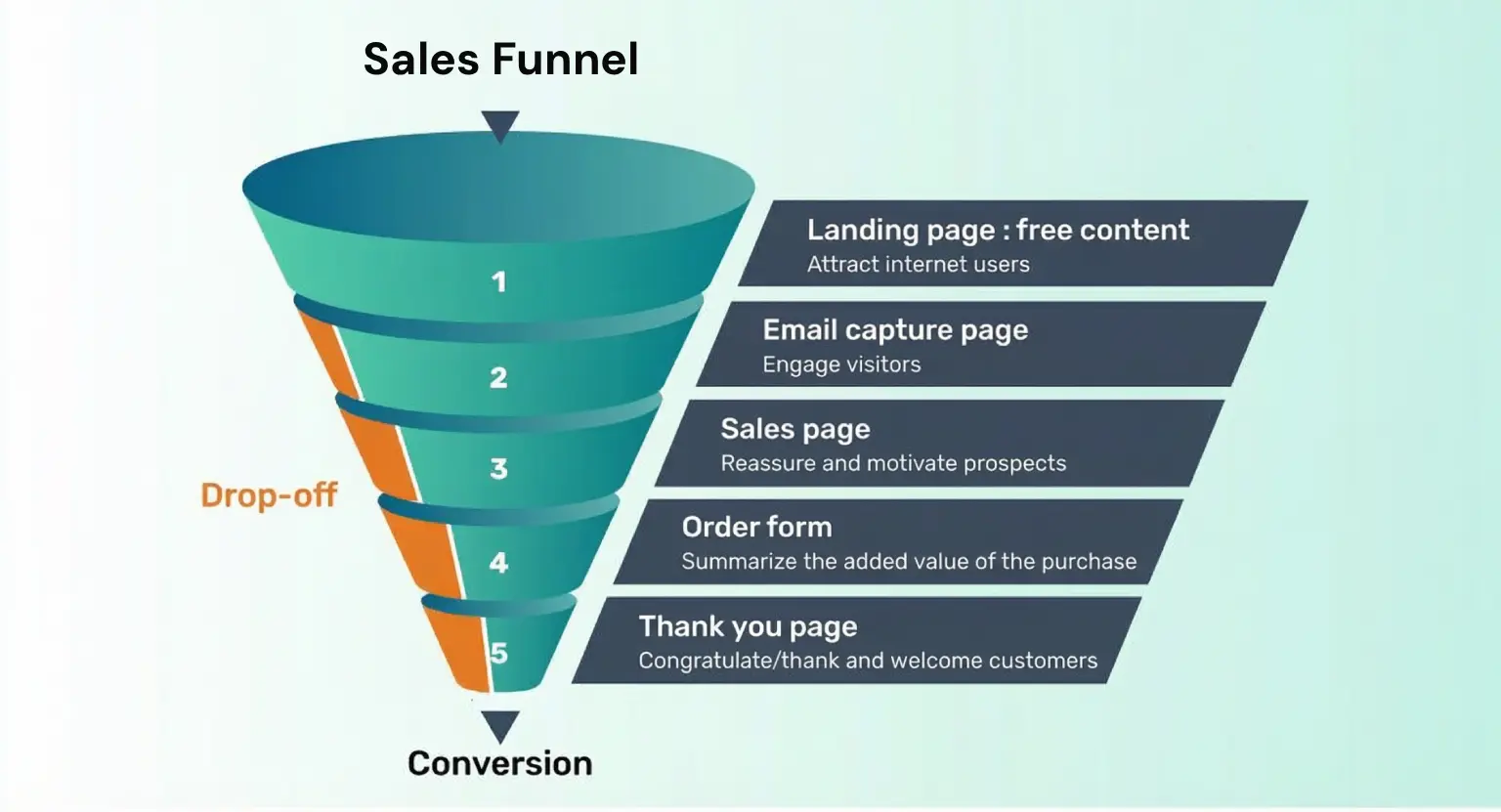
A sales funnel is the path a potential student takes from first discovering you to enrolling in your course. The word "funnel" is apt: you start with a large number of people at the top, and a smaller, more qualified group makes it through to purchase.
What makes a course funnel different from a general sales funnel is the nature of the product. Online courses require a higher level of trust than most purchases.
People aren't just buying information - they're buying a transformation. They're asking: Will this actually work for me? Is this person qualified to teach me? Is it worth my time and money?
A well-built funnel answers all three questions before the prospect even reaches the checkout page.
The funnel typically moves through five stages:
Awareness → Interest → Consideration → Decision → Enrollment.
But in practice, the most effective course funnels add two more layers that most guides ignore: Post-Purchase Ascension (turning students into repeat buyers) and Referral Loops (turning happy students into your best marketers).
The 5 Core Stages of an Online Course Sales Funnel
Stage 1 - Awareness: Getting Found by the Right People
You can't sell to someone who doesn't know you exist. The awareness stage is about reaching your target audience in the places they already spend time - and giving them a reason to pay attention.
The mistake most course creators make here is trying to be everywhere at once. They post on Instagram, start a YouTube channel, write blog posts, run ads, and launch a podcast - all at the same time. The result is diluted effort and mediocre results across the board.
The smarter approach: pick one primary channel and go deep before going wide.
SEO-driven content remains one of the highest-ROI awareness channels for course creators.
A well-optimized blog post or YouTube video can generate consistent traffic for years without ongoing ad spend.
The key is targeting keywords with genuine purchase intent - not just "how to learn guitar," but "best online guitar course for beginners" or "how to get better at fingerpicking fast."
Short-form video (Reels, TikToks, YouTube Shorts) has dramatically lowered the barrier to reach.
A single 60-second video demonstrating a quick win from your course content can reach tens of thousands of people who've never heard of you.
The algorithm rewards specificity - the more niche your content, the more precisely it gets distributed to the right audience.
Paid traffic (Meta Ads, Google Ads, YouTube pre-roll) compresses the timeline.
Instead of waiting months for organic content to gain traction, you can put your lead magnet in front of a targeted audience immediately.
The tradeoff is cost - and paid traffic only makes sense once you've validated your funnel's conversion rates organically first.
Benchmark to hit: Cold social traffic converts at 0.75-1.5% on landing pages; warm audiences convert at 1.5-3%; search traffic with tightly matched intent can reach 3-5%.
Stage 2 - Interest: Capturing Leads Before They Disappear
Here's a number that should make you uncomfortable: 97% of first-time website visitors leave without buying anything. Most of them never come back.
The interest stage is about capturing contact information - usually an email address - before that happens. You do this by offering something genuinely valuable in exchange: a lead magnet.
The lead magnet is the most underestimated element of the entire funnel. Most course creators offer a PDF checklist or a "free mini-course" that nobody asked for. The best lead magnets are hyper-specific, immediately actionable, and directly connected to the paid course.
Examples of high-converting lead magnets for course creators:
-
A free workshop or webinar that teaches one specific outcome (not a "masterclass" that's really just a 90-minute sales pitch)
-
A template or swipe file that saves the prospect hours of work
-
A quiz or assessment that diagnoses a problem and delivers personalized results
-
A challenge (5-day, 7-day) that creates a habit of engagement before the sale
Benchmark to hit: A well-targeted lead magnet landing page should convert at 20-40% for free offers, 12-25% for waitlists, and 6-12% for free trial signups.
Once you have the email address, the real work begins. The first 48-72 hours after someone opts in are the highest-engagement window you'll ever have with that subscriber. Use it.
Send a welcome sequence - not a single welcome email, but a 4-6 email series that delivers value, tells your story, and naturally introduces your paid course.
Stage 3 - Consideration: Building Trust at Scale
The consideration stage is where most funnels fall apart. The prospect is interested. They've read your content, watched your videos, maybe downloaded your lead magnet. But they haven't bought yet - and the reason is almost always trust.
They're asking questions they won't say out loud: Is this person actually an expert? Will this course work for someone like me? What happens if I buy and it doesn't deliver?
Social proof is the single most powerful trust-builder.
Not generic testimonials ("This course changed my life!") but specific, outcome-focused ones: "Before this course, I was charging $50/hour for my freelance design work.
Six weeks after finishing Module 3, I landed a $4,200 project." Numbers, timelines, before-and-after - these are what convert.
Email nurture sequences are the engine of the consideration stage.
A healthy email list has an open rate of 25-40% on a warm, regularly pruned list. The goal isn't to sell in every email - it's to show up consistently, deliver value, and stay top of mind until the prospect is ready to buy.
Retargeting ads are the consideration stage's secret weapon.
Someone who visited your sales page but didn't buy is already warm - they just need a nudge.
A retargeting campaign on Meta or Google showing testimonials, addressing objections, or offering a limited-time bonus can recover a significant portion of those lost leads.
Stage 4 - Decision: Making the Sale Inevitable
The decision stage is where the prospect is ready to buy - or almost ready. They just need the right conditions.
This is the stage most course creators over-engineer. They add more features to the course, lower the price, pile on bonuses. But the real barriers to purchase are rarely about the course itself. They're about risk, urgency, and friction.
-
Eliminating risk means offering a money-back guarantee.
A 30-day guarantee doesn't just reduce refund anxiety - it actually increases sales by more than it increases refund rates. When people feel safe, they buy more confidently.
-
Creating urgency means giving people a genuine reason to act now rather than later.
Real urgency comes from cohort-based launches, limited spots, or price increases tied to actual business decisions.
Manufactured urgency (the countdown timer that resets every time you visit the page) destroys trust the moment someone notices it.
-
Reducing friction means making the checkout process as fast and painless as possible.
One-click upsells, saved payment information, and a clean, distraction-free checkout page can meaningfully improve your conversion rate.
Benchmark to hit: A warm audience checkout page should convert at 24%; cold traffic at 14%. An order bump should see a 28% take-rate on a warm audience.
Stage 5 - Enrollment & Onboarding: The Sale Is Just the Beginning
Most funnel guides end at the sale. This is a mistake.
The enrollment and onboarding experience determines three things that matter enormously to your long-term business: completion rates, testimonials, and repeat purchases.
A student who completes your course and gets results will leave you a glowing testimonial, refer their friends, and buy your next product.
A student who buys, never logs in, and quietly requests a refund does the opposite.
Within 15 minutes of purchase, the student should receive a welcome email that doesn't just say "thanks for buying." It should tell them exactly what to do next, what to expect, and - critically - give them a quick win.
Something they can do in the first 10 minutes that makes them feel like they made the right decision.
Benchmark to hit: 70%+ of students should start their first lesson within 48 hours of enrollment. If your first-lesson start rate is below 50%, your onboarding is broken.
The first 7 days are the highest-dropout window.
A short email sequence (3-4 emails) during this period - checking in, celebrating small wins, answering common questions - can dramatically improve completion rates and reduce refund requests.
Beyond the Sales Funnel: Ascension and Referral Loops
The five stages above describe a funnel. What you actually want to build is a flywheel.
Post-Purchase Ascension
A student who just bought your $297 course is the most likely person on earth to buy your $997 coaching program. They've already proven they trust you, they value the topic, and they're willing to invest.
The ascension ladder - a logical sequence of offers that increase in price and depth - is where the real revenue lives:
| Offer | Price | Purpose |
|---|---|---|
| Lead magnet | Free | Capture email |
| Tripwire / intro offer | $27-$97 | Convert first-time buyers |
| Core course | $197-$497 | Primary product |
| Advanced course or bundle | $497-$997 | Deepen the relationship |
| Group coaching / mastermind | $1,500-$5,000+ | High-touch, high-value |
| 1-on-1 coaching | $3,000-$15,000+ | Maximum personalization |
Benchmark to hit: 10-20% of students should convert to your next logical offer within 14-30 days of completing your core online course.
Referral Loops
Word-of-mouth is the highest-converting traffic source in existence - and it costs nothing. But it doesn't happen by accident.
Build referral mechanisms into your funnel: a formal affiliate program, a "refer a friend" discount, or simply making it easy for students to share their results on social media.
A student who posts "Just finished [Your Course] and landed my first client!" is worth more than any ad you'll ever run.
A Real-World Example: The Complete Online Course Sales Funnel in Action
Let's make this concrete. Here's what a well-built funnel looks like for a course creator teaching freelance copywriting:
-
Top of funnel: A YouTube video titled "How I Wrote a $5,000 Email Campaign in 3 Hours" ranks for "freelance copywriting tips." It ends with a CTA to download a free "Client-Ready Email Templates" pack.
-
Lead capture: The templates landing page converts at 32% (warm YouTube traffic). The subscriber receives a 5-email welcome sequence over 7 days, each email teaching one copywriting principle and ending with a soft mention of the paid course.
-
Consideration: On day 8, subscribers receive an invitation to a free live workshop: "How to Land Your First $2,000 Copywriting Client." The workshop delivers real value and ends with a pitch for the core course.
-
Decision: The course is offered at $397 with a 30-day money-back guarantee, a payment plan option ($147 x 3), and enrollment closing in 5 days (genuine cohort-based launch). An order bump ("The Freelance Proposal Template Pack" for $47) converts at 31%.
-
Onboarding: Buyers receive a welcome email within 10 minutes with a link to "Module 1: Your First Client in 14 Days." A 7-day check-in sequence keeps engagement high.
-
Ascension: 60 days after purchase, students who completed the course receive an invitation to a $1,200 group coaching program. 14% convert.
Result: From 1,000 YouTube viewers - 320 email subscribers - 48 workshop attendees - 11 course sales - 1-2 coaching clients. Total revenue per 1,000 viewers: approximately $5,200.
How to Measure and Optimize Your Sales Funnel
Building the funnel is step one. Optimizing it is where the compounding gains happen.
| Funnel Stage | Metric | Good | Elite |
|---|---|---|---|
| Awareness | Landing page CVR (cold) | 0.75-1.5% | 3-5% |
| Interest | Lead magnet opt-in rate | 20-40% | 40-60% |
| Consideration | Email open rate | 25-40% | 40-50%+ |
| Consideration | Nurture email CTR | 3-8% | 8-15% |
| Decision | Sales page CVR (warm) | 12-24% | 24-35% |
| Decision | Abandoned cart recovery | 10-15% | 15-20% |
| Enrollment | First-lesson start (48h) | 70%+ | 85%+ |
| Ascension | Upsell CVR (30 days) | 10-15% | 15-20% |
The most common funnel leaks - and how to fix them:
-
High traffic, low opt-ins:
Your lead magnet isn't specific enough, or the landing page copy doesn't make the value obvious. Test a new headline and a more specific offer.
-
High opt-ins, low sales:
Your nurture sequence isn't building enough trust, or your sales page isn't addressing the right objections. Add more social proof and a FAQ section that tackles the top 5 reasons people don't buy.
-
High sales, high refunds:
Your onboarding is weak. Students feel buyer's remorse because they don't know what to do next. Fix the first 7 days.
-
Low ascension rates:
Your next offer isn't a natural next step from the first one. Revisit the logic of your ascension ladder.
Choosing the Right Tools to Build Your Sales Funnel
You don't need expensive software to build a high-converting funnel. You need the right tools for each job.
The most common mistake is using six different tools that don't talk to each other.
Every integration is a potential point of failure - and a source of data loss. An all-in-one platform that handles course hosting, email, landing pages, and checkout in a single dashboard eliminates that complexity and gives you a complete view of your funnel performance.
| Function | What You Need | Examples |
|---|---|---|
| Course hosting | An LMS that handles video, quizzes, and community | LearnyBox, Teachable, Kajabi, Thinkific |
| Landing pages | A page builder with conversion-focused templates | LearnyBox, Leadpages, Unbounce |
| Email marketing | Automation, segmentation, sequences | LearnyBox, ActiveCampaign, ConvertKit |
| Checkout | One-click upsells, order bumps, payment plans | LearnyBox, ThriveCart, Stripe |
| Webinars | Live and evergreen options | LearnyBox, Zoom, Webinarjam |
| Analytics | Track funnel performance end-to-end | Google Analytics 4, Hotjar |
The One Thing Most Online Course Sales Funnels Get Wrong
After everything we've covered, here's the insight that ties it all together.
Most course creators think about their funnel as a mechanism for extracting money from prospects. The best course creators think about it as a mechanism for delivering value at every stage - and trusting that the sales will follow.
The lead magnet that genuinely solves a problem. The email sequence that teaches something real. The workshop that leaves attendees better off whether they buy or not. The onboarding that makes students feel like they made the best decision of the year.
When your funnel is built around genuine value delivery, the conversion rates take care of themselves. People buy from people they trust. Trust is built through consistent, generous, specific helpfulness.
That's the funnel. Build it once, optimize it continuously, and it will work for you every single day - whether you're at your desk or not.
Ready to build your online course sales funnel? LearnyBox gives you everything in one place - course hosting, email marketing, landing pages, checkout, and webinars - so you can focus on teaching instead of duct-taping tools together !
FAQ - Sales Funnels for Online Courses
How long does it take to build a sales funnel for an online course?
A basic funnel - lead magnet, landing page, welcome sequence, and sales page - can be built in 2-3 days.
A more complete funnel with webinars, retargeting, and an ascension path typically takes a few weeks to build and a few months to optimize based on real data.
Do I need a large audience to make a sales funnel work?
No. Some of the most profitable course launches happen with email lists of fewer than 500 people - because the list is highly targeted and the funnel is well-built.
A small, engaged audience outperforms a large, disengaged one every time.
What's the best lead magnet for a course funnel?
The best lead magnet is the one that solves a specific, urgent problem your ideal student has - and that naturally leads them to want your paid course.
A free workshop or webinar typically outperforms a PDF because it creates a real-time relationship and allows you to pitch at the end.
How much should I spend on paid traffic to my funnel?
Don't spend money on paid traffic until you've validated your funnel organically.
Once you know your opt-in rate, your email-to-sale conversion rate, and your average order value, you can calculate exactly how much you can afford to pay per click.
A funnel with a $50 average order value and a 2% email-to-sale rate can afford to pay roughly $1 per email subscriber.
What's a realistic conversion rate for a course sales page?
A warm audience (people who've been on your email list for at least 7 days and have received your nurture sequence) should convert at 12-24%.
Cold traffic sent directly to a sales page typically converts below 2%. This is why the email nurture sequence is so critical - it does the heavy lifting before the prospect ever sees the price.
Should I use a launch model or an evergreen funnel?
Both work - and the best long-term strategy is usually a combination. Launches create urgency and generate a surge of revenue.
Evergreen sales funnels generate consistent income between launches. Start with a launch to validate your offer, then build the evergreen system once you know what works.

 Learnybox VS Podia : Which one to sell online courses ?
 Online Course Sales Funnel: Stages, Examples & Tips
 How to Sell Online Courses and Actually Make Money
 How to organize a successful webinar