





How to Sell Online Courses and Actually Make Money
How to Sell an Online Course: A 7-Step System That Actually Works
To sell online courses consistently, you need seven things working together: clear positioning, an effective sales funnel, a steady flow of leads, an automated email sequence, a webinar that delivers real value, an irresistible offer on a high-converting sales page...
And that's just the start. You'll also need a smooth, secure checkout process - and a system that maximizes your average order value while onboarding new customers in a way that keeps them coming back.
Sound like a lot? It is.
But with LearnyBox, the all-in-one LMS platform, everything is integrated and ready to configure: landing pages, sales funnels, email sequences, payments, webinars, and your member area - all in one place.
Let's walk through each step together !
Who is this guide for?
Solopreneurs, coaches, trainers, therapists, training organizations, content creators: if you have expertise and a digital product - courses, memberships, bootcamps, templates, or certifications - this guide will help you build a system that attracts, nurtures, and converts prospects into paying customers, without needing technical skills.
What's inside: a step-by-step method, ready-to-use templates (landing page, sales funnel, email sequences, webinar), KPIs to track, and the most common mistakes to avoid.
The goal:
hit a 3–8% conversion rate on your sales page,
a 35–60% opt-in rate on your landing page,
and grow your AOV (average order value) through order bumps and upsells.
Step 1 to sell an online course - Understand your market : who, what, and why now?
Before you build anything, get crystal clear on two things: who your course is for, and what specific result you're promising them.
The online courses that convert best share one thing in common: a sharp, specific promise that speaks directly to a real and urgent pain point - written in the words your future customers actually use.
Persona & core pain point
✓ Profile: experience level (beginner/intermediate/advanced), industry, context (B2B/B2C).
✓ Goal: the transformation they're after (e.g., "land a new job," "reach $10k MRR," "speak Spanish in 3 months").
✓ Objections: "I don't have time," "I've tried before," "it's too expensive," "it's too technical."
✓ Proof they need: real examples, live demos, customer testimonials, case studies.
Value proposition (simple formula)
Who + Measurable result + Timeframe/conditions + Proof
Example: "B2B freelancers: build a client acquisition system that generates 3–5 qualified calls per week in 30 days - templates and coaching included."
Positioning & format
✓ Angle: methodology, niche expertise, speed, level of support.
✓ Format: self-paced (recorded modules), cohort-based (group masterclass or bootcamp), hybrid coaching, certification, etc.
✓ Offer: Core (the course) + Bonuses (templates, live Q&A, community) + Guarantee (14 or 30-day money-back).
Step 2 - The system that sells an online course : the sales funnel
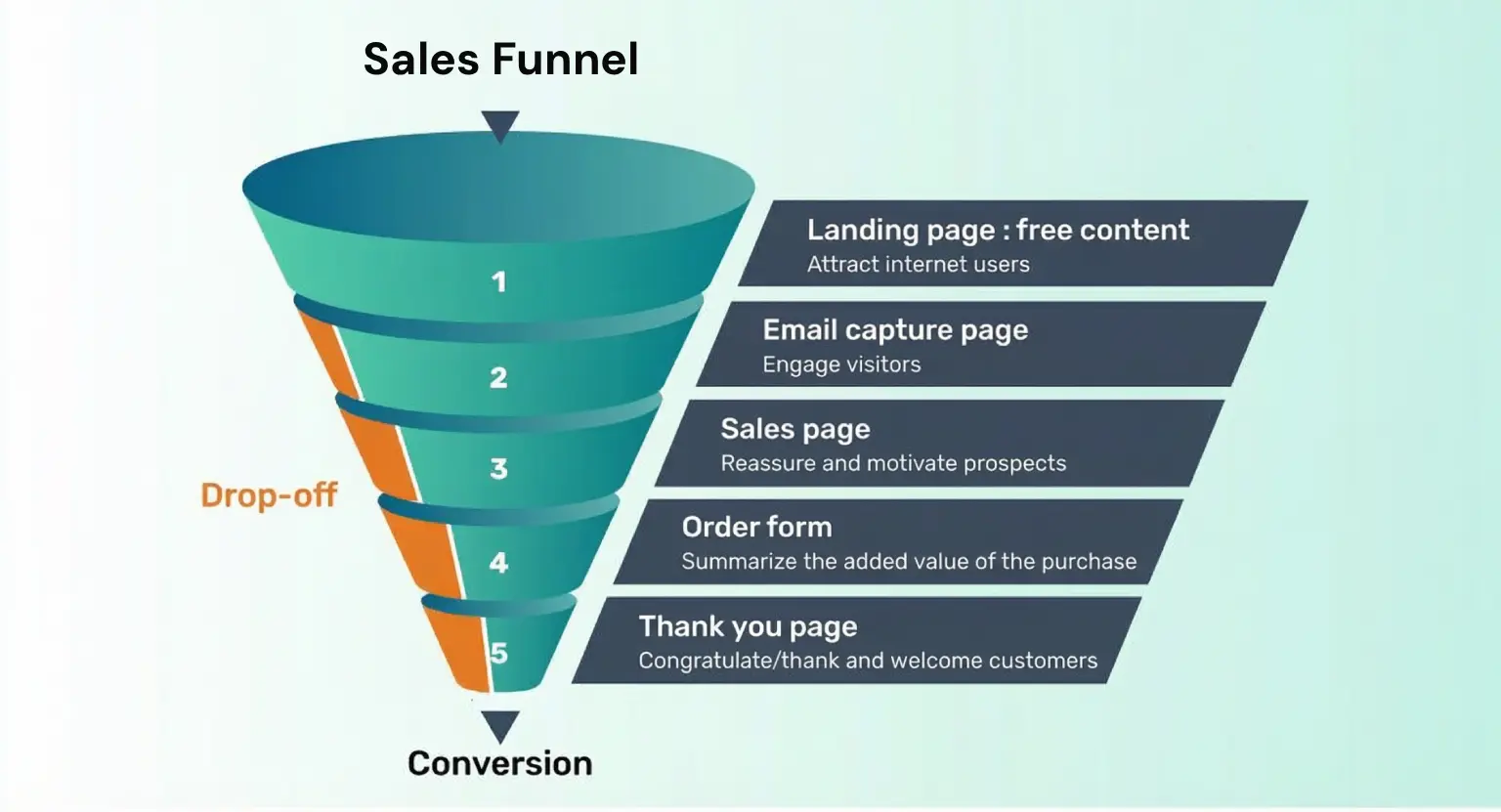
A sales funnel is a deliberate sequence of steps that moves someone from first-time visitor to paying customer - and ideally, to loyal advocate.
The flow looks like this: Traffic → Capture → Nurturing → Offer → Checkout → Order maximization → Delivery & Onboarding → Retention
KPIs to track from day one
• Opt-in rate = leads ÷ landing page visitors (target: 35–60%)
• Sales page conversion = buyers ÷ visitors (target: 3–8% depending on price point)
• AOV (average order value) = revenue ÷ orders (boosted by bumps and upsells)
• LTV (customer lifetime value) = AOV × purchase frequency × customer lifespan
• ROI = (revenue − ad spend) ÷ ad spend
Why build your funnel in LearnyBox? Because landing pages, sales funnels, email sequences, webinars, payments, your member area, and analytics all live in one place - less friction, fewer errors, more time to focus on creating and selling.
Step 3 - Generate free and paid qualified leads to sell an online course
If you already have an engaged social media following or a blog that ranks well on Google, you know where to start. If not, here's how to build that foundation.
Free traffic methods
✓ SEO content: pillar articles, practical guides, and case studies that rank on search engines.
✓ YouTube and Shorts with a CTA driving viewers to a lead magnet.
✓ LinkedIn and Instagram carousels breaking down key steps → link in bio.
✓ Lead magnets: checklists, mini-courses, templates, calculators, etc.
✓ Strategic partnerships.
Paid traffic methods
✓ Affiliate marketing (typical commission: 20–40%), or co-created offers with complementary creators.
✓ Meta Ads or Google Ads.
Step 4 - Nurturing & authority : email sequences and webinars to sell an online course
Between capturing a lead and closing a sale, you need to build trust, demonstrate expertise, and create genuine desire for your course. That's what nurturing does.
5- to 7-day email sequence
• Day 0 - Delivery & activation: send the lead magnet and ask a simple question ("Where are you right now with X?") to spark a conversation.
• Day 1 - Value nugget #1: one concrete insight + a quick win (5–10 min task).
• Day 2 - Value nugget #2 + objection handling: counter the most common objection with a real example.
• Day 3 - Case study: real results + behind-the-scenes (screenshots, numbers, anecdotes).
• Day 4 - The offer: benefits, bonuses, guarantee, and a limited window (e.g., 72 hours).
• Day 5 - Targeted FAQ: objections, comparisons, frequently asked questions.
• Day 6 - Final reminder: short, direct, and decision-focused.
Live or evergreen webinar (45 to 60 min)
• Hook (first 5 minutes): clear promise, agenda, quick credibility proof.
• Core content (30–35 min): 3 key pillars, a live demonstration, a quick win for the audience.
• Offer presentation (10–15 min): bonuses, guarantee, urgency trigger + live Q&A.
• Post-webinar: 2 to 3 abandoned-cart follow-up emails + SMS (if opted in) within 24–48 hours.
With LearnyBox: build visual email sequences, tag contacts by behavior, and automatically trigger replay access and follow-up messages.
Step 5 - The offer and sales page that make people say "yes" and buy your online course
Your sales page needs to anticipate every objection and make buying feel like the obvious next step.
Offer structure
• Core offer: the program, its modules, and the outcomes it delivers.
• Bonuses: templates, group coaching, audits, community access.
• Guarantee: 14 or 30 days, stated clearly and without fine print.
• Proof: named testimonials, screenshots, stats, client logos.
Sales page structure (recommended)
• Hero section (above the fold): outcome-focused headline + subtitle + visible CTA - grab attention immediately.
• Who it's for / who it's not for: qualify your audience upfront.
• Proof: use cases, screenshots, hard numbers.
• What you get: deliverables, modules, formats, duration, level of support.
• Results: concrete, quantified, or verified transformations.
• Bonuses: push perceived value well above the price point.
• Guarantee: remove the risk and reduce purchase anxiety.
• FAQ: address the objections that don't get asked out loud.
• Final CTA: recap the key benefits + payment options.
Headline swipe file (ready to use)
"Launch and sell your first online course in 30 days - with little to no ad spend."
"The 3-step method to convert 3–8% of your visitors into paying customers."
"Templates + coaching to build a sales funnel that converts from day one."
Pricing & plans
• Price anchoring: compare to the value of the outcome (example: one B2B customer recouped the full course fee from a single client within 3 days).
• Flexible payment options: installments, credit card, PayPal, Apple Pay, Google Pay.
• Time-limited offers: effective for one-off conversion boosts - use them sparingly to protect credibility.
In LearnyBox: manage pricing plans, promotional offers, VAT, invoicing, installment payments, and currencies in one place - plus order bumps and upsells, fully integrated.
Step 6 to sell online courses - A frictionless checkout and a higher average order value
Your checkout page should do two things: remove friction and reinforce trust. Keep it focused - every extra element is a potential reason to abandon.
Checkout best practices
✓ Minimal form fields (first name, email, payment). Everything else can come later.
✓ Multiple payment methods (card, digital wallets). Trust badges and security seals.
✓ Clear order summary: what they're buying, the price, terms, and guarantee.
Order bump & upsell
✓ Order bump: a complementary add-on at checkout (e.g., template pack, priority support) - priced below 30% of the cart total.
✓ Upsell: coaching access, an advanced tier, or a team license - presented after payment is confirmed.
Thank-you page & next steps
✓ Immediate access to the member area + a clear "getting started" checklist.
✓ Invite new customers to join the community (private group, office hours).
Step 7 - Online Course Delivery & onboarding: the experience that keeps them coming back
Perceived value peaks at the moment of purchase. Your job is to match that excitement with a onboarding experience that builds momentum immediately.
First 60 minutes of onboarding
✓ Welcome video: three clear next steps, delivered warmly.
✓ Quick win: a first visible result in under 60 minutes (e.g., publish a post, book an appointment, build a page).
✓ Guided journey: structured modules, progress checklist, live session or Q&A schedule.
Ongoing support & engagement
✓ Weekly Q&A sessions, community space (with clear ground rules), gamification (badges, certificates).
✓ Progress-triggered emails: celebrate milestones and re-engage members who go quiet.
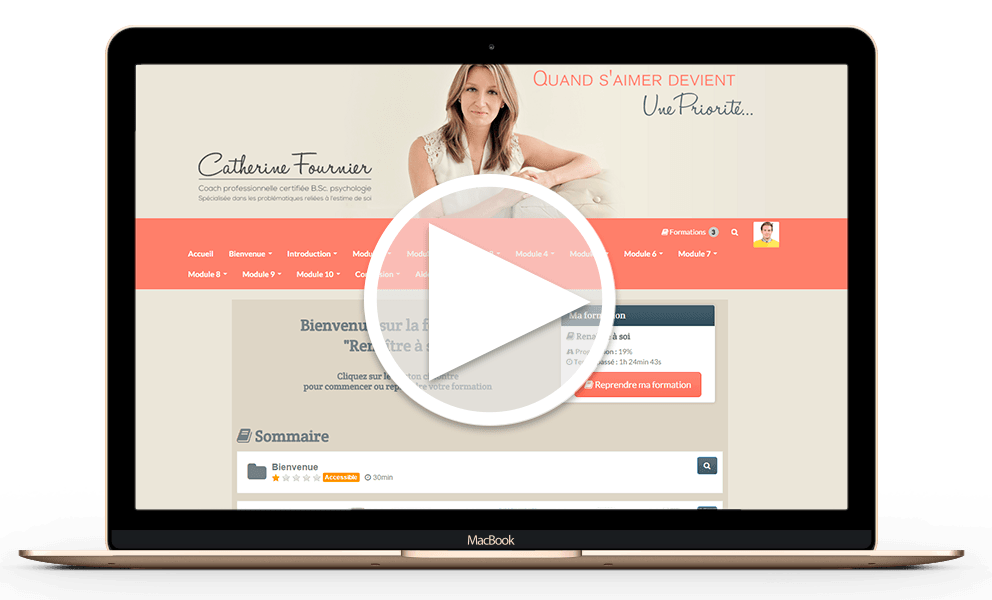
In LearnyBox: build your full member space (lessons, quizzes, certificates, community), manage and re-engage inactive learners, and automate milestone emails to keep completion rates high.
Measure, test, scale - then do it again
What gets measured gets improved. And the more you improve, the more you earn.
The KPIs that matter
✓ Landing page opt-in rate: target 35–60%
✓ Sales page conversion rate: 3–8% depending on price point
✓ AOV & LTV: impact of order bumps and upsells
✓ Churn rate (for subscription-based offers)
✓ Attribution by traffic source (SEO, ads, affiliates, partners)
High-impact A/B tests (one variable at a time)
✓ Landing page headline and promise
✓ Hero section + CTA copy and placement
✓ Pricing (anchoring, monthly vs. annual billing)
✓ Order bump (offer wording and positioning)
Ready to scale further?
✓ Build evergreen assets that sell year-round: automated webinars, dynamic email sequences, etc.
✓ Launch an affiliate program with a ready-to-promote kit for partners.
✓ Create bundles and co-branded offers with complementary creators.
✓ Go international: multi-currency, translations, subtitles - new markets, new revenue.
3 real-world scenarios to benchmark against
Scenario 1 - B2C beginner course ($347)
• 12,000 video views → 1,800 landing page visits → 720 opt-ins (40%)
• 720 leads → 22 sales (3%) → $6,534
• Order bump at $35, taken by 35%: +$223
• Upsell at $97, taken by 18%: +$384
Total: $7,140 over one launch cycle (excluding repeat purchases)
Scenario 2 - $29/month subscription (fitness)
• 5-day challenge: 900 sign-ups → 135 paying members (15% conversion)
• Average retention of 7 months: $27,405 LTV (before coaching upsell)
Scenario 3 - B2B certification ($990)
• Evergreen webinar: 2,500 registrants → 40% show-up rate → 1,000 live attendees
• 6% live conversion + 2% replay → 200 sales → $198,000
Common mistakes - and how to fix them fast
• Vague promise: rewrite it around a specific, measurable result within a clear timeframe.
• Too many choices: one CTA per page, always. Decision fatigue kills conversions.
• Not enough social proof: add video testimonials, before/after screenshots, and real numbers.
• Cluttered checkout: strip out non-essential fields and double down on trust signals.
• No follow-up sequence: send at minimum 3 emails post-event (abandoned cart, deadline reminder, objection handling).
• No upsell: every offer should have a natural next step - coaching, a premium tier, a team license.
• Tool sprawl: fragmented tech stacks create errors and waste time. Centralize everything in an all-in-one platform like LearnyBox.
Ready-to-use templates
5-day email sequence template
• Day 0: deliver the lead magnet + activation question ("Where are you right now with X?")
• Day 1: insight + quick win task (5–10 min) + supporting screenshot
• Day 2: handle objection #1 with a concrete demonstration
• Day 3: customer case study (before/after) + CTA to sales page
• Day 4: full offer - benefits, bonuses, guarantee, and a 72-hour deadline
Essential checklists
✓ Sales page: clear promise, who it's for, proof, module breakdown, bonuses, guarantee, FAQ, repeated CTAs.
✓ Checkout: minimal fields, multiple payment methods, trust signals, installment option.
✓ Webinar: hook, agenda, demonstration, case study, offer, live Q&A, direct link to checkout.
Content hooks (swipe for social media)
"3 mistakes that are killing your course sales - and how to fix them in 24 hours."
"The 3-step framework to go from 2% to 4%+ conversion on your sales page."
"The 10-point course launch checklist (free PDF)."
Ready to get started?
✨ Launch your first online course for free on LearnyBox ✨
FAQ - Sell online courses
How do you sell online courses when you have no audience?
Start with a highly targeted lead magnet, affiliate and community partnerships, and organic content (YouTube, SEO).
A webinar builds trust quickly and converts cold audiences faster than almost anything else. Lock in social proof from your first customers - even a handful of strong testimonials changes everything.
How much should you charge for an online course?
Price based on the transformation you deliver and the level of support included. General benchmarks: $100–$300 (entry-level), $300–$1,000 (signature offer), $1,000+ (premium or certified program with personalized coaching).
Always offer a payment plan - it removes the biggest barrier to purchase.
Do you need a webinar to sell an online course?
It's not mandatory, but it's one of the most effective conversion tools available - especially for courses priced above $350.
A webinar lets you combine education, social proof, and a time-limited offer in a single session that builds trust in real time.
Which pages do you absolutely need to sell online courses?
The non-negotiables: a landing page, a sales page, a checkout page, and a thank-you page.
Highly recommended additions: a webinar registration page, order bump and upsell pages, and a member area for course delivery.
How do you automate online course sales?
Use email sequences (nurturing, deadline, abandoned cart), an evergreen webinar funnel, behavioral tagging to personalize follow-ups, and order bumps and upsells at checkout.
All of this can be set up and managed directly inside LearnyBox.