







Online Course Formats Explained: The 2026 Guide to Student Success
Online Course Formats Explained : The 2026 Guide to Student Success
Key Takeaways
-
Engagement is King : in 2026, the format you choose determines whether students finish the course or leave it sitting in their dashboard.
-
Hybrid is the Standard : most successful creators now blend live elements with pre-recorded lessons for the best balance of scale and impact.
-
Structure Matters : before you record, you need a solid foundation by learning how to make a course outline tailored to your specific format.
-
Tech Simplification : using an all-in-one platform to sell online courses ensures all these formats work together seamlessly.
Look around the e-learning space today and you will see that things have changed drastically from just a few years ago.
We are no longer in the era where you can just dump ten hours of grainy video into a folder and call it a masterclass.
People are busier, their attention spans are under constant siege, and they are looking for specific outcomes rather than just "information."
In 2026, the format of your online course isn't just a delivery method; it's a core part of your value proposition. Choosing the right one can be the difference between a thriving community of raving fans and a digital product that gathers dust.
And let's be honest, as a creator, you probably feel the pressure to be everywhere at once. But you don't need to master every single format to be successful. You just need to find the one that resonates with your teaching style and your audience's lifestyle.
Whether you are aiming for a low-touch passive income stream or a high-impact transformation program, the "how" matters as much as the "what."
So, let's dig into the primary structures that are dominating the education market right now and see which one fits your vision for the year ahead.
The Classic Evergreen : Self-Paced Learning
The self-paced format remains the backbone of the industry for a reason. It is the ultimate "set it and forget it" model for creators who want to scale their expertise without being tied to a calendar.
In this format, students get immediate access to all materials - videos, PDFs, worksheets - the moment they hit the "buy" button. It's perfect for busy professionals or hobbyists who want to learn at 2:00 AM on a Tuesday without waiting for a scheduled session.
But don't mistake "classic" for "boring."
Modern self-paced courses in 2026 use branching logic where the curriculum adapts based on student quiz results, making it feel less like a static library and more like a personal tutor.
But there is a catch. The biggest challenge with self-paced courses has always been the completion rate. Without a deadline or a group of peers, many students lose steam halfway through.
To combat this, smart creators are adding gamification elements like badges, progress bars, and automated "nudge" emails.
If you're going this route, you'll want to follow a course creation checklist to ensure your onboarding process is so smooth that students feel hooked from minute one.
This format is ideal for evergreen topics like "How to use Excel" or "Introduction to Watercolor Painting" where the information doesn't change rapidly and the steps are linear.
So, why choose this? It's about freedom.
You do the hard work once - filming, editing, and setting up the funnel - and then you let the system handle the rest.
It allows you to reach thousands of people worldwide regardless of their time zone. For the student, the benefit is absolute control. They can binge-watch the whole thing in a weekend or take six months to chew on it.
Just remember that in 2026, the "standard" version of this format is expected to be polished, mobile-friendly, and very well-organized. If your content is messy, the self-paced learner will simply move on to the next expert who has their act together.
The Power of Connection : Cohort-Based Learning (CBL)
If self-paced learning is the Netflix of education, Cohort-Based Learning is the live theater.
This format has exploded in popularity because it solves the loneliness problem. In a CBL model, a group of students starts and finishes the course together on a fixed schedule. They attend live sessions, participate in group discussions, and often collaborate on projects.
This creates a high-pressure (in a good way) environment where the "fear of missing out" and social accountability drive completion rates through the roof. It's common to see 80% to 90% completion in cohorts, compared to the 10% to 15% seen in traditional recorded courses.
Now, this does require a lot more work from you. You have to be "on" during the live weeks. You are moderating chats, leading Q&As, and managing the group energy.
But the payoff is usually a much higher price point. People are willing to pay a premium for access to you and a curated community of peers.
In 2026, these cohorts are often integrated with private social networks or Discord-like communities where the learning continues long after the Zoom call ends. It's a brilliant way to build a brand where you are seen as a mentor, not just a content producer.
But you must be careful not to burn out; many creators run only two or three cohorts a year to keep their energy high.
And here is a pro-tip : If you are worried about the risk of launching a big cohort, you should learn how to pre-sell an online course before you even build the curriculum. This allows you to validate the demand and get your first group of students committed before you spend weeks designing slides.
Cohorts are the gold standard for transformational topics like "Launching Your First SaaS Business" or "Advanced Leadership for Executives" where discussion and real-time feedback are non-negotiable components of the success formula.
The Micro-Learning Revolution : The "Nanodegree" Approach
As we move further into 2026, we are seeing the rise of the "snackable" course. Think of this as the TikTok-ification of professional development.
Students today often don't have three hours for a deep dive; they have fifteen minutes on their commute or between meetings.
Micro-learning involves breaking down complex topics into very short, highly focused bursts of content - usually 3 to 7 minutes long.
Each "micro-lesson" tackles exactly one specific problem or skill. This format is incredibly effective for technical skills, software tutorials, or quick daily habits where the learner needs a quick win to keep going.
This format isn't just about making videos shorter; it's about shifting the pedagogy. You have to get to the point immediately. No long intros, no fluff.
In 2026, micro-learning is often delivered primarily via mobile apps. If your platform doesn't have a stellar mobile experience, you've already lost this segment of the market.
These courses are often sold as low-cost "entry points" into your larger ecosystem or even as subscription-based "daily tips" that keep your brand top-of-mind.
It's an excellent way to build trust with a new audience who might not be ready to drop $500 on a massive masterclass but will happily spend $20 to solve one specific headache.
But don't be fooled - just because the content is short doesn't mean it's easy to make.
In many ways, micro-learning requires more precision. You have to be an expert at condensing information without losing the "why" behind the "how."
It's a great format for creators who are naturally concise and love a fast-paced teaching style. Plus, it's much easier to update a 5-minute video than a 60-minute one when things change in your industry.
If you want to see how this stacks up against traditional platforms, checking out a LearnyBox vs Podia comparison can show you which tools actually support this kind of high-velocity delivery well.
The Hybrid Model : Best of Both Worlds
The hybrid (or blended) model is where the real "smart money" is in 2026. It combines the scalability of evergreen recorded content with the high-touch intimacy of live elements.
Usually, this looks like a structure where students watch the core lessons on their own time but come together once a week for a live Q&A or a workshop.
This allows you to move the "information transfer" to the recordings while saving the "dynamic interaction" for the live sessions.
It's highly efficient because you aren't repeating the same lecture over and over again, but you are still there to help students overcome specific roadblocks.
In this format, webinars play a massive role - not just for selling, but as a core teaching tool.
You might have a 6-week program where the core content is dripped out every Monday, and then on Thursday, you host a live office hour. It gives students the flexibility they crave but provides just enough of a "safety net" to ensure they don't get stuck.
For many creators, this is the final evolution of their business because it allows for high student satisfaction without the exhaustion of a 100% live cohort.
It's also very easy to "productize" by eventually recording the live sessions and turning them into "bonus material" for future self-paced versions.
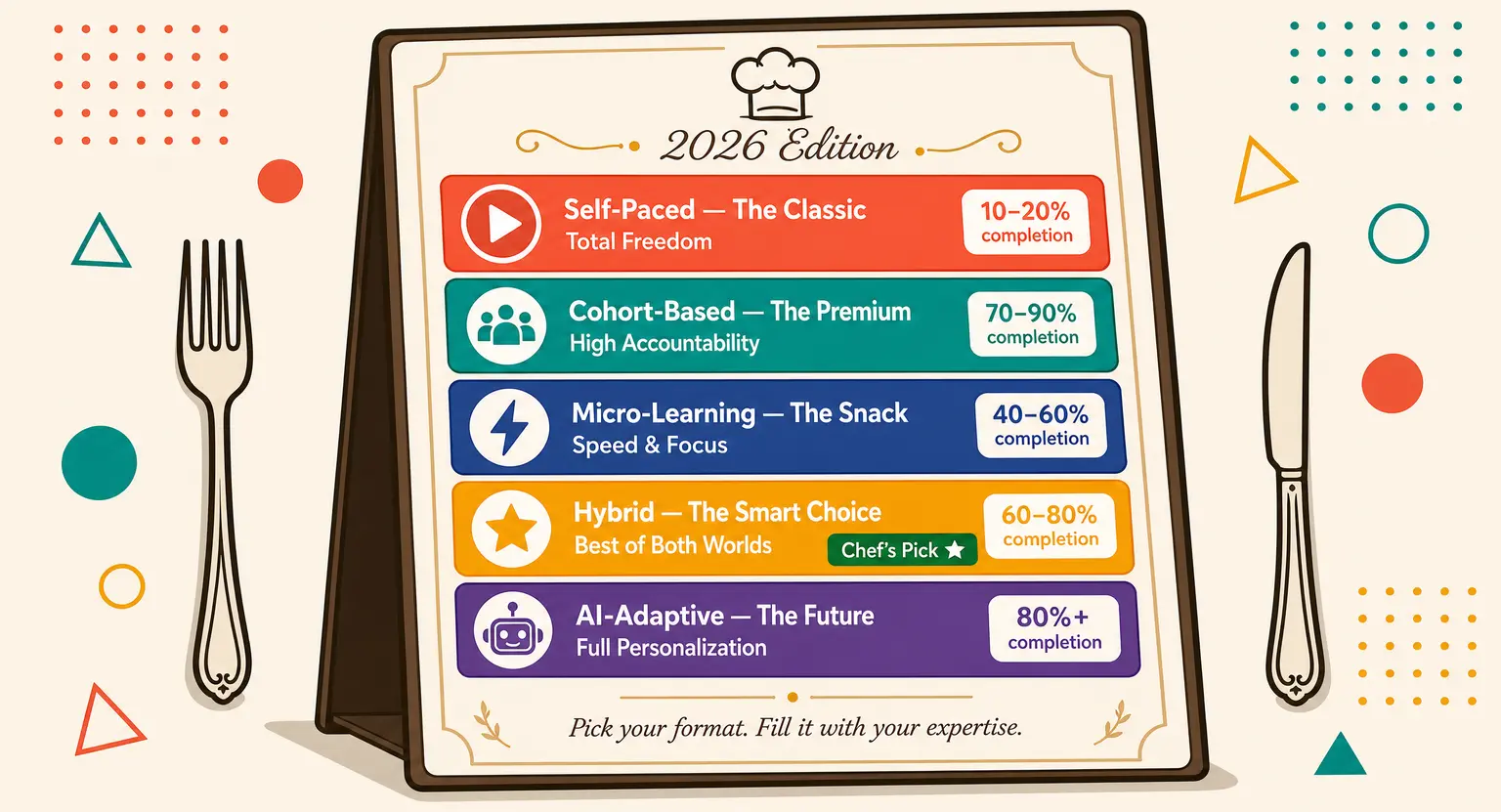
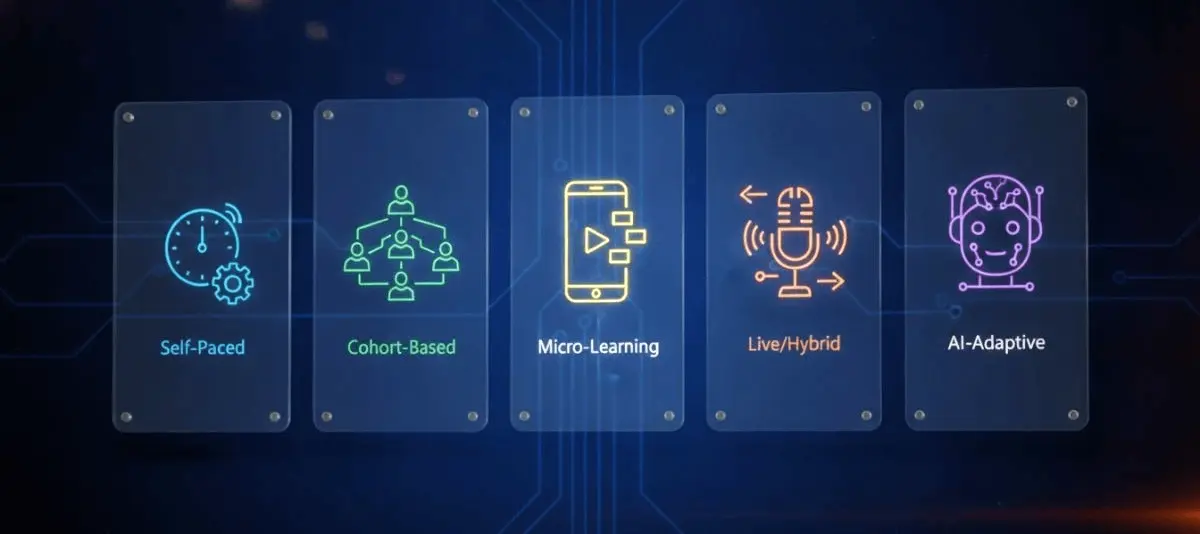
| Course format | Main benefit | Best for... | Content type | Completion rate |
|---|---|---|---|---|
| Self-Paced | Total Flexibility | Introductory Skills | Recorded Video/PDFs | Low (10-20%) |
| Cohort-Based | Accountability | High-Ticket Transformation | Live Sessions/Workshops | High (70-90%) |
| Micro-learning | Speed & Focus | Specific Problem Solving | Short Video/Interactive | Moderate (40-60%) |
| Hybrid/Blended | Efficiency & Support | Mid-to-High Tier Mastery | Recorded + Live Q&A | High (60-80%) |
| AI-Adaptive | Personalization | Complex Science/Tech | Dynamic Text/Branching | Very High (80%+) |
The Future : AI-Adaptive & Generative Learning
By now in 2026, we can't ignore the elephant in the room : AI. The newest format on the block is "Adaptive Learning."
Instead of every student following the same path, the platform uses data to pivot. If a student breezes through a quiz on "Basic Marketing Principles," the AI skips the next three introductory videos and jumps them straight to "Advanced Segmentation."
If they struggle, the AI automatically serves up extra practice exercises or a different explanation of the same concept. It's education that literally rewrites itself as you go.
While this sounds like science fiction, it's becoming increasingly accessible for independent creators. You don't need a team of engineers; you just need a platform that supports dynamic tagging and conditional content.
This format is incredibly powerful because it respects the learner's time more than any other.
No one likes being forced to watch something they already know. When you respect their existing knowledge, they stay engaged longer.
This is particularly effective for technical training, medical education, or any field where students come in with wildly different baseline skills. It creates a "boutique" feeling for every single user, which is a huge competitive advantage in a crowded market.
But, a word of caution : building an adaptive course requires a lot of "if/then" planning. You have to map out the different paths a student might take and ensure that every path leads to the same finish line.
It's sophisticated work, but the results in terms of student retention are staggering.
If you're looking to push the boundaries of what's possible, this is where you should be looking. It marks the transition from being a "content creator" to being an "experience designer."
Membership Models : Learning as a Lifestyle
Finally, we have the membership or "Academy" model. Instead of selling a single course with a start and end date, you sell ongoing access to a library of content, a community, and regular updates.
This is the ultimate recurring revenue play. In 2026, many creators are moving away from the "big launch" stress and moving toward this slower, more stable growth model.
Students pay a monthly or yearly fee to stay "in the loop." It works beautifully for rapidly changing industries like AI technology, fitness, or creative arts where there is always something new to learn.
The challenge here is the "hamster wheel" effect. You have to keep adding value to prevent people from canceling.
But if you do it right, you build a loyal "tribe" that stays with you for years. Successful memberships often act as the "hub" for all the other formats mentioned above.
You might have your micro-courses inside the membership, a self-paced masterclass for new members, and a discount for live cohorts. It creates a holistic ecosystem that supports the learner at every stage of their journey.
If you're ready to dive in, you can start with an LMS free account to get the basics of your membership structure in place before you go live.
So, where does that leave you? The "perfect" format doesn't exist in a vacuum. It only exists in the context of your goals, your student's needs, and the time you are willing to invest.
But don't let the options paralyze you. The most important step is to choose one that feels sustainable and start.
You can always iterate, pivot, and expand. In the world of 2026 e-learning, the only real mistake is staying static.
Whether you're building a massive academy or a tiny micro-course, the tools are there to make it happen. Now, go pick your box and start filling it with your expertise.
Common Questions About Choosing Your Format
Which course format is the best for a complete beginner in 2026?
For newcomers, a self-paced evergreen model is usually the safest bet because it allows you to refine your content without the pressure of live management.
You can focus on building a high-quality curriculum using a course creation checklist to ensure you don't miss any vital steps while getting comfortable with the technology.
Once you build confidence and an audience, you can transition into more complex hybrid or cohort-based models that require more active involvement and higher levels of community management.
Starting simple lets you learn the ropes of digital marketing and platform management without the high-stakes pressure of a live group of fifty people waiting for you on a call.
How do I decide between a cohort-based and a self-paced course?
The choice depends entirely on your student's needs for accountability versus their desire for flexibility.
Cohort-based courses are fantastic for high-ticket offers where transformation and community networking are the primary selling points, leading to higher completion rates but requiring more administrative work.
On the flip side, self-paced courses are better for skill-based training where learners want to move at their own rhythm and you want a passive income stream that scales without daily intervention.
Ask yourself : Is the primary goal for my students to 'know' something or to 'become' someone? If it's the latter, go with a cohort. If it's the former, self-paced is usually more than enough.
Can I mix different course formats within the same platform?
Absolutely, and in fact, the most successful creators in 2026 use a blended approach to maximize their reach and impact.
You might offer a free micro-learning lead magnet to get people through the door, an evergreen mid-tier course for those who want to DIY, and a premium live cohort for your most dedicated fans - all through an all-in-one platform for selling online courses.
This 'stacking' strategy allows students to enter your ecosystem at different price points and commitment levels, which significantly increases the overall lifetime value of each customer. It also protects your business by diversifying your income streams so you aren't reliant on just one type of product or one big launch event every year.
Is video still the dominant medium for all course formats?
While video remains a core pillar of e-learning, 2026 has seen a massive rise in interactive elements, audio-only lessons, and AI-driven personalized text paths.
Students today suffer from 'screen fatigue,' so the most effective formats incorporate varied media like downloadable workbooks, private podcasts for learning on the go, and interactive quizzes that provide immediate feedback.
The key is to match the medium to the learning objective rather than defaulting to video for every single lesson.
For instance, a complex technical setup might be better explained via an interactive diagram or a live screen-share, while a motivational pep talk might be more powerful as an audio file the student can listen to while they go for a walk.
Explore Further
-
Ready to Build? Use our Ultimate Course Creation Checklist.
-
Pre-Launch Strategy : Learn how to pre-sell your course to validate your idea.
-
The Foundation : Mastering how to make a course outline is the first step to any format.
-
Platform Choice : Why many creators prefer an all-in-one platform to sell online courses for simplicity.


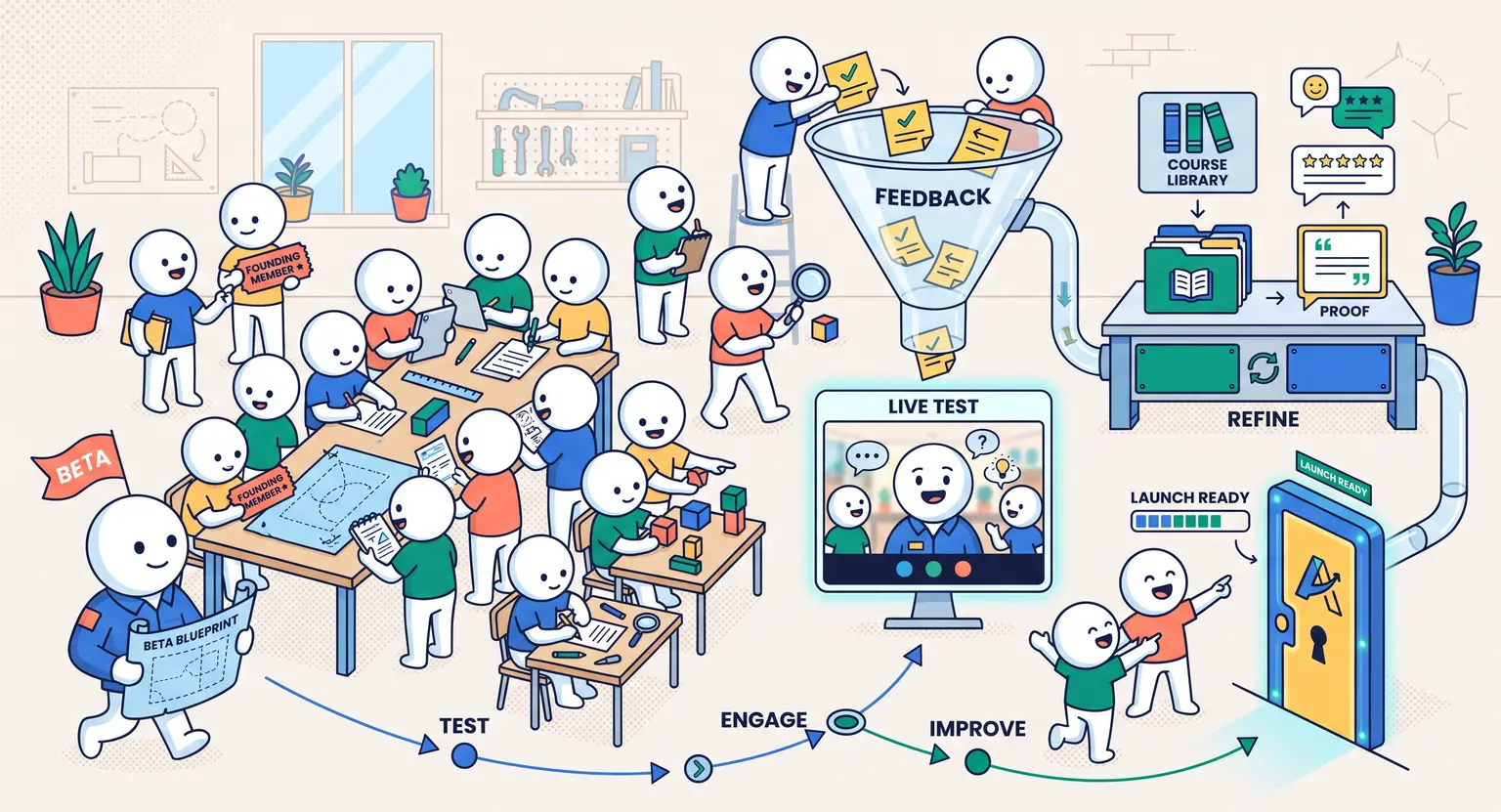 How to Run a Beta Version of an Online Course (2026 Guide)
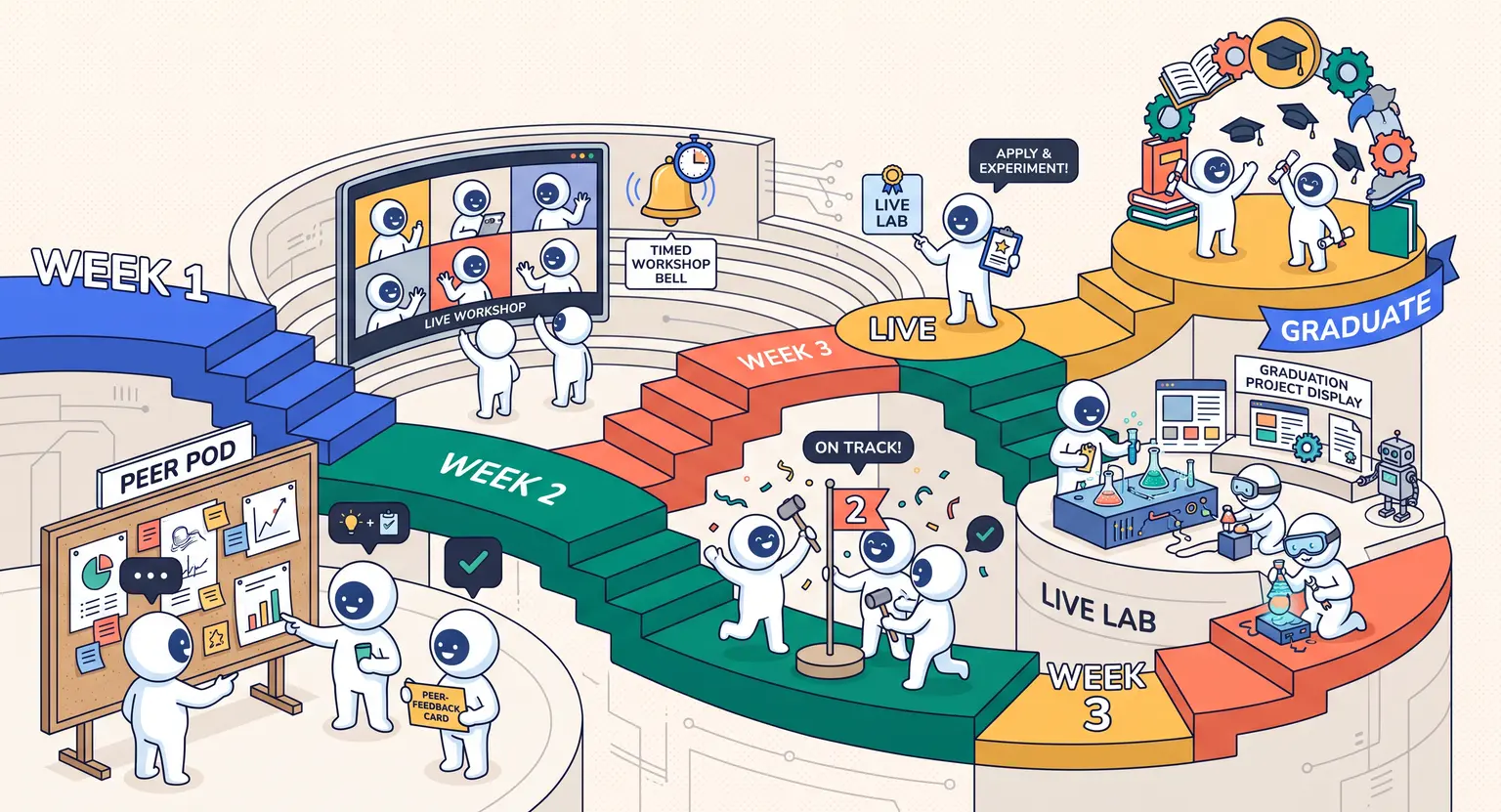 How to Create a Cohort-Based Online Course (2026 Guide)
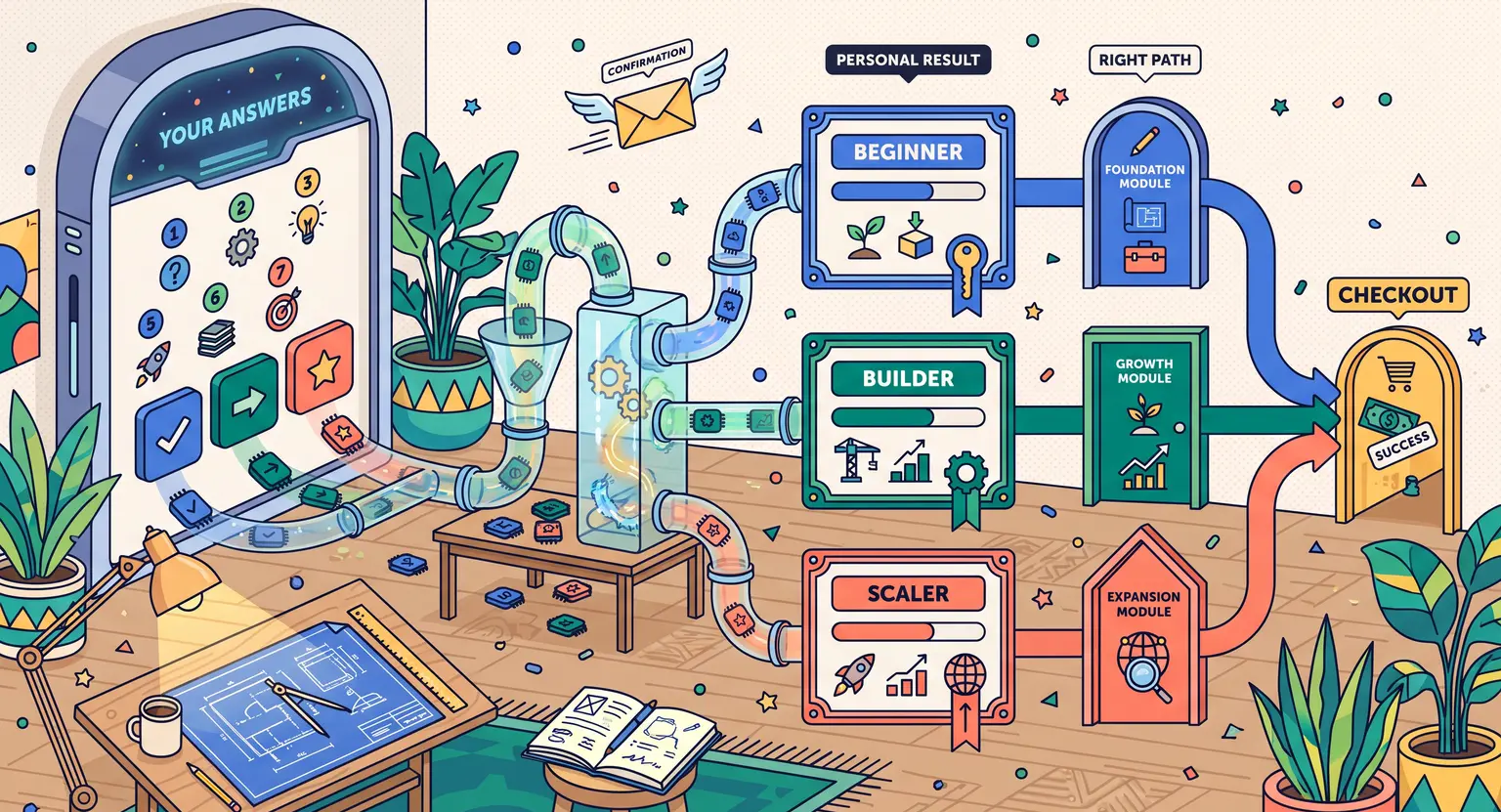 How to Sell an Online Course With a Quiz Funnel (2026 Guide)
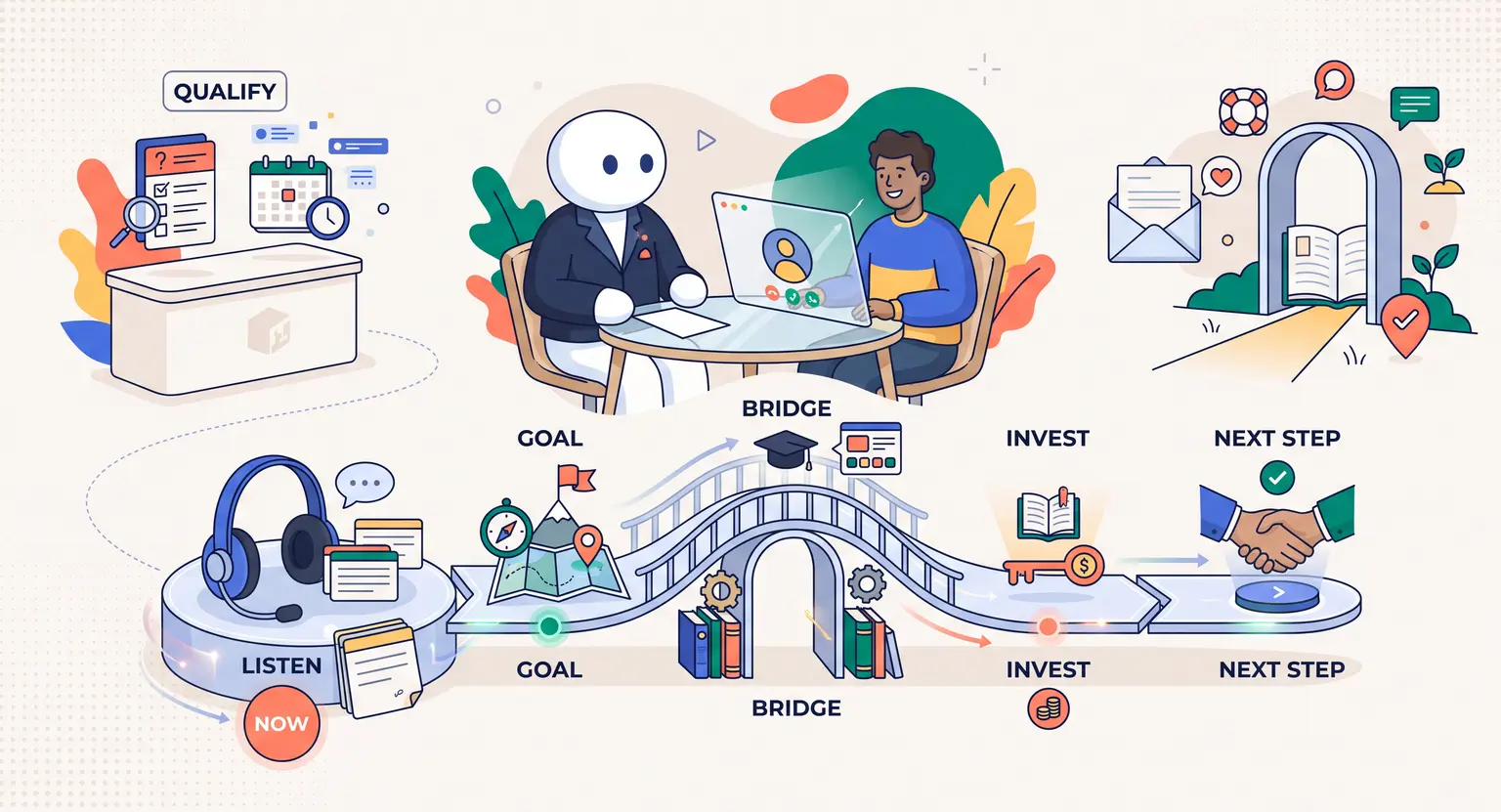 How to Sell an Online Course Through a Sales Call (2026 Guide)