






Customer Education: The Growth Driver That Cuts Churn, Reduces Support Costs, and Raises LTV
What Is Customer Education? The Complete Guide to Turning Your Customers into Experts
Did you know that 90% of companies that invest in Customer Education report a positive return on investment?
A striking number - especially considering that most companies are still leaving value on the table, settling for a basic customer onboarding process and calling it a day. The opportunity here is enormous.
Without a genuine customer education strategy, companies expose themselves - often without realizing it - to higher churn, spiraling support costs, and shallow product adoption.
Left to figure things out on their own after purchase, customers end up using only a fraction of the value you promised them. Disappointment builds quietly, and cancellation is never far behind.
This guide is designed to help you build a Customer Education program that goes beyond retention - one that transforms your customers into genuine experts and brand advocates.
We'll cover what Customer Education actually is, why it has become a critical growth driver, how to build your own program from scratch, how to measure its ROI, and where the field is heading next.
What Is Customer Education?
Definition: Beyond product training
Customer Education is a strategic function whose goal is to give your customers the skills and knowledge they need to achieve their own objectives using your product or service.
That distinction matters. It's not just about teaching people where to click or how to activate a feature. It's about teaching the methodologies, strategies, and best practices of their own field - into which your product fits as a natural, effective solution.
Put simply: you're not training customers on your product. You're helping them get better at their jobs - and your product is the tool that makes that possible.
This reframes your company's entire relationship with customers: by aligning your success with theirs, you stop operating in a purely transactional mode and start building a genuine growth partnership.
Customer Education vs. Onboarding vs. Customer Success vs. Support
If these four concepts feel blurry, you're not alone - they're frequently conflated.
Here's how they actually differ:
| Concept | Main Objective | Key Metric | Timeframe |
|---|---|---|---|
| Customer Education | Empower customers to become self-sufficient experts in their field | Adoption Rate, Customer Education Score | Ongoing |
| Customer Onboarding | Guide first steps and reach the first "Aha! moment" | Time to First Value (TTFV) | Start of lifecycle |
| Customer Success | Ensure the client's business goals are met (typically through 1:1 engagement) | Retention, Net Revenue Retention (NRR) | Ongoing (proactive) |
| Customer Support | Resolve one-off technical issues | Resolution time, CSAT | Reactive |
Onboarding is a sprint to prove initial value.
Support is a reactive intervention.
Customer Success is personalized, proactive guidance.
Customer Education is none of those things in isolation. It's a strategic, scalable marathon - continuously raising the capability of your entire customer base over time.
Why Customer Education Is No Longer Optional in 2026
Ignoring Customer Education today is a bit like ignoring digital marketing in the early 2000s: you risk being lapped by competitors who've already understood that power now sits with an over-informed, highly demanding customer.
The data is unambiguous: acquiring a new customer costs 5 to 25 times more than retaining an existing one.
In a retention-driven economy, investing in your customers' success isn't a nice-to-have - it's a strategic imperative.
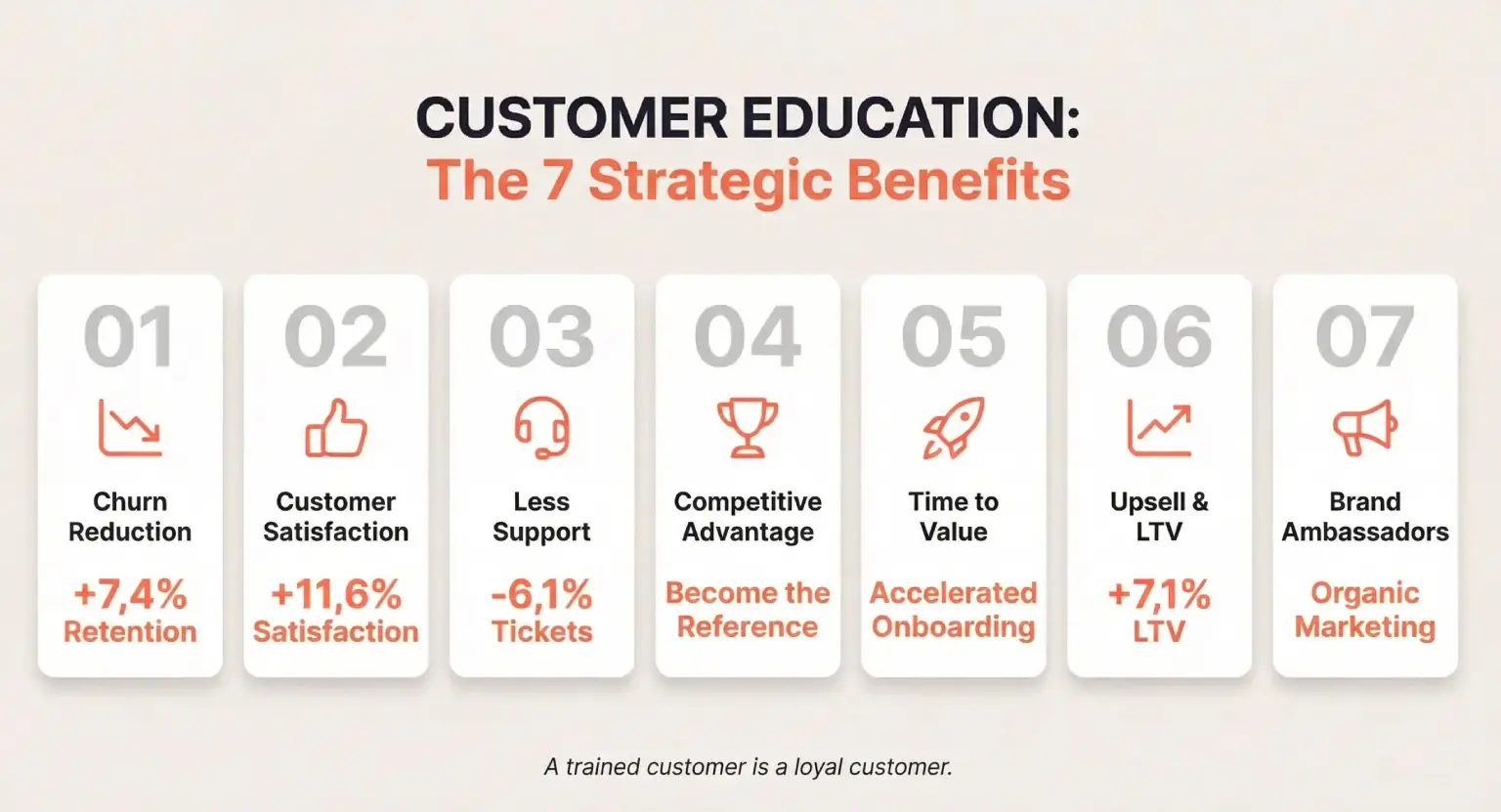
The 7 Strategic Benefits of a Customer Education Program
Investing in Customer Education isn't an act of goodwill. It's a business decision with concrete, measurable, and often substantial results.
1. Dramatically lower churn and higher retention
A customer who truly masters your product, sees its full value, and achieves real results has no reason to leave.
A Forrester study found that companies with a formal Customer Education program increase customer retention rates by an average of 7.4%.
This is the most direct impact: by making your customers more capable, you deepen their commitment to your ecosystem.
2. Higher product adoption and customer satisfaction
How many of your product's features are your customers actually using? Often, just a handful.
Customer Education surfaces the full depth of what you've built. Training customers on advanced use cases drives broader product adoption across the board.
The result: more satisfied customers - an average improvement of +11.6% according to Forrester - because they're finally extracting the full value of their investment.
3. Significant reduction in support costs
A better-trained customer is a more self-sufficient one. They stop contacting support for basic questions that your educational resources already answer.
That translates to a measurable drop in inbound support volume - an average of -6.1% according to Forrester - freeing your support team to focus on genuinely complex issues.
4. A durable competitive advantage and an expert reputation
In markets where products are increasingly commoditized, experience and support quality become the real differentiators.
A high-quality training academy means you're no longer just selling a product - you're selling expertise. You become a trusted authority in your space, which strengthens your brand and naturally draws in new prospects.
5. Faster Time to Value and stronger onboarding
Time to Value (TTV) is how long it takes a new customer to perceive real value from your product.
The shorter that window, the lower the risk of early churn. A well-structured Customer Education program, available from day one of onboarding, walks customers step by step toward their first wins - anchoring the relationship before doubt sets in.
6. More upsells, cross-sells, and higher LTV (+7.1%)
An educated customer understands your full offering and the value of your premium capabilities. That makes them significantly more likely to upgrade (upsell) or expand into complementary products (cross-sell).
By driving both retention and expansion revenue, Customer Education has a direct impact on Lifetime Value (LTV) - which increases by an average of 7.1% according to Forrester.
7. Turning customers into brand advocates
The ultimate outcome. A customer who becomes a genuine expert in your product and their field naturally becomes an advocate.
They share their results, answer questions from fellow users in community spaces, and sometimes create their own content - tutorials, case studies, how-to videos.
That's the most powerful and credible form of marketing in existence - and it compounds over time.
How to Build Your Customer Education Program from Scratch: The 5-Step Method
Launching a Customer Education program can feel like a big lift. But broken into clear phases - and grounded in the fundamentals of instructional design - it's entirely manageable, even with limited resources.
Step 1: Define Business Objectives - Start with Strategy, Not Content
Before creating anything, ask the question that actually matters:
"What business problem are we trying to solve?"
The answer can't be "create an online course." It must tie directly to measurable company objectives.
For example:
"Reduce new customer churn by 15% over the next 6 months"
or
"Increase adoption of our analytics feature by 30%"
That objective becomes the north star for every decision that follows.
Step 2: Identify and Segment Your Audience
Not all your customers have the same needs. A new end user doesn't need the same information as a seasoned system administrator.
Segment your audience to deliver custom learning paths that actually resonate.
Segment by:
-
Role: End User, Manager, Administrator
-
Proficiency level: Beginner, Intermediate, Expert
-
Use case: What specific goals are they trying to reach with your product?
Step 3: Create Educational Content in Formats That Engage
Once you know who you're educating and why, you can focus on the what. Vary formats to hold attention and serve different learning preferences:
-
Online Academy (via an enterprise LMS): The most structured format, with courses, modules, and chapters.
-
Webinars: Ideal for live training, product demos, and real-time Q&A.
-
Video tutorials: Short, visual, and perfect for step-by-step "how-to" explanations.
-
Blog posts and guides: For deeper dives into strategic concepts.
-
Certifications: To validate skills, recognize progress, and motivate completion.
Step 4: Choose Your Tools and Delivery Platform
Technology should serve your strategy - not the other way around. Your options:
-
Specialized LMS platforms (Skilljar, Docebo): Highly capable but often expensive - better suited to larger organizations with dedicated teams.
-
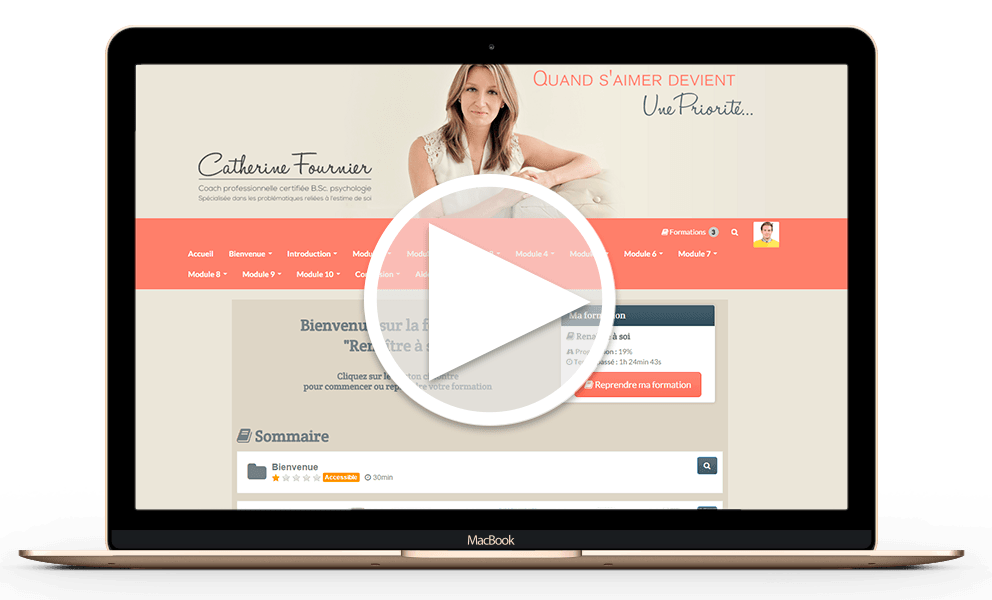
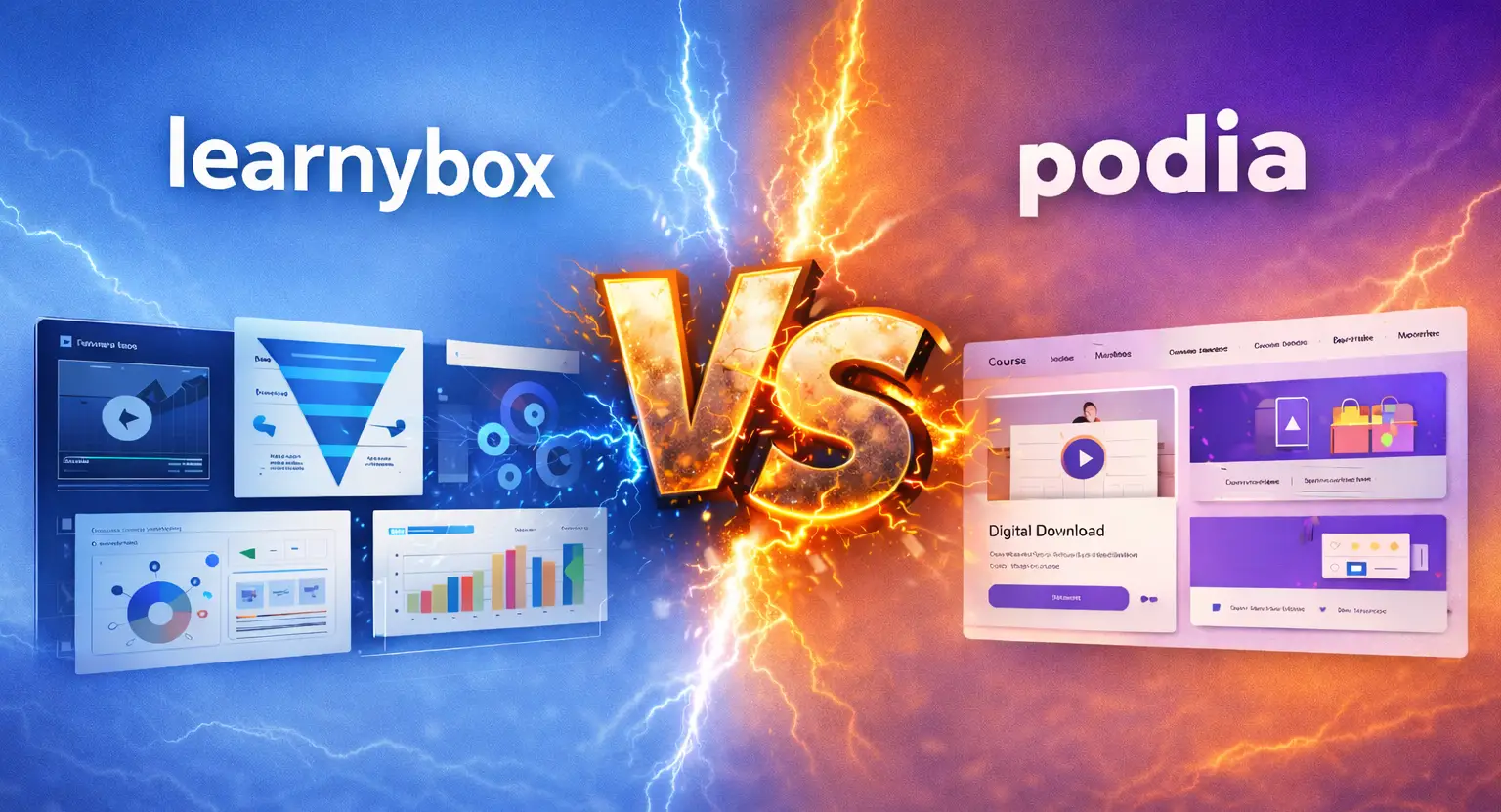
All-in-one platforms (LearnyBox): Combine course creation, automated communications, and user management - a strong balance of capability and accessibility.
-
In-app tools (MeltingSpot): Embed learning directly inside your software, meeting customers where they work.
-
DIY approach: A dedicated section on your website with YouTube videos and blog posts is a legitimate, zero-cost starting point.
Step 5: Promote and Distribute Your Program
The best content in the world is useless if no one finds it. Integrate promotion at every stage of the customer journey:
-
In onboarding emails: Offer the "Getting Started" course from day one.
-
In your app: Push contextual notifications that link directly to the relevant resource.
-
Through your Customer Success Managers: Have them recommend specific training paths during follow-up calls.
-
In your newsletter and on social: Feature new courses, certifications, and upcoming webinars.
Customer Education in Practice: 3 use cases Worth Studying
The clearest way to understand what a great Customer Education strategy looks like is to study the companies that have built the best ones.
1. HubSpot Academy: The Gold Standard
HubSpot doesn't just sell marketing and sales software - the company has literally educated an entire generation of marketers in Inbound Marketing.
Their academy offers dozens of free certifications recognized across the industry. The strategy is genuinely clever: train your future customers for free, establish market authority, and generate millions of qualified leads in the process.
HubSpot Academy is proof that Customer Education can become your primary customer acquisition engine.
2. Salesforce Trailhead: Gamification Done Right
Salesforce transformed learning about a notoriously complex product into something genuinely engaging.
Trailhead makes extensive use of educational gamification: users follow structured learning paths, complete modules, earn badges and points, and can display their credentials on their profiles.
By building a real community of learners with a social recognition system, Salesforce has motivated millions of people to train within its ecosystem - and inadvertently created a deep talent pool for its own customers.
3. Ahrefs: Education Through Content, No Formal LMS Required
Ahrefs is a textbook example of Customer Education delivered without a traditional learning platform.
Their strategy rests on two pillars: an exceptionally detailed blog and a high-quality YouTube channel. They don't just explain how to use their tool - they teach the fundamentals and advanced strategies of SEO itself.
By educating the market for free, they attract millions of visitors, demonstrate the power of their own product in the process, and naturally convert readers and viewers into paying customers.
Measuring Success: Customer Education KPIs and ROI
To justify the investment and steer your strategy, you need to measure impact. Ignore vanity metrics. Focus on the numbers that connect to business outcomes.
The Metrics That Matter
KPIs fall into two categories:
Engagement KPIs (leading indicators) - measure content consumption and signal early program health: number of active users in the academy, course completion rates, average assessment scores, and the "Customer Education Score" (a weighted measure of all learning activity).
Business KPIs (lagging indicators) - measure the ultimate impact on company performance: correlate training consumption with retention rate, churn rate, support ticket volume per customer, speed of new feature adoption, and LTV growth.
How to Calculate Your Program's ROI
The formula is straightforward:
ROI = (Gains - Costs) / Costs
Costs are relatively easy to quantify: LMS platform fees, staff time (even if part-time), and content production costs (freelancers, tools, materials).
Gains require more work - but are worth calculating. Quantify the value of:
-
customers retained who would otherwise have churned without the training,
-
support cost savings (tickets avoided × average cost per ticket),
-
incremental upsell revenue attributed to trained vs. untrained customers.
The calculation won't be perfect the first time. But the exercise itself forces rigorous thinking about the business value your program is generating - and that discipline compounds over time.
The Future of Customer Education
The field is evolving fast, and three trends are already reshaping best practices.
AI-Driven Personalization
Artificial intelligence is making hyper-personalized learning paths a reality.
Imagine a system that analyzes a user's behavior inside your product, identifies their specific knowledge gaps, and automatically surfaces a 2-minute micro-lesson at the exact moment they need it - without them ever having to search for it.
This marks the end of one-size-fits-all curricula and the beginning of genuinely adaptive learning.
In-App, Just-in-Time Learning
Rather than redirecting users to an external learning platform, training will increasingly meet them inside the product itself.
Interactive guides, contextual tooltips, micro-tutorials, and embedded checklists enable learning "by doing" - without ever interrupting the workflow. This is the principle of just-in-time learning, and it dramatically lowers the barrier to engagement.
The Rise of Learning Communities
Learning is fundamentally social. The platforms that win will be those that build a strong community layer on top of their content.
Discussion forums, working groups, group coaching, and peer review systems let users learn from each other, exchange best practices, and develop a real sense of belonging. The community becomes a living, self-sustaining extension of your training program.
Customer Education Is Not a Cost - It's a Strategic Investment
As this guide has shown, Customer Education is far more than a set of tutorials. It's a fundamental shift in posture - a deliberate decision to put your customers' success at the center of your business strategy.
In a world where competition is one click away, the companies that will pull ahead are not those with the most features. They're the ones that have created the most capable, self-reliant, and loyal customers.
Most markets are still largely untapped when it comes to Customer Education. By positioning yourself today as an educator - not just a vendor - you're not just building a customer base. You're building a community of experts and advocates. And that's where the most durable competitive advantage lives.
✨ Ready to take your Customer Education to the next level?
Book your custom demo with our team ✨
FAQ - Customer Education
1. What's the first step to launching a program from scratch?
Start small. Interview 5 of your newest customers and 5 of your longest-standing ones.
Ask them where they got stuck and what they wish they'd known sooner. You'll quickly surface 3-4 critical topics that actually need addressing.
Build a simple FAQ or record 3 short videos on those topics. That's your MVP - and it's enough to start.
2. How much does a Customer Education program cost?
Anywhere from near zero (a blog and a YouTube channel) to hundreds of thousands per year for a dedicated team and enterprise LMS.
A practical starting point for most companies is an all-in-one platform that offers a strong balance of features and value.
3. What's the ideal team size to get started?
One person is enough. Often it's a Customer Success Manager, a product manager, or a marketer who takes ownership part-time. What matters isn't headcount - it's having a clear, accountable owner for the project.
4. How do you get leadership to invest?
Lead with numbers. Avoid the word "training" - talk about "reducing churn" and "cutting support costs."
Build a concise business case that shows what current churn is costing the company and how a modest Customer Education investment could deliver a positive ROI within 12 months.
5. Do I need an LMS to start?
Not necessarily. Webinars, an automated email sequence, and blog posts are a perfectly valid starting point. Don't wait for the perfect tool to exist.
That said, an LMS quickly becomes essential once you need to structure, automate, and measure your program at any meaningful scale.
6. How do I know if my content is actually working?
Correlate content consumption with product behavior.
Do customers who completed the course on feature X actually use it more?
Do customers who finished the onboarding path contact support less during their first month?
Those correlations are what prove effectiveness - not completion rates alone.
7. Is Customer Education only for SaaS companies?
Not at all. Any company whose product or service has a learning curve can benefit.
Industrial equipment manufacturers, consulting firms, financial services providers - even a specialty coffee brand educating customers on brewing technique - can all build meaningful Customer Education programs.
8. What's the number one mistake to avoid?
Creating content based on what you assume customers need to know, rather than what they're actually trying to achieve.
Always start from your customers' goals and frustrations - never from your feature list.