







Online Course Platform Comparison: Find the Perfect Fit (2026)
Online Course Platform Comparison : Find the Perfect Fit
Picking an online course platform in 2026 feels a lot like walking into a crowded coffee shop with an overcomplicated, multi-page menu where every single option requires a different configuration of milk, sweetener, and cup size.
All you really want is a fresh, hot cup of black coffee that tastes great, but instead, you are forced to sift through a maze of complex choices.
In the context of digital education, that cup of coffee is your course content : you just want to deliver it flawlessly to your students, keep them engaged, and get paid securely without losing half of your revenue to sneaky charges.
However, if you have spent any time research-drifting through the web lately, you already know that finding the perfect home for your expertise is easier said than done.
The digital learning market has matured massively over the last couple of years, and the generic setups that worked a decade ago simply do not cut it anymore.
Today's learners are selective, demanding highly polished interfaces, native community experiences, and frictionless content consumption right from their mobile phones.
On the flip side, as a business owner, you cannot afford to waste your time manually sending login details, connecting broken Webhook APIs, or managing four separate software subscriptions just to make a single sale.
You need a platform that behaves like a quiet business partner - working efficiently in the background while you focus on what you actually do best, which is teaching and building relationships.
With dozens of options claiming to be the absolute best, sorting through the marketing noise can feel like a full-time job.
Some platforms focus purely on slick course delivery but leave you stranded when it comes to actual marketing tools.
Others offer incredibly robust funnel designs but charge such steep monthly fees that your profits are eaten up before you even launch.
In this comprehensive online course platform comparison, we are going to bypass the typical affiliate fluff and look at the real, hands-on differences between the leading contenders in 2026.
Inside This Comparison Guide :
-
Consolidate Your Tech Stack : merging your core LMS, email marketing automation, and checkout system under one roof saves you hundreds of dollars and avoids complex API troubleshooting every single week.
-
Calculate Hidden Fees : always check transaction fees carefully. High-volume sales on basic plans will end up costing you far more money than upgrading to high-quality flat-rate systems.
-
Tailor to Your Experience Level : if you are just starting, search for the best course platform for beginners to avoid tech overwhelm.
-
Lean Budgeting : to minimize initial financial risks, compare the cheapest online course platform options that still deliver full scalability as your student list grows.
-
Keep Your Sanity : do not fall into the trap of using three different plugins when one integrated system can handle your entire digital business smoothly.
The Frankenstein System versus Built-In Simplicity
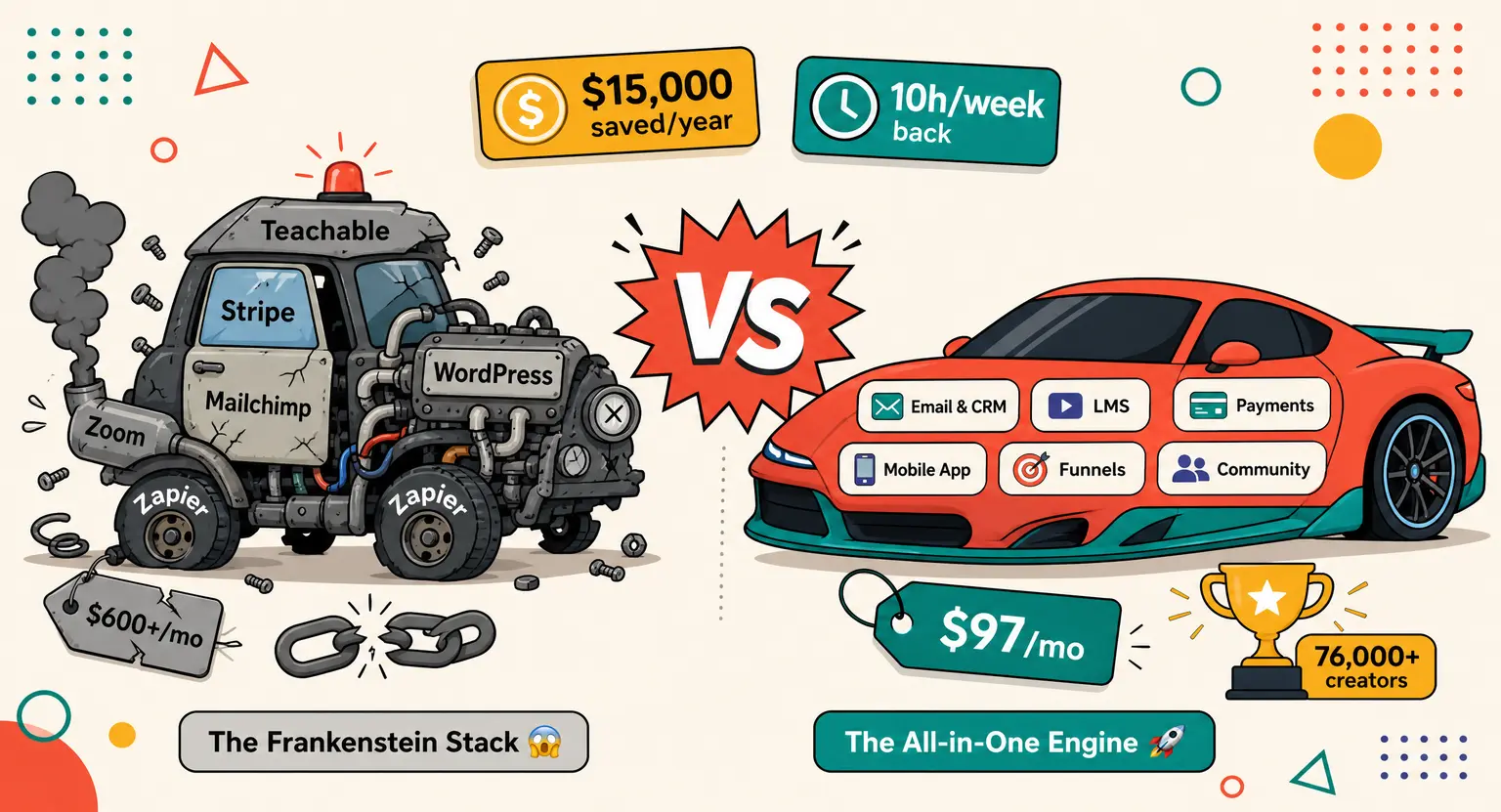
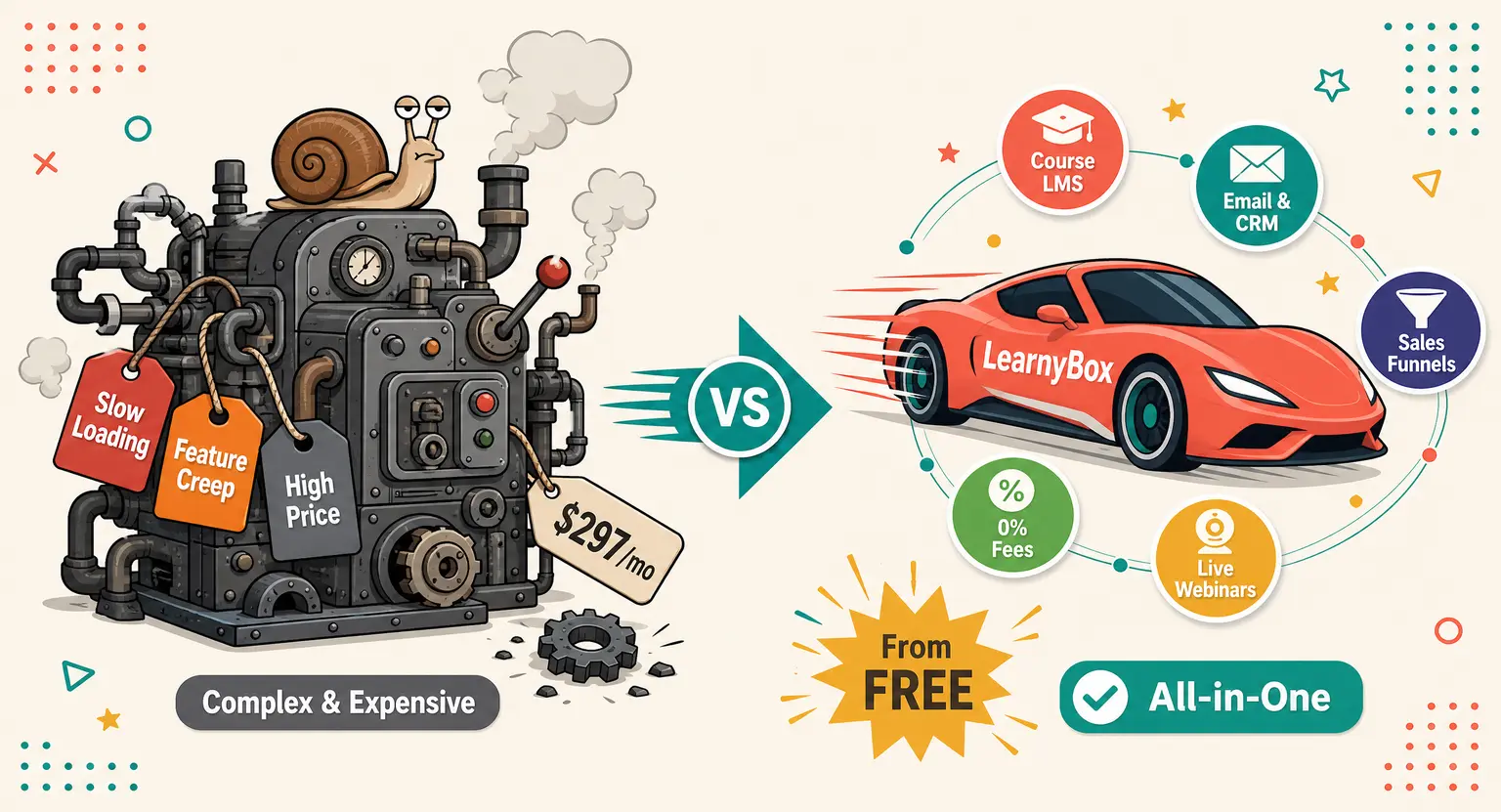
For years, the standard advice given to new course creators was to assemble what we lovingly call the "Frankenstein System."
You would buy a hosting plan on WordPress, install three different membership plugins, connect an external email provider, sign up for a separate landing page builder, and tie everything together with Zapier.
It sounded decent on paper because it felt like you had total control over every individual element. In reality, it was an absolute nightmare that caused endless tech headaches and cost a small fortune.
Every time one of those platforms updated its software, the delicate connections between them would break, leaving your students locked out of their accounts and your checkout cart completely broken during critical launch periods.
In 2026, nobody has time for that kind of stress anymore. When you look at the economics of running a digital business, paying five separate subscription fees is incredibly inefficient.
A standard landing page builder can cost you ninety dollars a month, while an automated email provider adds another eighty, and video hosting tacks on sixty more.
Before you have even sold your first digital course, you are already facing hundreds of dollars in fixed overhead.
By consolidating your business tools into modern, fully optimized sales funnels, you bypass this massive financial tax completely.
A unified setup ensures your pages load lightning-fast, your emails trigger automatically when someone signs up, and your student progress is tracked under a single, clear dashboard without annoying data mismatches.
Feature-by-Feature : What Actually Separates the Good from the Great
To make an intelligent investment in your digital business, you have to look past basic video hosting. Today, hosting high-definition content is a commodity that almost any basic platform can accomplish.
The real differences between platforms are found in their secondary systems : engagement tools, community spaces, and marketing automation systems.
First, let's talk about community engagement. For a long time, creators relied on external Facebook groups to foster student discussions. But in 2026, social media platforms are too distracting, noisy, and subject to algorithmic changes that depress engagement.
The leading course spaces now offer built-in community hubs directly alongside the modules. Having a single login where students can review lectures, participate in focused forums, and message peers directly increases course completion rates and reduces refund requests.
Second, marketing and automated sales are where your revenue is secured. Many basic LMS platforms deliver beautiful student areas but provide almost zero tools to actually sell the courses.
You want a platform that allows you to easily set up upsells, order bumps, automated abandoned cart sequences, and optimized checkouts.
Furthermore, utilizing highly integrated payment gateways like LearnyPay secure payments eliminates the need to pay double fees to external payment processors, keeping more hard-earned cash in your wallet.
Lastly, live interactions are vital. Whether you are running a weekly coaching session or a high-converting masterclass, having built-in webinar and auto-webinar capabilities is essential.
Instead of paying for expensive external streaming tools, you want a system that automatically records your live streams, turns them into replay pages, and schedules evergreen automated follow-up emails to viewers.
Head-to-Head Comparison : The Leading Platforms of 2026
Let's get down to the actual platforms. The market has divided into two distinct philosophies : dedicated course portals that do one thing well, and comprehensive all-in-one platforms that act as the operating system for your entire digital brand.
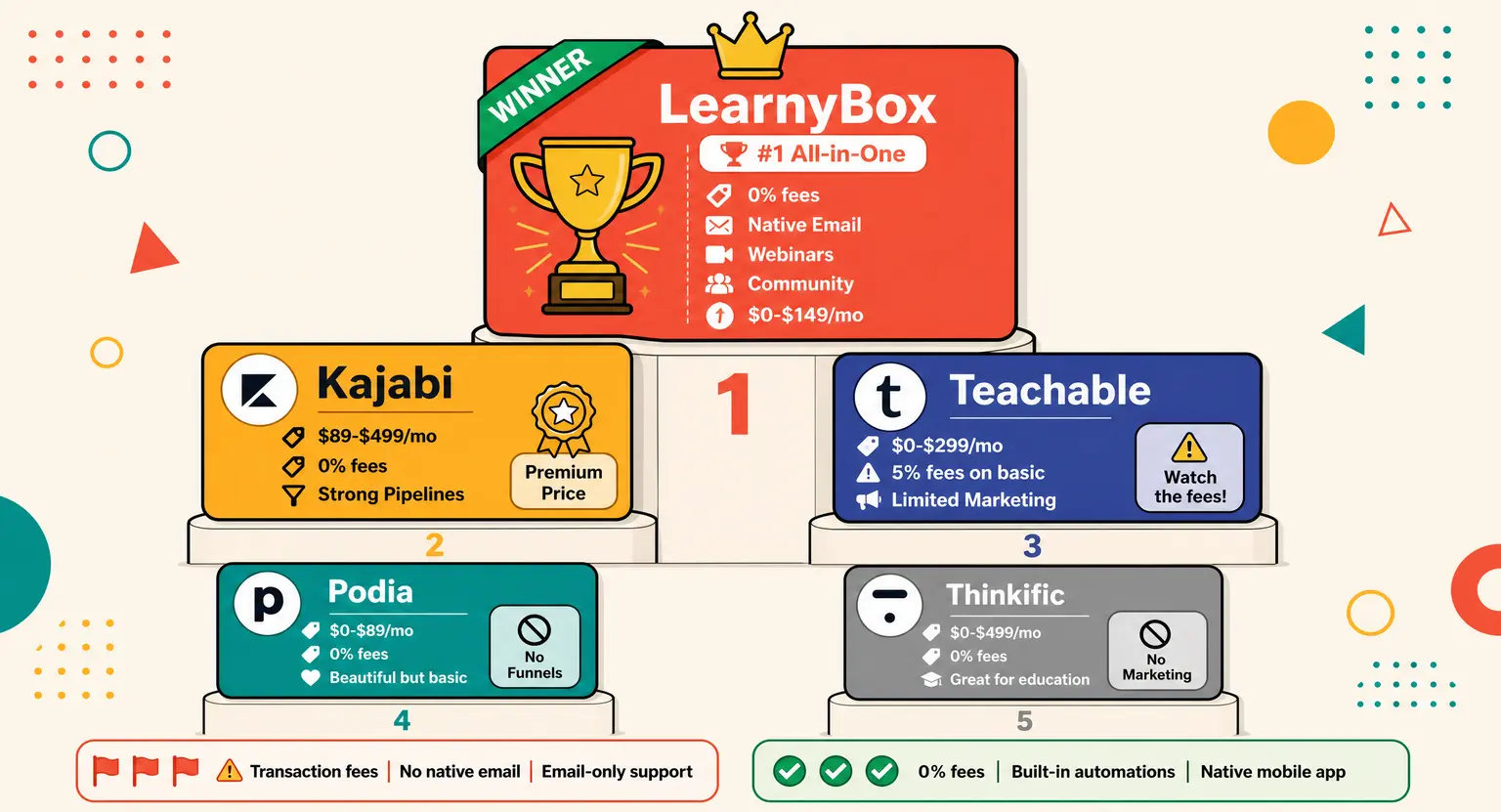
Here is how the top five candidates stack up under real-world testing.
LearnyBox : The Absolute All-in-One Powerhouse
LearnyBox is designed specifically to replace a mountain of different software subscriptions.
It natively handles everything from course creation and video hosting to email campaigns, sales pages, automated webinars, and secure payments.
What makes it incredibly appealing in 2026 is its zero-commission policy across all flat-rate tiers. Whether you are testing out your first offering with their robust free plan or running a massive enterprise school, you keep all of your money.
It represents a direct upgrade from platforms like ClickFunnels and Kajabi, providing a much cleaner, localized, and intuitive interface.
It also comes equipped with a dedicated French & English speaking support team that is highly helpful, visual drag-and-drop landing page builders, and its own integrated wallet system.
If you want to experiment without any stress or monthly fees, you can start today with their completely free online course platform tier to build your brand without risking your own capital.
Kajabi : The Premium Giant with a Premium Price Tag
Kajabi is a well-established player in the digital product space, but it is not without its drawbacks.
It offers incredibly strong marketing automations and sleek design templates, making it a favorite for established high-ticket coaches. However, that power comes with a major cost.
With plans starting at eighty-nine dollars a month for highly restrictive basic layouts and climbing rapidly to over three hundred dollars, it represents a massive financial barrier for growing creators.
Additionally, many independent educators find the system overly complex, requiring a steep learning curve to build simple pages, and often find themselves paying for advanced tools they never actually use.
Teachable : The Traditional Player with Hidden Fee Pitfalls
Teachable remains popular because of its user-friendly interface and clean, structured course player. It is very easy to drag and drop your video lectures and set up simple quizzes.
However, their pricing model contains a massive trap that catches many creators off guard.
While their entry-level plans appear affordable, they charge a five percent transaction fee on their Free and Basic plans.
If your digital academy manages to bring in two thousand dollars a month on their Basic subscription, Teachable will take one hundred dollars from you every single month.
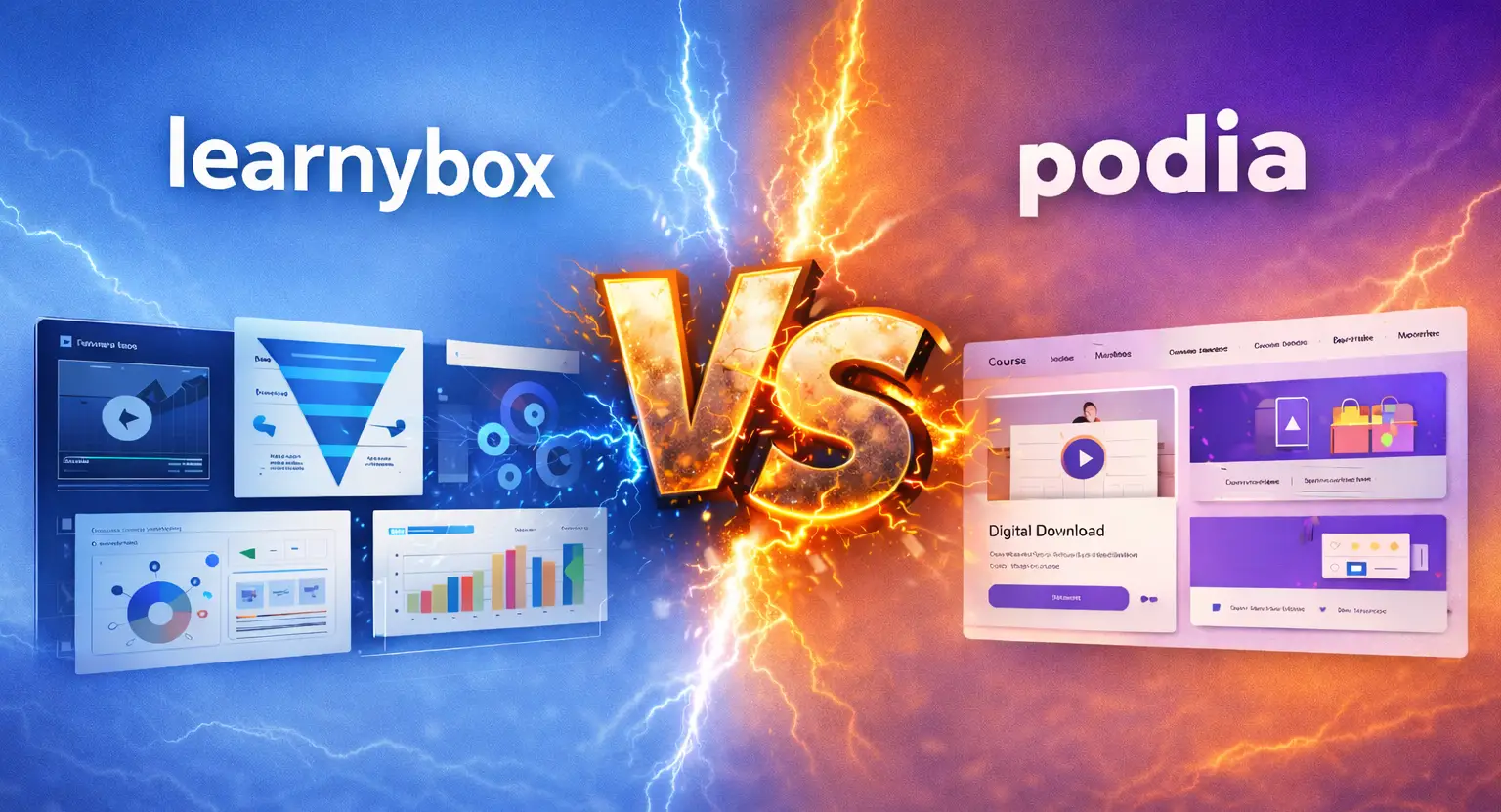
When you do a realistic LearnyBox vs Podia and Teachable analysis, you quickly realize that flat-rate platforms are far more profitable as your audience grows.
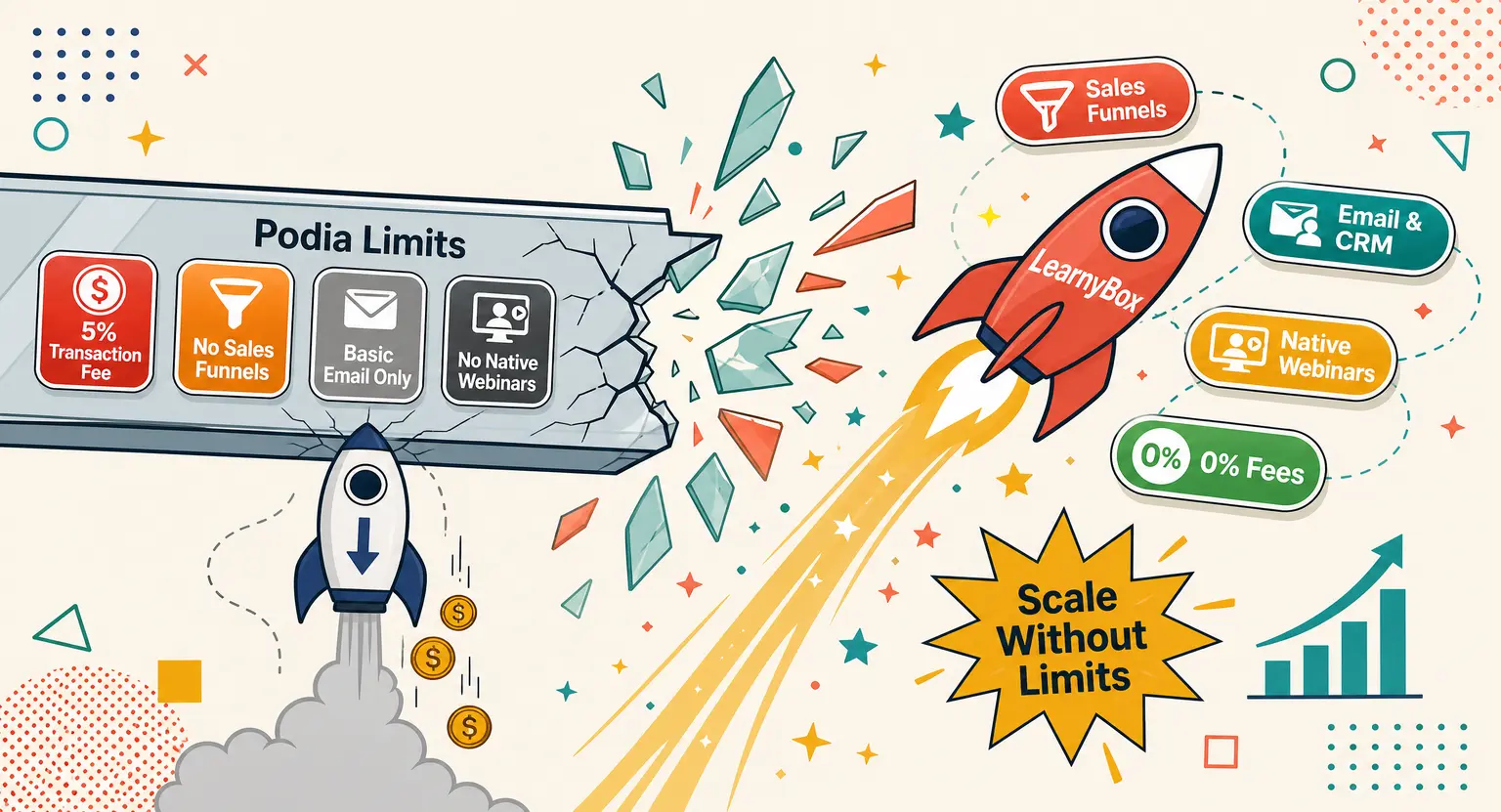
Podia : Sleek and Minimalist, but Lacking Marketing Muscle
Podia is highly regarded for its beautiful, clean, and modern aesthetics. It is an amazing home for simple digital downloads, small membership communities, and basic online courses.
It is incredibly user-friendly, and their support is notoriously friendly. However, Podia is not built for high-scale marketing.
If you want to construct complex sales funnels with multiple upsells, run advanced email sequences based on student behaviors, or stream live webinars directly on your platform, Podia will disappoint you.
It is a highly aesthetic storage box for your content, but it simply lacks the heavy-duty marketing engine required to run a high-volume business.
Thinkific : Great for Pure Education, Light on Conversions
Thinkific is highly respected for its educational design tools. It allows you to build complex student assessments, specialized quizzes, and even structured student certificates.
For academic organizations, it is fantastic. But like Teachable, Thinkific is fundamentally an educational tool, not a sales machine.
You will almost certainly need to purchase external email software, separate funnel builders, and third-party landing page tools to market your courses effectively, bringing you right back to the expensive Frankenstein System we want to avoid.
Our Verdict : Which Platform Fits Your Long-Term Goals?
Choosing the absolute winner of this comparison depends entirely on what your business goals look like over the next twelve months.
If you are a solo entrepreneur or a small business looking to maximize your ROI without juggling ten different logins or losing money on commissions, an integrated setup like LearnyBox is the smartest option.
It lets you run your entire business from one place without any messy API integrations.
However, if you are a massive training organization that only cares about compliance metrics and does not need native marketing or web builders, Thinkific is a respectable alternative.
But for most creators who want to build a real, highly profitable online business, consolidating under an all-in-one platform to sell online courses setup is the ultimate hack to save time and sanity.
To help you see the entire field at a glance, we compiled an exhaustive, feature-by-feature comparison of how these tools operate in real-world scenarios.
Use this grid to weigh monthly subscription costs against total business capability.
| Platform | Best for | Base pricing | Transaction fees | Core marketing | Built-in community |
|---|---|---|---|---|---|
| LearnyBox | Serious creators and organizations seeking full growth tools. | $0 to $149/mo | 0% on all plans | Native email, automations, webinars. | Yes, integrated community forums. |
| Kajabi | Well-funded businesses and high-ticket coaches. | $89 to $499/mo | 0% transaction fees | Strong pipelines and templates. | Yes, basic community circles. |
| Teachable | Academic creators with a single course. | $0 to $299/mo | 5% on starter plans | Basic emails, limited pages. | No, relies on integrations. |
| Podia | Beginner artists with small digital files. | $0 to $89/mo | 0% to 5% based on plan | Simple sign-up forms. | Yes, clean but basic discussion. |
| Thinkific | Corporate training with deep quiz requirements. | $0 to $499/mo | 0% transaction fees | Minimal marketing setups. | No, standard course player only. |
LMS Red Flags and Green Flags in 2026
When you perform your own online course platform comparison evaluations, it helps to separate the surface-level marketing talk from actual utility.
Here is our checklist of modern warning signs and winning indicators.
-
? Slipping in custom transaction fees on top of standard payment processor cuts.
-
? Lacking native email automations, forcing you to pay for external subscriptions.
-
? Clunky mobile web responsive design rather than having a dedicated native app experience.
-
? Horrible, slow email-only support that leaves you hanging during a live launch.
-
✅ Transparent all-in-one pricing with clear caps on contacts.
-
✅ Zero percent transaction cuts on paid subscriptions.
-
✅ Fully integrated customer analytics showing exactly where students drop off.
Explore Further
Ready to build your digital academy? Learn how to smoothly sell online courses without any technical headaches today.
Frequently Asked Questions
What is the easiest way to avoid transaction fees?
You should choose a flat-rate plan with zero commissions, such as LearnyBox.
Platforms like Teachable charge up to five percent on their starter plans, which quickly eats into your hard-earned profits as your brand scales.
By utilizing an integrated platform, you keep 100% of your sales from day one.
Do I still need an external email platform?
No. Modern fully unified systems include visual email tools and customer databases. This completely eliminates expensive, stressful extra subscriptions forever.
Can I offer a simple trial option to my students?
Yes, absolutely. Providing an accessible, interactive free trial lets students test your teaching first, building crucial trust before they commit to buying your content.


 How to Create a Course Refund Policy (Templates & Best Practices for 2026)
 How to Run a Beta Version of an Online Course (2026 Guide)
 How to Create a Cohort-Based Online Course (2026 Guide)
 How to Sell an Online Course With a Quiz Funnel (2026 Guide)
 How to Sell an Online Course Through a Sales Call (2026 Guide)