







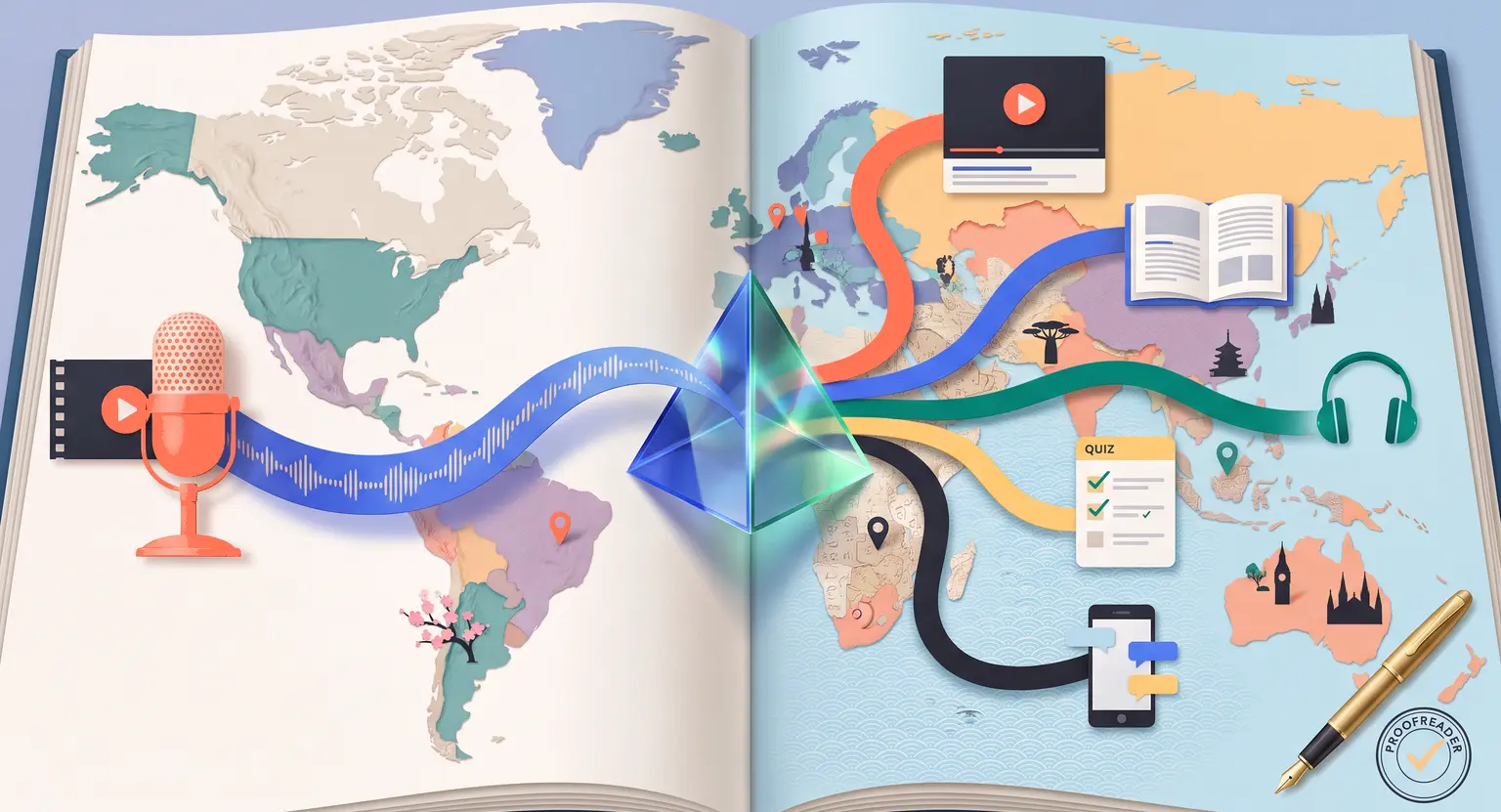
AI for Online Course Translation: Scale Nationally & Globally
AI for Online Course Translation
We live in a world where geographic borders vanish the moment you hit publish, but language boundaries are still very real… If you only sell your expertise in English, you ignore a massive global audience eager to learn.
A few years ago, translating an entire course meant hiring translators, voice actors, and video editors, draining your budget before making a single international sale.
Everything changed. In 2026, artificial intelligence doesn't just swap words. It preserves your exact voice, synchronizes your lip movements, and adapts regional slang so you sound like a local.
But how do you use this tech without sounding like a robotic machine? Let's talk about scaling globally without losing your unique human touch.
Scaling a digital school internationally is no longer a luxury reserved for multi-million dollar corporations. With the right tools, individual educators can expand their reach overnight, provided they understand where automation excels.
Key Takeaways
-
Reach new markets : instantly adapt your content for global audiences to scale your knowledge business.
-
Preserve your brand : use localized voice-cloning to maintain your distinct tone across multiple languages.
-
Cut costs : reduce translation expenses by up to 90 % by using AI before doing a final human pass.
-
Pick the right setup : to make money, host on the best platform to sell online courses that supports multi-language delivery seamlessly.
The Shift from Simple Translation to Complete Localization
Let's clear something up right away. Simple translation replaces word A with word B. That is how we used to build terrible, dry localized materials. Localization, on the other hand, is about rewriting context.
It ensures a cultural reference about baseball in New York translates cleanly to a cricket reference in Mumbai or a football reference in Paris.
By 2026, AI engines will have cracked this code. They recognize humor, analogies, and idiomatic phrases. Instead of breaking your flow, modern AI adjusts sentences to preserve your curriculum's core meaning.
If you want to build a truly global audience, you must design your materials with localization in mind from day one. It starts by ensuring you create engaging course content that relies on clean, easy-to-understand frameworks.
And let's not forget text formatting. Dynamic AI models automatically adjust translation lengths to prevent your custom layouts from breaking. Many languages take up more physical space than English.
If you don't use smart AI tools, your pristine slide decks will look like a cluttered mess. Modern tools handle these micro-adjustments quietly.
Video and Audio : Beyond Simple Subtitles
Reading subtitles is fine, but listening to a lesson in your native tongue is a completely different experience.
Students learn faster when they can close their eyes and still absorb your exact points. Historically, custom voiceovers cost thousands of dollars per hour. Today, smart dubbing changes the entire playing field.
With current platforms, you can upload a video, and the software will clone your unique voice print. It then speaks Spanish, Japanese, or Portuguese while keeping your pitch, pacing, and emotional peaks.
Even better, video translators now adjust lip movements to match the newly generated audio. It minimizes that awkward badly dubbed movie effect that turns students off.
But voice is only half of the puzzle. You also need transcripts to make your content accessible and searchable. You can easily save yourself days of effort when you learn how to use AI to create course transcripts.
This creates a solid foundation for your localization process, as text engines use these pristine transcripts to feed voice generation pipelines.
Comparing Course Translation Methods in 2026
To help you decide which route fits your budget, let's look at how the different translation approaches stack up today.
| Feature | Traditional agencies | Pure AI | Hybrid approach |
|---|---|---|---|
|
Speed |
Weeks or months of communication. |
Near real-time in minutes. |
A few days to verify. |
|
Costs |
Very high ($0.15+ per word). |
Extremely low (pennies per minute). |
Moderate (paying a native editor). |
|
Accuracy |
High, native intuition. |
Moderate to high, misses slang. |
Perfect. Best of both worlds. |
|
Voice cloning |
Requires local actors. |
Fully automatic cloned versions. |
Automated clone with manual edits. |
Building a Seamless Hybrid Translation Workflow
Do not just blindly trust the machine. To maintain your brand's reputation, you need a workflow that treats artificial intelligence as an assistant rather than a completely unsupervised replacement.
The sweet spot lies in a structured three-step process : automate, refine, and host. This ensures your final product looks polished and premium.
First, run your core modules through an AI translator to get your baseline texts and transcripts.
Second, hire a native-speaking editor to review the output. It is far cheaper to pay an editor to fix minor errors than to pay a translator to write everything from scratch.
This step ensures your tone remains friendly and natural. If you are updating older materials before translating them, learn how to use AI to update outdated course content to set yourself up for a clean start.
After refining the core text, trigger the synthetic voice generation and lip-sync features. This step ensures that your interactive videos flow smoothly.
When everything looks pristine, publish the newly localized version onto an all-in-one platform to sell online courses. Choosing the right system saves you from managing scattered external portals.
Choosing the Right Multi-Language Host
Having translated files scattered on your hard drive does nothing for your business. You must host them in a structure that naturally supports global operations.
The biggest mistake creators make is trying to duct-tape several different plug-ins together to handle different language variants of their course dashboard.
Instead, look for a setup that natively lets you switch languages with one click. When a user logs in from Europe, the dashboard should automatically shift to their local tongue.
This keeps things sleek and professional. If you want to dive deeper into setups, learn why selecting an online training platform with native multi-language support makes sense.
Driving Revenue with Your Multilingual Content
Translating your core program is an empty achievement if nobody finds it. Once you have localized elements ready, you need to match them with localized landing pages, payment gateways, and marketing funnels.
You cannot sell to Spain using a checkout page written in English. Ensure your sales pipeline speaks the local language too.
So, use AI marketing tools for creators to write localized ad copy, sales emails, and landing page headlines. This keeps your messaging consistent from the first ad impression to the final certificate.
When you are ready to introduce your newly translated offer, study how to launch an online course globally. It will give you a clear blueprint for organizing international cohorts, setting regional prices, and scheduling launches across varied time zones.
Fostering Global Communities
Translation doesn't stop inside the video player. Once your foreign students join, they expect answers to their questions.
Translating student hubs, forums, and lesson responses automatically keeps everyone engaged. By using instant messaging translators, you can support your community seamlessly.
You don't need to speak five languages to build an international classroom. Modern tools do the heavy lifting for you while you focus on sharing your raw expertise.
Frequently Asked Questions
Can AI accurately translate technical courses?
Yes. By using specialized AI models trained on industry terminology and glossaries, you can translate technical and niche academic courses with high precision, though we always recommend a native speaker review the final draft.
Is voice-cloning in translation legal and ethical?
It is ethical and legal as long as you own the rights to the voice and consent to the cloning. Modern platform terms protect your voice ownership rights.
How much does AI course translation cost compared to agencies?
AI translations reduce costs by up to 90 %. Traditional translation agencies charge massive amounts per word and per minute of run time, while modern AI setups process localized files for cents, saving huge budgets.





 How to Create a Course Refund Policy (Templates & Best Practices for 2026)
 How to Run a Beta Version of an Online Course (2026 Guide)
 How to Create a Cohort-Based Online Course (2026 Guide)
 How to Sell an Online Course With a Quiz Funnel (2026 Guide)
 How to Sell an Online Course Through a Sales Call (2026 Guide)