






Online Course Platform vs LMS: 2026 Key Differences
Online Course Platform vs Learning Management System : What's the Difference?
Key Takeaways
Before diving deep, here is the quick breakdown to help you make a fast, clear decision today :
-
Online Course Platforms are built for selling. They focus on promotional tools, landing pages, and student acquisition.
-
Learning Management Systems (LMS) are built for tracking. They excel in corporate compliance, internal training, and highly granular student reporting.
-
Monetization vs Training : if your main goal is to generate revenue, go with a direct sales platform. If you need to manage employee onboarding or academic compliance, choose an LMS. This guide will make it simple.
Let's address the elephant in the room. If you have spent any time looking for a place to host your digital lessons, you have probably run into a wall of confusing jargon. People use "Online Course Platform" and "Learning Management System" (LMS) interchangeably, but they are not the same thing - not even close.
Choosing the wrong software is a massive pain. It can cost you thousands of dollars, waste weeks of migration work, and frustrate your students. So, why does this confusion exist?
Mainly because both systems host video lessons, quizzes, and text documents… But their core architectures serve different masters.
One is built to help you run a profitable business, while the other is engineered to help organizations train, track, and evaluate people internally.
Let's break down these differences cleanly. By the end of this complete guide, you will know exactly which system fits your 2026 business growth strategy perfectly.
What is an Online Course Platform?
To understand an online course platform, think of it as a digital storefront. It is built from the ground up for entrepreneurs, infopreneurs, and scaling creators who need to monetize their expertise.
When you use one of the best online course platforms, you get a setup specifically designed to convert cold traffic into paying customers.
These systems combine hosting, delivery, and commerce. They do not just store your video files; they help you sell them. Because of this, you find incredibly strong marketing tools cooked right into the software. We are talking about email automation, landing page builders, affiliate management, and optimized checkouts.
And since you need to make money, these platforms offer native integrations with global payment gateways. They manage coupon codes, upsells, and subscription billing seamlessly. Your main priority is student acquisition and a friction-free experience.
If your goal is to package your knowledge, utilizing an all-in-one platform to sell online courses keeps your tech stack simple. You do not have to stitch together multiple separate plugins to accept payments or send promotional emails.
What is a Learning Management System (LMS)?
Now let's look at the other side. A Learning Management System, or LMS, is built for administration, compliance, and deep academic tracking. Instead of targeting external buyers, an LMS typically targets internal learners - like employees, university students, or corporate partners.
Historically, an LMS is the backbone of human resources. If you run an active LMS training organization, you care less about slick checkout pages and more about compliance standards.
An LMS excels at checking boxes. It tracks exactly how many minutes an employee spent on a safety module, whether they passed their certification exam, and when that certification expires. It also supports complex learning standards like SCORM and xAPI, allowing you to move interactive courses across different enterprise systems.
Administrators use these systems to manage massive cohorts of users, often integrating them directly with internal HR databases. If you need a robust enterprise LMS e-learning platform, you want deep automation for role assignments and advanced grading rubrics.
Marketing and sales features are almost non-existent here because students are already required to participate in compliance programs - this makes corporate training highly structured and secure.
Feature-by-Feature Head-to-Head Comparison
Let's put these two digital tools side by side right now. While their features occasionally overlap, their overall business priorities remain worlds apart.
| Feature | Online Course Platform | Learning Management System |
|---|---|---|
|
Primary goal |
To sell courses, build a brand, and generate revenue. |
To train, onboard, and track internal compliance. |
|
Target audience |
External buyers, individual students, community members. |
Employees, corporate teams, university students. |
|
Marketing tools |
Integrated sales funnels, checkout pages, and email automation. |
Rarely included; built for internal distribution. |
|
Compliance standards |
Not supported natively; focuses on simple media formats. |
Full support for SCORM, xAPI, and official audits. |
|
Analytics |
Focuses on sales and progress metrics. |
Granular tracking, time on page, audit trails. |
|
System integrations |
Payment gateways, email lists. |
HR systems and database networks. |
The 4 Major Differences That Choose for You
Still unsure which path to walk? Let's zoom in on four defining operational differences that make the choice clear.
1. Sales Funnels vs Simple Hosting
A course that nobody buys is just a collection of files gathering digital dust. Course platforms live and die by promotions. They come with tools designed to walk leads through the sales funnel stages explained in modern marketing. You can set up upsells, downsells, and coupon structures in minutes.
An LMS doesn't care about conversions at all. It assumes your students are employees who must complete compliance training to keep their jobs, replacing sales funnels with strict enrollment rules.
2. Selling Integration vs Corporate HR Setup
If you want to charge your students recurring monthly membership fees, you need a robust built-in engine. Course platforms handle billing, multi-currency processing, and automatic subscription renewals natively.
An LMS focuses on Single Sign-On systems. This ensures an employee can log in using their custom office credentials. It syncs directly with HR platforms to automatically assign training when someone gets promoted.
3. Engagement vs Compliance
Engagement on a creator platform focuses on community, gamification, and keeping learners interested enough to finish and buy your next product. You will build discussions, offer simple digital downloads, and present completion badges to successful students.
An LMS uses SCORM packages to run complex interactive simulations. It tracks progress to verify compliance for audits and prevents users from skipping essential compliance modules.
4. Easy Onboarding vs Technical Setup
Creating a course on a creator platform is fast. You upload a video, drag and drop text boxes, set a price, and publish. The admin interface is clean, modern, and highly intuitive.
With an LMS, setting up your environment is a serious technical IT project. You must configure user groups, define hierarchy roles, and map specific learning pathways for cohorts.
How to Choose Which One Fits Your Business
To make this decision as clear as possible, let's look at your current goals. Your choice depends entirely on what you want your students to do and how your business makes money online.
You should choose an Online Course Platform if :
-
You are a creator, coach, or entrepreneur looking to package your expertise.
-
You want to launch a membership site, offer digital downloads, or run a high-ticket coaching cohort.
-
You want to learn how to start an online coaching business with minimal tech frustrations and headaches.
-
Having a beautiful, high-converting checkout page is crucial.
-
You need to build larger email lists and automate your promotional marketing campaigns.
If these points describe your current journey, look for the best all-in-one course platform you can find. It will save you from buying multiple subscription tools.
You should choose an LMS if :
-
You run an established worldwide corporation and need to onboard new hires.
-
You are an accredited training institute issuing audited certifications.
-
Your courses require complex pathways, advanced grading, or SCORM compliance.
-
You deal with internal team members every day and need enterprise integrations.
Knowing this major difference saves you from picking a complex system you will struggle to use, or a simplified tool that simply can't handle complex compliance.
Can You Move From One to the Other?
Yes, absolutely. But it takes planning. Many creators start on simple networks, then realize they need more control. When this happens, understanding when you should move to a more advanced online course platform becomes essential.
If you are building your own brand, you want complete control over your traffic and billing. Often, creators realize that using a crowded online course marketplace vs your own website holds back their revenue potential.
Transitioning to a dedicated, high-performance creator platform is the natural next step as your student base grows.
Make sure any modern tool you choose always allows you to export your entire database of student data easily. You do not want your hard-earned student list held hostage by software.
Finding the Perfect Balance with LearnyBox
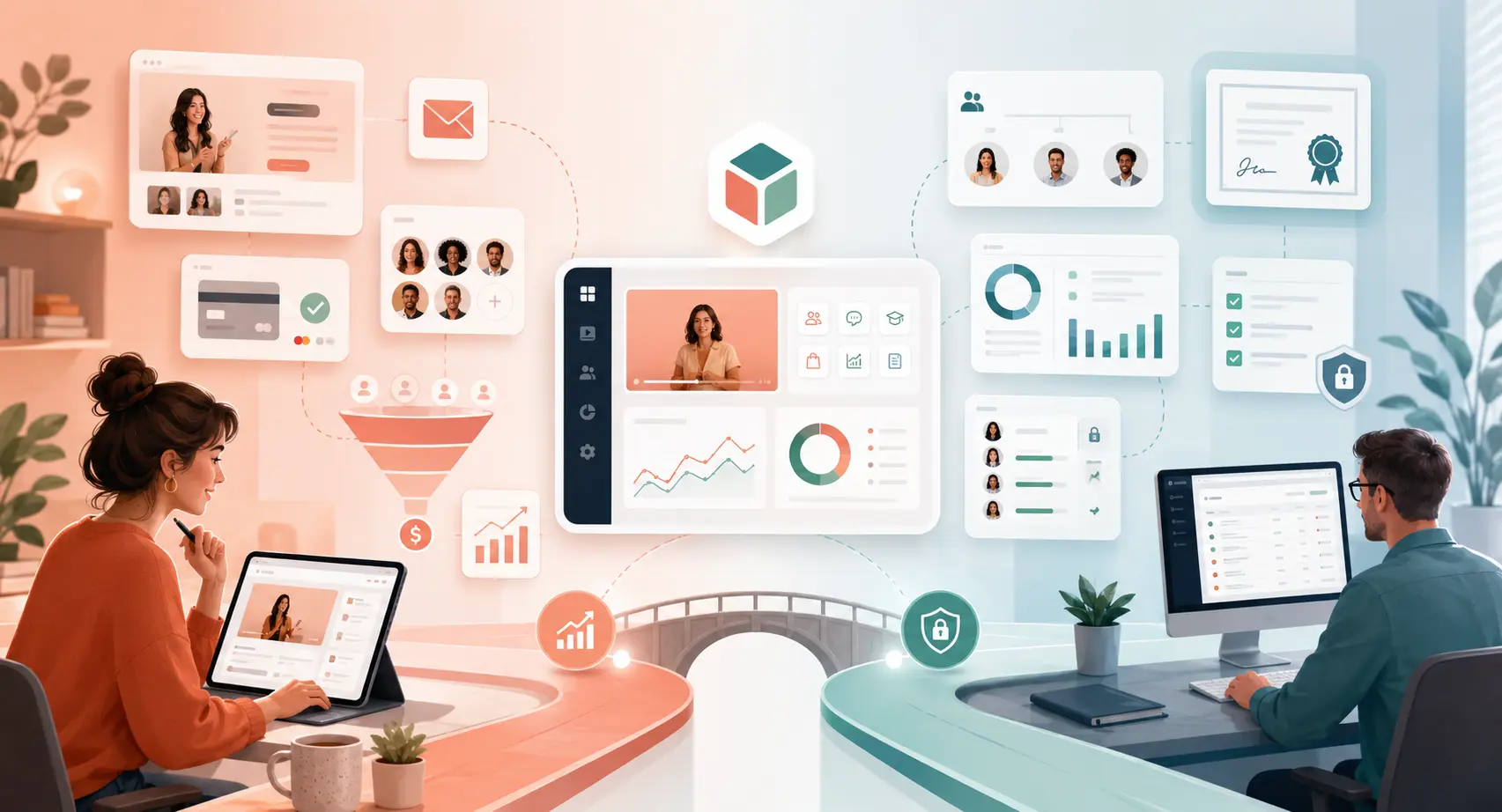
What if you need a little bit of both? This is a common dilemma in 2026. You might run a training center that needs to sell courses to the public but also requires robust tracking tools.
That's where LearnyBox comes in. It bridges the gap perfectly. It gives you the robust, powerful marketing engine, funnel builder, and slick checkout processes of a premium creator platform.
At the same time, it provides the structured student management, clean dashboards, and security of an intuitive learning platform.
By using LearnyBox, you get a sleek, unified environment that makes selling your expert knowledge easy while keeping your students happy and highly engaged.
Frequently Asked Questions
Can I sell courses on an LMS?
Yes, but it is rarely a smooth process. Most corporate LMS systems require external integrations or heavy developer customization to handle retail sales.
They lack built-in marketing funnels, downsells, and optimized checkouts. If your goal is to generate revenue, a creator platform is a much better fit.
What does SCORM mean and do I need it?
SCORM stands for Sharable Content Object Reference Model. It is an industry standard that ensures online learning content interacts perfectly with any LMS.
You only need SCORM if you sell courses directly to corporations who upload your content into their own LMS, or if you run audited academic certification programs.
Which option is better for beginners?
An online course platform is almost always better for beginners.
They are designed to be user-friendly with drag-and-drop course builders, visual editors, and integrated payment processing.
A traditional LMS has a much steeper learning curve because of its complex administrative setups.
Do online course platforms handle student grading?
Yes, but they keep it simple. They offer standard multiple-choice quizzes, open text reflections, and basic automatic lesson grading.
An LMS supports advanced digital grading rubrics, peer reviews, weighted grade books, and secure, fully proctored examinations.



 How to Create a Course Refund Policy (Templates & Best Practices for 2026)
 How to Create a Cohort-Based Online Course (2026 Guide)
 How to Sell an Online Course With a Quiz Funnel (2026 Guide)
 How to Sell an Online Course Through a Sales Call (2026 Guide)