







How to Make a Course Outline That Actually Works (2026 Strategy)
How to Make a Course Outline That Actually Works (2026 Strategy)
Key Takeaways
-
Start with the end : always define the student's "After" state before writing a single lesson title.
-
Sequence matters : arrange modules from the lowest barrier to entry to more complex skill application.
-
Validate first : use a validate your module ideas strategy to ensure people actually want to learn your planned topics.
-
Consistency : maintain a uniform structure across all modules to reduce the cognitive load on your students.
So, you have a brilliant idea swirling around in your brain. You know your stuff, and you're ready to share it with the world.
But then you sit down at your computer, open a blank document, and... nothing. The "cursed" blank page syndrome hits.
You start wondering where to even begin. Do you start with the history of the topic? The technical tools? Or just jump straight into the deep end?
This is exactly where most would-be educators get stuck and eventually quit.
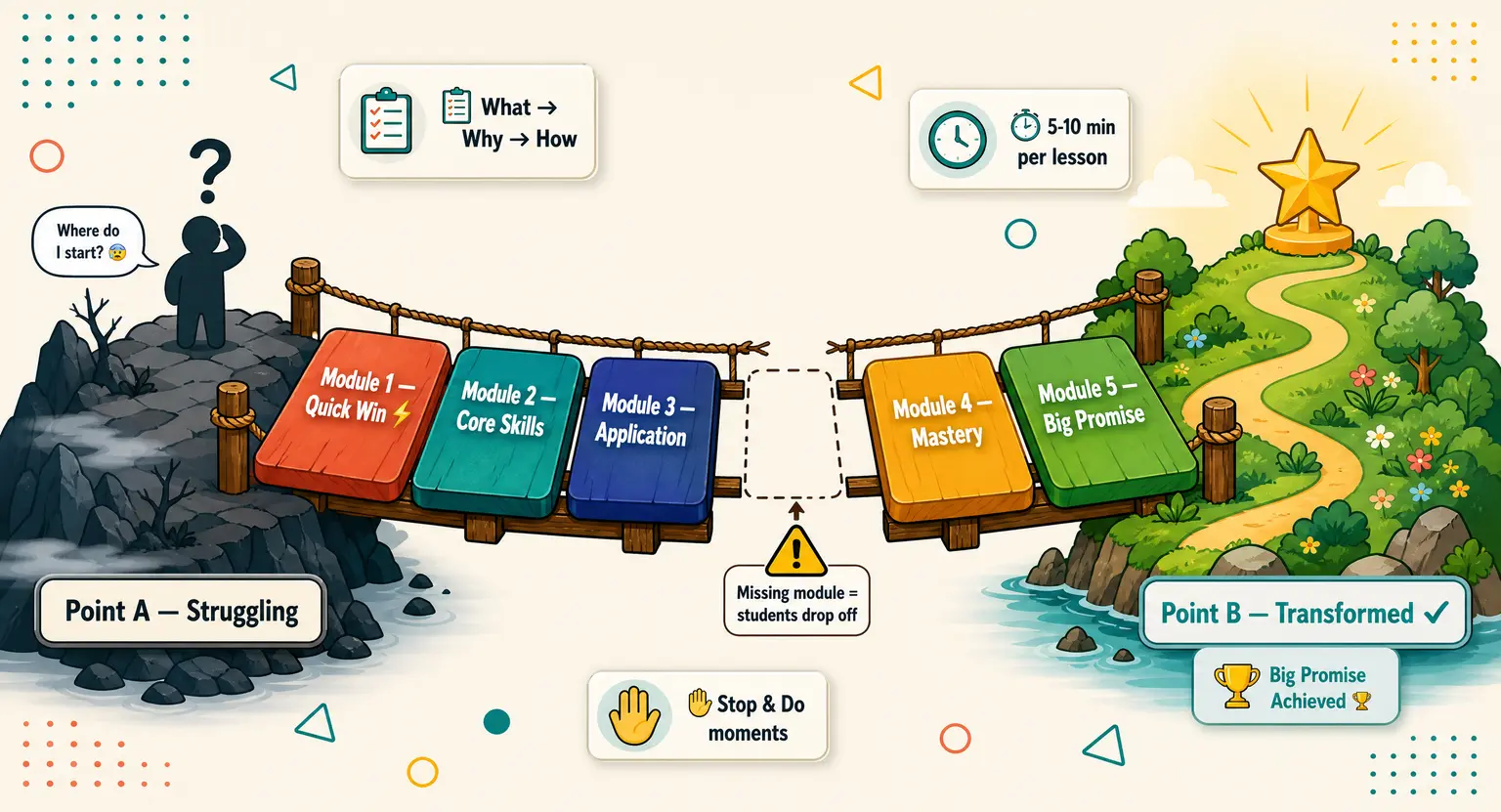
But here is the thing : a course outline isn't just a table of contents. It is a transformation map.
You aren't just selling information; you are selling a bridge from Point A (where they are struggling) to Point B (where they have solved their problem).
If your bridge is missing planks or ends in the middle of a river, your students will fall through. And they won't come back for more. So let's talk about how to build a bridge that actually holds weight.
Identify the Transformation First
Before you even think about "Module 1," you need to get crystal clear on who you are talking to. If you try to teach everyone everything, you'll end up teaching nobody anything.
This is why target audience profiling is so critical at this early stage. You need to know what keeps them up at night.
What are the specific hurdles they face? If you can't describe their problem better than they can, they won't trust you to provide the solution.
Spend some time interviewing potential students or lurking in forums where they hang out. Listen to their language. Use their words in your outline.
And once you have that persona dialed in, define the "Big Promise." This is the one-sentence result your course delivers.
If your course is about gardening, the promise isn't "learn about plants." It's "grow your own organic salad in a tiny apartment balcony in 30 days."
See the difference? One is a topic; the other is a result.
Every single module you put in your outline must serve that Big Promise. If a lesson doesn't directly contribute to that result, cut it. Your students will thank you for being concise because their time is their most valuable asset.
But don't stop at the big goal. Break that goal down into "Milestones." These are the smaller wins that keep students motivated.
If the big goal is the apartment garden, Milestone 1 might be "Picking the right containers." Milestone 2 might be "Seed starting secrets."
Each milestone will eventually become a module in your outline. This gives your curriculum a natural, logical flow that builds momentum.
Students love feeling like they are "checking boxes" as they progress through your material. It triggers those happy little dopamine hits that keep them logging back in day after day.

The Structural Roadmap of Your Curriculum
Now that you have your milestones, it is time to flesh them out into a structure roadmap.
Think of each module as a mini-course in itself. It should have an introduction, a core teaching component, an application phase, and a summary.
This consistency helps students know what to expect. They don't have to spend energy figuring out your "style" each time; they can put all their focus on the actual learning.
It is also a good idea to alternate between theory and practice. Don't let them go three videos without actually doing something.
So, how do you decide what goes into a specific lesson? I like to use the "What, Why, How" framework.
For every lesson, tell them what they are learning, why it matters for their big goal, and then show them exactly how to do it.
This covers all the different learning styles.
The analytical students need the "why," while the action-oriented ones just want the "how."
By hitting all three, you ensure no one feels left behind or bored.
And keep the lessons short! In 2026, people's attention spans are shorter than ever. Aim for 5-10 minutes per video maximum. If a topic is huge, break it into Part 1 and Part 2.
But don't forget the "Gap" between modules. Each module should logically lead into the next.
At the end of Module 1, you should be able to say, "Now that you've mastered your soil mix, you're ready to pick the best seeds, which is exactly what we cover in Module 2."
This creates a narrative thread that pulls the student through the course. It makes the experience feel like a journey rather than a random collection of videos.
This is the difference between an amateur YouTube playlist and a professional educational product that you can monetize your knowledge with effectively.
Comparing Popular Outline Styles
Different subjects require different ways of organizing information. You wouldn't teach a mindset course the same way you'd teach a software tutorial.
Choosing the right "vibe" for your outline can save you a lot of headache later.
Here is a quick look at three common ways to arrange your content nodes.
| Outline type | Best for... | The core logic |
|---|---|---|
| The Linear Path | Skill-based hobbies (Photography, Cooking) | Step 1 leads to Step 2. You cannot skip ahead without missing vital info. |
| The Pillar Model | Broad topics (Digital Marketing, Parenting) | Standalone themes that can be consumed in any order but create a whole. |
| The Case-Study | Advanced professional niches (Consulting, Coding) | Learning by watching a project go from start to finish in real-time. |
And remember, you don't have to stick strictly to one. You can have a course that is mostly linear but has a "Resource Pillar" at the end. The key is that the student always knows "You are here" and "Here is where you go next."
If you are unsure which to pick, check out some pedagogical structures to see what fits your specific expertise best.
Your goal is clarity above all else.
Refining for Real-World Engagement
Once you have the skeleton of your outline, it's time to put some meat on the bones. This is where you add the "Engagement Hooks."
These are elements like quizzes, PDF checklists, community discussion prompts, or even live Q&A sessions.
An outline that is just "Video 1, Video 2, Video 3" is boring. It feels like a lecture hall from 1995. You want to create an interactive environment where the student is an active participant in their own success.
So, look at your module list and ask : "Where will my students get stuck?"
Every course has a "Danger Zone" - usually about 30% of the way through - where the initial excitement wears off and the work gets hard.
Identify that spot in your outline and add an extra dose of encouragement or a "quick win" lesson to get them over the hump.
Maybe this is where you offer a bonus template or a motivational video? By anticipating their struggle, you prove that you are a true expert who understands their journey. This builds massive loyalty.
But don't overcomplicate it. You don't need a thousand features. Sometimes, the most valuable part of an outline is the "Stop and Do" moments.
These are dedicated lessons where you tell the student : "Stop the video. Do not watch the next one until you have completed this specific task."
This enforces the transformation. It ensures that they aren't just binge-watching your content like a Netflix show but actually building the skills they paid for. This is how you get those glowing testimonials that help you sell more in the future.
And if you're worried about the cost of setting all this up, remember that you can start small.
You can even use a zero-cost setup to host your initial outline and test it with a few founding students.
Getting feedback on your outline before you spend months filming high-production videos is a pro-level move. It allows you to pivot and adjust based on what students actually find difficult, which saves you hundreds of hours of re-shooting later.
This lean approach is the smartest way to launch in today's market.
So, there you have it. Making a course outline isn't about being a perfect academic; it's about being a helpful guide.
If you stay focused on the transformation, keep your structure logical, and build in room for engagement, you're already miles ahead of the competition.
But don't just let this information sit here.
Open a fresh document right now.
Write down your Big Promise.
Then write down three milestones.
You've just started your outline.
And that is the hardest part done.
Go get it!
Frequently Asked Questions
How long should a standard course outline be?
Your outline should be as long as it needs to be to cover the transformation, but usually, a 4 to 8-week program requires a 5-10 page detailed breakdown.
It needs to include every lesson title, the specific learning objective for that video, and any worksheets you plan to include. Check our learning resources for specific templates.
Can I change my outline after I start filming?
Yes, but you should try to avoid major shifts that break the logic of your earlier modules.
Small tweaks to improve clarity are fine, but re-ordering entire phases often requires re-shooting introductions, so it is better to finalize the structure early on.
Do I need a fancy software to make an outline?
Not at all, because a simple text document or a mind-mapping tool often works best for the initial brainstorming phase.
Once you have the flow right, you can move it into your platform to start building the actual curriculum tabs.
If you're deciding on a home for your content, a platform comparison can help you see which tool handles outlines best.
What is the biggest mistake people make when outlining?
The most common error is including way too much information which leads to student overwhelm and high dropout rates.
Focus only on what the student needs to know to reach the specific goal you promised them at the start.



 How to Create a Course Refund Policy (Templates & Best Practices for 2026)
 How to Run a Beta Version of an Online Course (2026 Guide)
 How to Create a Cohort-Based Online Course (2026 Guide)
 How to Sell an Online Course Through a Sales Call (2026 Guide)