







How to Manage a Growing Online Course Community Without Burnout
How to Manage a Growing Online Course Community
What You Will Learn
-
Proactive community management : transition from reactive firefighting to building structured, scalable oversight systems that work without your constant involvement.
-
Strategic team building : identify and recruit your best students into official ambassador roles to share your moderation workload.
-
Automation integration : deploy smart community tools and triggers to handle repetitive administrative tasks so you can focus on high-impact teaching work.
-
Segment and serve : learn how to effectively segment your student cohorts to deliver perfectly personalized support, by linking into our core guide on how to build a student support system for an online course.
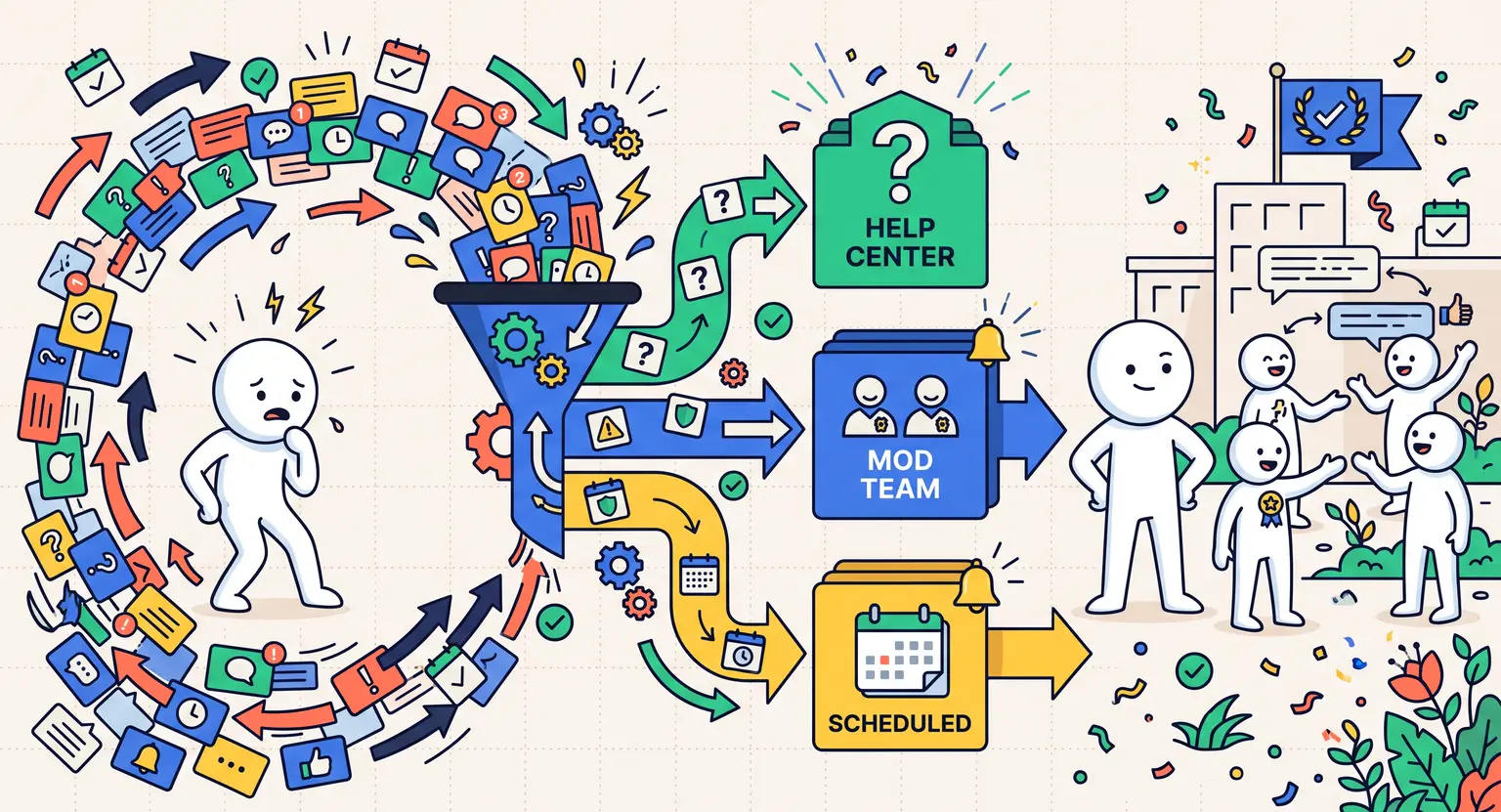
There is a specific moment in every successful course creator's journey when the community they built stops feeling like a tight-knit family and starts feeling like a bustling city they can barely navigate.
Messages fly in at all hours,
Technical questions clog the discussion boards,
New members feel lost...
And as the architect, you feel like you are drowning.
But here is the truth. A thriving, engaged community is not just a bonus feature for your online course. It is a powerful retention engine and one of your strongest competitive advantages in an overcrowded market.
Students who feel deeply connected to an active, supportive group are far more likely to finish their modules, upgrade to premium packages, and send referrals your way.
The key is making the shift from being the community's sole shepherd to becoming its architect. You need to build systems, empower leaders, and let the community sustain itself at scale. This is how you go from exhausted creator to thriving community curator.
1. Understanding the Scaling Problem
When your community was small, everything was manageable. You knew your students personally, replied to every post, and maintained clear cultural norms through sheer force of presence. But communities do not scale linearly.
Once your cohort crosses a certain critical mass, usually somewhere around the two-hundred-member mark, informal management methods break down - Posts get missed. Culture gets diluted. Long-time members get frustrated as new arrivals repeatedly ask the same questions that were answered months ago....
This is the moment many course creators make a critical error. They either try to answer everything personally until they burn out, or they go completely silent and watch their community slowly die. The solution sits between these two failure modes.
You need to implement what we call a layered engagement strategy. Think of your community architecture like concentric circles.
At the center, you have your core content and your official brand voice,
In the next ring, your moderation team handles tone and guidelines,
In the outer ring, peer-to-peer interactions and student-led discussions flourish with minimal oversight from you.
Each layer supports the others.
2. Building a Structured Ambassador Program
Your best students are hiding in plain sight. They are the ones who help newcomers, consistently post thoughtful replies, and share genuine wins from your course.
Identifying these individuals and giving them a formal role transforms your biggest fans into your most valuable operational asset.
But structuring an ambassador program goes well beyond simply assigning someone a new username badge. You need to create a clear charter.
Define what ambassadors are responsible for.Outline exactly what they are authorized to do, and what decisions must escalate to you. Establish how they will communicate with each other and with your support team.
It is also important to compensate their contributions meaningfully. This does not have to mean a salary.
Access to advanced course materials, a spot in an exclusive monthly expert call, public recognition in your newsletter, or free upgrades to premium course tiers are all highly motivating non-monetary rewards for the right person.
Most importantly, never neglect your ambassadors after onboarding. Schedule a simple monthly check-in with your full team. Ask them what is working, where they are struggling, and what community trends they are noticing.
This invaluable ground-level intelligence will help you make smart course and content decisions you simply cannot see from the creator's chair.
3. Running a Community Content Calendar
A planned content calendar is the backbone of a healthy, predictable community. Without it, your platform becomes reactive, cluttered, and confusing for newcomers who arrive mid-conversation with no context.
Design a simple monthly rhythmic framework. This means your students know exactly what to expect, when to participate, and where to post. Consistency reduces cognitive friction and steadily increases participation rates.
A sample high-performing monthly pattern might look like this :
-
Week 1 : a structured welcome thread for new members joining that cohort month.
-
Week 2 : a focused challenge or assignment with peer review built in.
-
Week 3 : a live Q&A session or an expert guest interview.
-
Week 4 : a student success spotlight and reflection thread.
You will quickly notice something exciting. As students begin to anticipate these recurring events, your ambassador team can take ownership of them with minimal creator input.
This frees you up to focus on high-leverage work like creating new modules and launching strategic marketing campaigns.
4. Using Automation Without Losing the Human Touch
Every growing community eventually produces a category of repetitive administrative tasks. New members need welcoming. Technical questions need routing to your help center. Rule violators need first-contact warnings.
These tasks are essential, but they consume extraordinary amounts of time when handled manually.
Intelligent automation tools can take these recurring tasks off your plate while still delivering a warm, personal feel.
When a new student joins your community, a trigger can send an automated welcome message with their first steps,
When someone posts a technical support question in the wrong thread, a bot can gently redirect them to your dedicated student help center.
The critical line to walk here is ensuring that automation handles logistics, not relationships. Any time a student has a highly personal struggle, an emotional roadblock, or a complex creative question, a real human being must step in.
Automation builds infrastructure. Humans build connection.
A smart way to think about this : automate anything that has a clear correct answer, and humanize anything that requires empathy or judgment.
Community Management Approaches : A Strategic Overview
| Management approach | Strengths | Limitations | Best scaling stage |
|---|---|---|---|
|
Solo creator moderation |
Maximum brand authenticity and consistent voice throughout. |
Completely unsustainable once you have more than fifty students. |
Launch phase (0-50 students). |
|
Volunteer ambassador model |
Authentic peer-to-peer culture; increases social proof and student loyalty. |
Requires careful vetting and consistent recognition to prevent burnout. |
Growth phase (50-500 students). |
|
Hired community manager |
Professional oversight; reliable availability; deep strategic engagement. |
Monthly investment cost; extended onboarding required to match your brand voice. |
Scale phase (500+ students). |
|
Automation-first systems |
Handles repetitive logistics twenty-four hours a day without human supervision. |
Can feel deeply impersonal; requires skilled setup and regular maintenance updates. |
Any phase as a supplemental support layer. |
5. Using AI to Enhance Community Management
The AI revolution has opened remarkable new doors for community managers. Smart tools can now analyze your forum activity to surface patterns you might miss.
They can highlight trending questions that signal a content gap, detect negative sentiment before it escalates, and suggest optimal times to post for maximum visibility.
When used well, AI becomes your early warning system. You can program prompts to review your last week of forum posts and generate a summary of key emerging themes, unresolved questions, and student mood patterns.
Here are five straightforward ways to leverage AI in your community workflow right now :
-
Review the past week of discussion threads and identify the top three unresolved student pain points.
-
Draft a warm welcome message template for new members joining this specific course community.
-
Generate five engagement prompt ideas for a community focused on building an online business.
-
Write a polite, private message to a community member who has repeatedly violated the self-promotion guidelines.
-
Summarize the top insights from last month's student success spotlight thread to repurpose as a newsletter feature.
The key to sustainable community management at scale is remembering that you are building culture, not just managing logistics.
Every system you put in place, whether it is an ambassador charter, a content calendar, or an automated welcome bot, should serve one core goal.
Making every single student feel like they belong in a place that genuinely helps them grow.
When you get that culture right, your community becomes your most powerful marketing tool.
Students who feel deeply connected do not just complete your course - they champion it, refer their friends, and build their own success stories using your frameworks. That is the real compounding return on investment of a well-managed community.
And if you want to understand how to keep your community healthy on a daily operational level, do not miss our detailed guide on how to moderate an online course community.
Frequently Asked Questions
When should I hire a dedicated community manager?
If community management is consistently consuming more than five hours of your work week, it is time to hire.
A dedicated manager typically makes sense once you cross five hundred active students or launch a second course that requires a separate, independent community channel.
How do you re-engage a community that has gone quiet?
Start with a highly personalized direct outreach to your top twenty most active historical members.
Ask them a simple question and invite them back. Then launch a structured thirty-day re-engagement challenge with daily prompts and visible progress tracking.
Silence is rarely permanent. It is almost always a sign of unclear expectations or a missing routine.
What platform works best for large course communities?
The best platform is the one your students are already using comfortably and confidently.
That said, keeping your community inside your native course platform dramatically reduces friction and login fatigue.
When evaluating options, prioritize platforms with robust search functions, clear notification settings, and strong native moderator controls.
How do you measure community health effectively?
Track three core metrics every single week without fail.
First, your active participation rate, meaning the percentage of members who post or reply at least once.
Second, peer response rate, meaning what fraction of questions receive an answer from another member before you intervene.
Third, sentiment tracking, meaning whether the general emotional tone of discussions remains constructive, positive, and collaborative.





 How to Create a Course Refund Policy (Templates & Best Practices for 2026)
 How to Run a Beta Version of an Online Course (2026 Guide)
 How to Create a Cohort-Based Online Course (2026 Guide)
 How to Sell an Online Course With a Quiz Funnel (2026 Guide)
 How to Sell an Online Course Through a Sales Call (2026 Guide)