







How to Sell an Online Course With a Quiz Funnel (2026 Guide)
How to Sell an Online Course With a Quiz Funnel
Key Takeaways
-
Interactive quizzes generate opt-in rates 3x higher than standard PDF downloads.
-
Self-segmentation allows you to pitch the exact module or course tier that matches each learner's current roadblock.
-
Personalized result pages bridge curiosity directly into buying intent by delivering immediate diagnostic value.
-
Integrating your quiz with high-converting sales funnels creates an automated, tailored enrollment pipeline.
Free PDF checklists used to rule digital marketing. You gave away a five-page cheat sheet, collected an email, and dropped every subscriber into the exact same automated sales pitch.
But today's learners ignore generic downloads because their inboxes are already overflowing with untouched freebies…
People do not want more generic information. They want immediate insight into their own unique situation. They want someone to hold up a mirror, pinpoint why they are stuck, and hand them a direct path forward.
That is precisely why quiz funnels have become the gold standard for selling online courses. Instead of broadcasting a one-size-fits-all offer, a quiz invites your prospect into a two-way diagnostic conversation.
By the time they see your checkout page, they already understand why your course is the logical solution to their specific problem.
The Psychology Behind Quiz Funnel Conversions
Why do quiz funnels convert casual scrollers into paying students so consistently? It comes down to human psychology and cognitive momentum.
First, quizzes tap into the powerful human desire for self-discovery. We naturally want to know our personality type, our skill level, or where we rank compared to peers in our industry. An interactive assessment satisfies that natural curiosity right away.
Second, each answered question represents an effortless micro-commitment. Clicking an answer requires virtually zero friction.
By the time a visitor reaches the lead capture form after answering seven interactive prompts, they have invested sixty seconds of active effort.
Walking away without seeing their personalized outcome feels like wasted work.
Finally, quizzes eliminate the biggest barrier in course sales : generic positioning. When you construct an evergreen system that maps student pain points directly to your syllabus, as outlined in our guide on how to build a sales funnel, your marketing stops feeling like a sales pitch and starts functioning as tailored advice.
Choosing the Right Quiz Archetype for Your Course
Not every quiz format fits every course topic. Picking the wrong archetype can attract clicks without driving revenue.
Before drafting questions, pick the structure that aligns with how your ideal student makes buying decisions.
-
The Diagnostic Assessment (Skill Gap Analysis) : evaluates a student's current proficiency in a specific topic. It highlights what they are doing right and exposes the exact knowledge gaps holding them back.
Best for professional skills, business, coding, and technical disciplines.
-
The Personality or Style Identifier : categorizes respondents into defined profiles (e.g., "The Storyteller Creator" vs. "The Analytical Creator").
Best for creative courses, leadership coaching, and mindset programs.
-
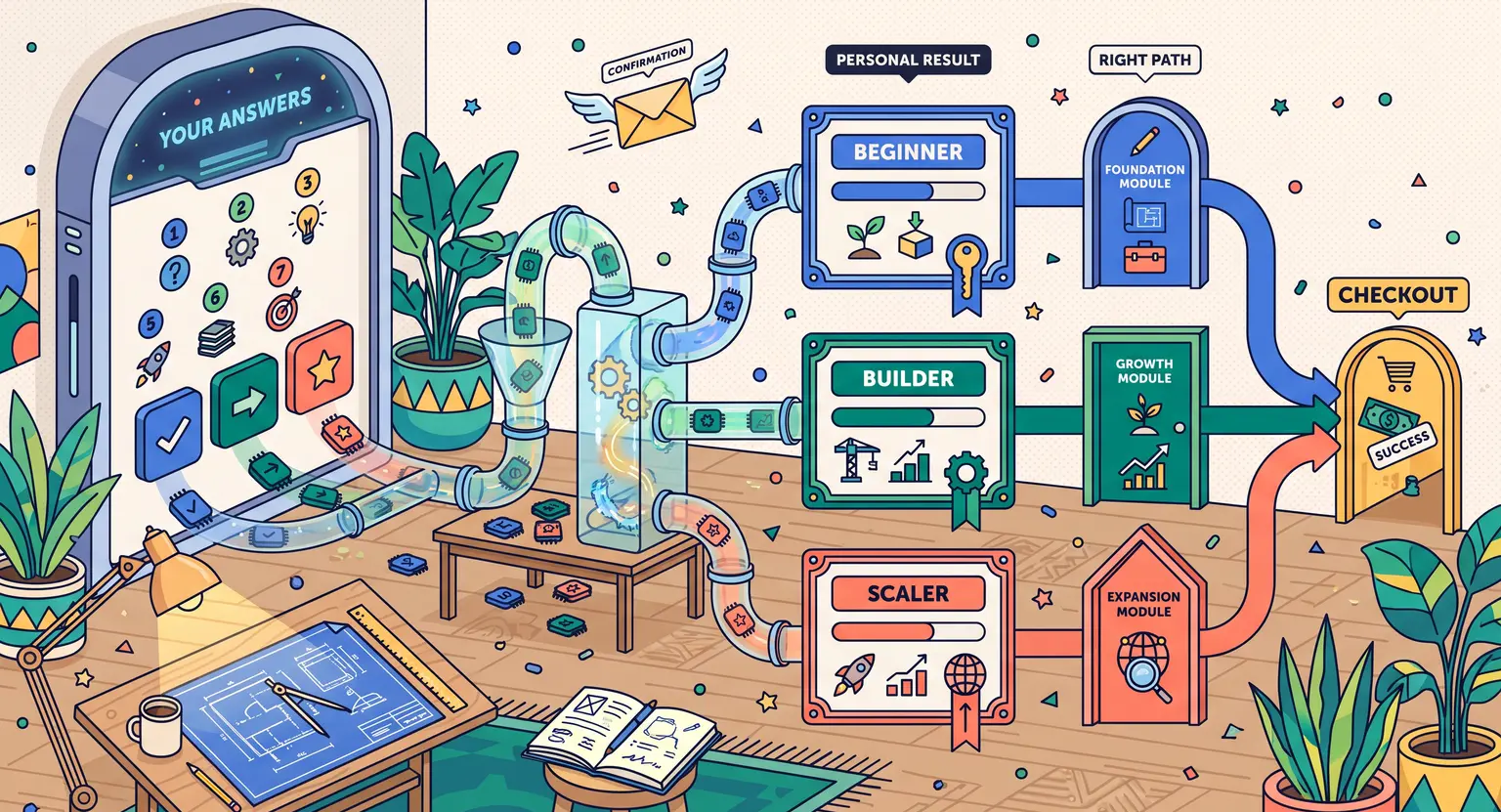
The Readiness or Stage Scorecard : identifies which phase of a journey the learner currently occupies (e.g., Beginner, Builder, Scaler).
Ideal for multi-tier courses or academy memberships where different stages need different curriculum tracks.
-
The Personalized Roadmap Generator : asks users about their goals, available time, and hurdles, then outputs a custom study schedule that features your course as the core engine.
Structuring Quiz Questions to Presell Your Course
A fatal mistake creators make is treating a sales quiz like an academic exam. Trivia questions test memory, but they do not build buying intent.
Your questions must serve two strategic masters : gathering diagnostic data and priming the student for your solution.
Keep your quiz lean. Aim for 7 to 8 questions total.
If you make it too short, visitors will question the accuracy of your results.
If you make it fifteen questions long, mobile drop-off will crush your completion rates.
Use question types strategically across three distinct phases :
-
Questions 1-2 (The Icebreakers) : low-friction questions that anyone can answer in one second. These build momentum and establish basic demographic context.
-
Questions 3-5 (The Problem Diagnosticians) : probing inquiries about specific frustrations, past failures, and daily bottlenecks. Answering these forces the prospect to acknowledge their current pain.
-
Questions 6-8 (The Future-Pacing Questions) : inquiries focusing on their target outcome, timeline, and preferred learning style. This gets the prospect imagining their post-transformation reality.
Every multiple-choice option should correspond to a specific tag in your marketing backend. This segmentation powers your personalized results and follow-up emails.
Crafting Results Pages That Turn Leads Into Buyers
The results page is where the sale happens.
Do not simply show a generic badge and say, "You are an Intermediate Writer! Sign up below." That throws away all the goodwill you just generated.
A high-converting outcome page functions as a personalized diagnostic report combined with a tailored sales presentation. It should follow a clear psychological flow :
-
Validate their outcome : give their result an empowering name. Celebrate what they are doing well so they feel understood and validated.
-
Explain the core bottleneck : explain clearly why their specific archetype gets stuck. Detail the hidden trap they are likely falling into right now.
-
Provide immediate actionable value : give them one quick tactical tip they can execute today. This builds immediate credibility and proves your authority.
-
Introduce the custom solution : present your online course as the tailored mechanism designed specifically to solve their archetype's roadblocks.
-
Highlight relevant modules : dynamically showcase the specific chapters or lessons inside your course that address the exact questions they answered.
-
Limited-time fast-action incentive : offer an exclusive discount or a relevant bonus pack tied to their quiz results, expiring within 48 to 72 hours.
Quiz Funnels vs. Traditional Lead Generation Funnels
To understand why interactive funnels perform so well, look at how the numbers and mechanics compare against standard lead magnets across key operational metrics.
| Funnel component | Standard PDF / cheat sheet | Interactive quiz funnel |
|---|---|---|
|
Average opt-in rate |
15% to 25% on standard landing pages. |
40% to 65% across cold and warm traffic. |
|
Audience segmentation |
Zero segmentation; all leads land in one generic bucket. |
Granular data tagging based on skill, budget, and goals. |
|
Initial sales page conversion |
1% to 2% conversion when using a lead generation funnel. |
3.5% to 7% conversion on personalized outcome pages. |
|
Entry-level offer fit |
Fixed, uncustomized tripwire funnel offers. |
Dynamic upsells matched to the user's identified skill level. |
|
Lead acquisition cost (CPA) |
Higher due to declining ad CTR on static lead magnets. |
Lower because interactive formats trigger higher ad engagement. |
|
Email follow-up relevance |
Generic broadcast sequence for everyone. |
Dynamic email sequences addressing specific quiz answers. |
Building the Segmented Email Nurture Sequence
Not every quiz taker will buy your course immediately on the results page... In fact, roughly 90% to 95% will review their diagnosis and close their browser tab.
The real revenue engine is what happens over the following six days in their inbox.
Because you tagged each user based on their quiz outcome, you do not have to write generic emails.
You can send an automated 4-part series crafted specifically for their archetype.
-
Email 1 (Immediate delivery) : deliver a summary of their diagnostic results, a direct link back to their custom results page, and a personal note explaining why their specific outcome is so common.
-
Email 2 (The deep-dive case study) : share a real story of a past student who had the exact same quiz outcome, struggled with the same bottleneck, and overcame it using your course curriculum.
-
Email 3 (Busting the core objection) : address the number one reason their specific archetype hesitates to invest (e.g., "I don't have enough time" or "I've tried similar courses before and failed").
-
Email 4 (The deadline reminder) : remind them that their custom quiz bundle or limited-time fast-action enrollment bonus expires at midnight. Emphasize the cost of staying stuck in their current stage.
Explore Further Course Creation & Funnel Resources
-
Learn how to price your core program effectively with our online course pricing strategy.
-
Discover in-course assessment design tips with our guide on how to create quizzes for online courses.
-
Plan your full marketing rollout step-by-step through our guide on how to launch an online course.
Frequently Asked Questions
How many questions should a course quiz funnel have?
The sweet spot for course sales quizzes sits between 6 and 9 questions.
Fewer than six questions often feels too superficial to provide meaningful personalization, while more than nine causes sharp completion drops on mobile devices.
You can read more about selecting opt-in formats in our breakdown of the best lead magnets for course creators.
Should I ask for an email before or after showing the quiz results?
Ask for the email address immediately after the final question and just before revealing the custom results breakdown.
This leverages the psychological principle of sunk cost and micro-commitments, yielding opt-in rates between 40% and 65%.
Can a quiz funnel work for high-ticket cohort courses?
Yes, absolutely.
For premium or cohort-based programs, the quiz acts as an interactive readiness assessment.
Instead of pushing an instant checkout, the outcome page invites qualified prospects to book a strategy call or join a priority waitlist based on their score.
What type of quiz converts best for online courses?
Diagnostic and skill-gap quizzes perform best because they expose the exact blind spot your course solves.
Personality quizzes work well for general interest niches, but diagnostic scorecards generate higher transaction intent when paired with an optimized email sequence for a course launch.



 How to Sell an Online Course Through a Sales Call (2026 Guide)
 How to Build an Online Course Business for Acquisition (2026 Guide)
 How to Create an Instructor Revenue-Sharing Model (2026)
 How to Build a Waitlist for an Online Course (2026 Guide)