







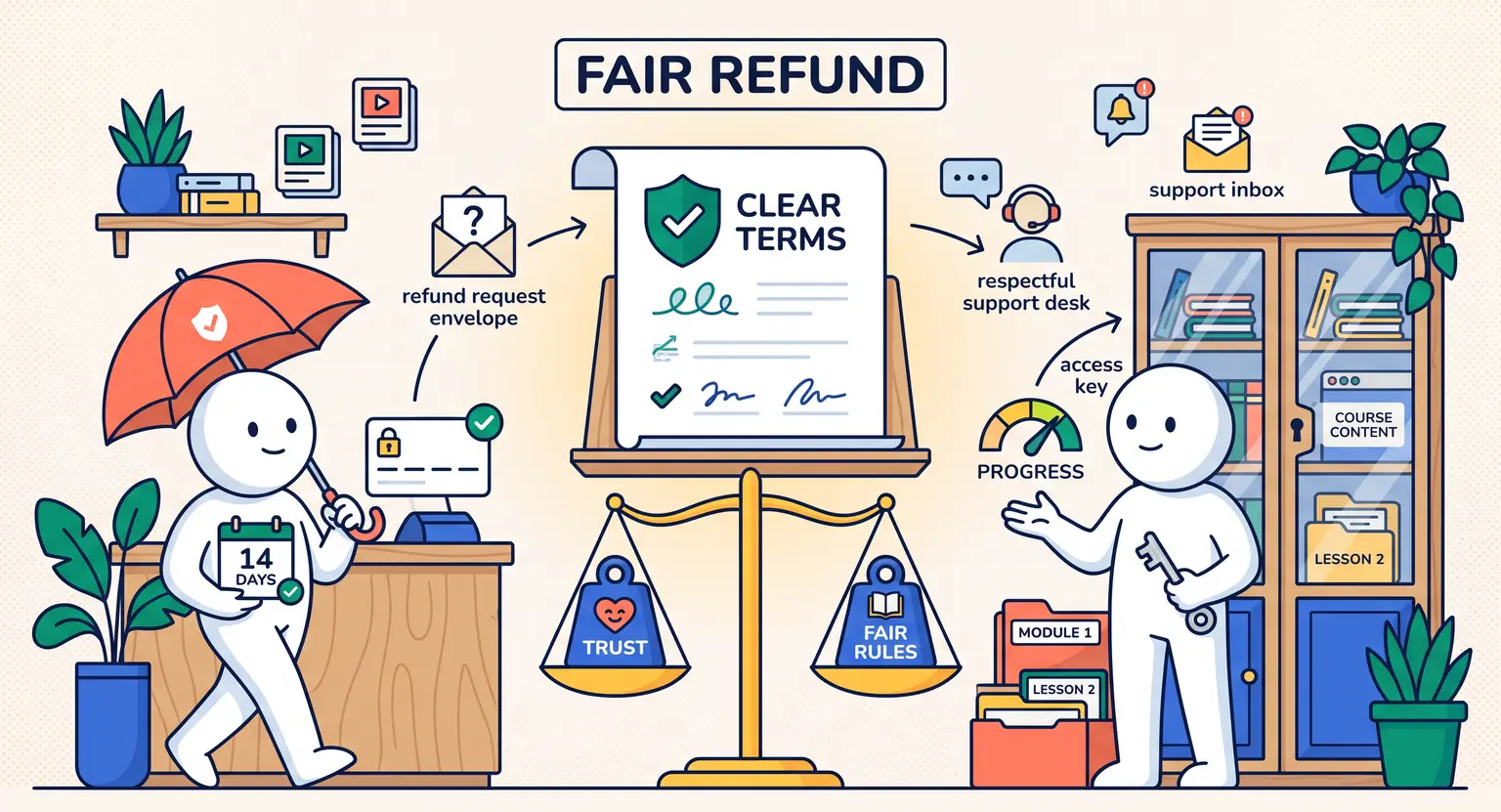
How to Create a Course Refund Policy (Templates & Best Practices for 2026)
How to Create a Course Refund Policy
Key Takeaways for Course Creators
-
A transparent refund guarantee actually lowers buyer friction and boosts checkout conversion rates.
-
Action-based refund terms protect high-ticket courses against serial refunders and digital content theft.
-
Pairing your refund rules with clear terms of sale helps prevent costly merchant chargeback disputes.
-
Drip feeding sensitive curriculum assets reduces abusive refund requests without hurting genuine student progress.
-
Displaying your policy prominently at checkout is mandatory for legal compliance and processor trust.
Every course creator remembers the sinking feeling of their first refund notification…
You spend hundreds of hours recording high-definition video modules, designing interactive exercises, and polishing workbooks, only for a student to demand their cash back forty-eight hours after checkout.
It stings. But when you run an online knowledge business, refund requests are not personal attacks. They are a routine operational metric.
And here is the strange truth : having a crystal-clear, generous refund policy will almost always make you significantly more money than having a rigid, defensive one.
When people hesitate before entering their credit card details, your guarantee acts as psychological insurance... It takes the risk off their shoulders and places it onto yours.
If you fail to define the rules of engagement beforehand, you open the door to credit card disputes, angry email threads, and bad reviews.
Let us walk through how to build a rock-solid, fair, and conversion-friendly course refund policy that protects your business while building immediate trust with your audience.
Why Your Course Refund Policy Is Secretly a Sales Asset
Most creators treat their refund policy as a legal shield designed exclusively to keep money inside their bank account. That mindset is backwards. Your refund policy is actually one of the most powerful conversion assets on your entire sales page.
Buying an online course requires a massive leap of faith... The buyer cannot touch the product, flip through physical pages, or guarantee that your teaching style matches their learning pace. They worry about getting burned by low-grade fluff.
So when you present a clear, fair guarantee, you eliminate the perceived risk of making a bad purchase. You remove buyer hesitation right at the critical moment of decision.
A well-crafted policy achieves three critical business outcomes :
-
It neutralizes purchase anxiety : hesitant prospects feel safe investing because they know they have a safety net if the material does not deliver on its promise.
-
It sets crystal-clear behavioral expectations : when students understand what qualifies for a return, they take their study commitments more seriously.
-
It protects your merchant processing accounts : processing systems like Stripe, PayPal, and LearnyPay secure payments heavily penalize accounts with high chargeback ratios. A clear policy keeps dispute rates near zero.
When you make your refund terms transparent, you project undeniable confidence in the value of your curriculum.
The 4 Primary Types of Online Course Refund Policies
There is no one-size-fits-all policy for every digital program.
A $27 self-study mini-course requires a completely different approach than a $3,000 cohort mastermind featuring weekly live coaching sessions. Choosing the right framework depends entirely on your delivery format, course tier, and operational capacity.
1. The "No Questions Asked" Time-Bound Guarantee (14 or 30 Days)
This is the golden standard for standard self-paced digital courses. You give the student a window - usually 14 or 30 days from the purchase date - to review the material.
If they decide it is not for them, they email your team and receive a full refund with zero interrogation.
Why does this model work so well? Because it offers maximum conversion lift - it shows total confidence in your material and gives buyers complete peace of mind.
The downside is that a small percentage of buyers will binge the entire curriculum, download your templates, and ask for a refund anyway. But for standard course prices under $500, the massive increase in overall sales almost always eclipses the small cost of opportunistic refunders.
2. The Action-Based (Conditional) Guarantee
An action-based policy is the premier choice for premium, outcome-focused masterminds and flagship courses priced between $500 and $2,500.
Under this model, students can only request a refund if they prove they actually did the required work.
To qualify for a refund, a student might be required to submit completed worksheets, provide proof of launching their campaign, or demonstrate attendance in coaching calls. You are not promising magic; you are promising a system that works if they execute it.
This structure filters out uncommitted buyers who expect overnight success without doing any heavy lifting. It shifts the burden of effort onto the learner while assuring them that you stand behind your educational methodology.
3. The Strict "All Sales Final" (No Refunds) Policy
With an all-sales-final policy, every transaction is non-refundable the second payment clears. You will see this model frequently used for digital asset downloads, source code libraries, low-cost tripwire products, and live cohort courses with limited seat caps.
While this approach eliminates refund processing time, it comes with distinct trade-offs. It suppresses baseline conversion rates on cold traffic because cautious buyers have zero fallback option.
If you choose an all-sales-final stance, your sales page copy must state the non-refundable terms in unmistakable, prominent text right above the purchase button. Otherwise, unhappy buyers will go straight to their bank and file unauthorized transaction disputes.
4. The Milestone or Progress-Capped Guarantee
A progress-capped refund policy blends time limits with learning management system data. Under this rule, a student can request a refund within 14 days, provided they have viewed less than 25% or 30% of the course lessons.
Modern e-learning platforms automatically track student progression percentages. If a user completes 90% of the lessons in two days and then asks for their money back, your support desk can point to the clear usage clause in your policy.
This framework provides a fantastic compromise : honest students get to sample the initial modules to evaluate production quality, while serial downloaders are blocked from exploiting full access.
Essential Clauses Every Course Policy Must Include
Drafting a policy does not require impenetrable legalese that puts your audience to sleep.
In fact, plain English is far better because it leaves zero room for misinterpretation - however, you must cover specific operational bases to stay protected.
Make sure your policy explicitly defines these core elements :
-
The exact time window : specify whether your 14 or 30 days starts from the exact minute of purchase or from the official cohort start date.
-
Eligibility and ineligibility rules : list specific actions that void the guarantee, such as excessive video consumption, downloading proprietary template packs, or missing homework deadlines.
-
The exact refund submission method : tell students precisely how to apply. Should they email a specific support address, open a ticket, or fill out a dedicated web form?
-
Processing and payout timelines : clarify that bank processing takes between 5 to 10 business days depending on their card issuer so they do not panic and file chargebacks.
-
Access revocation terms : state clearly that upon issuing a refund, the user's LMS account, community access, and license to use supplementary materials are immediately terminated.
-
Payment plan obligations : if you offer installment plans, state clearly that a refund cancellation stops future recurring billings, but failing to request an eligible refund does not excuse future scheduled installments.
Policy Comparison : Matching Your Model to Your Course
To help you decide which structure suits your current launch, review this side-by-side comparison of how different guarantee types perform across common delivery formats.
| Policy model | Best suited for | Conversion impact | Dispute risk | Admin overhead |
|---|---|---|---|---|
|
30-Day Unconditional |
Entry-level self-paced programs, low-ticket video courses. |
Very high (+15% to 25%). |
Extremely low. |
Low (fast automated refunds). |
|
Action-Based Conditional |
High-ticket flagship courses ($1,000+) and masterclasses. |
High (builds authority). |
Moderate (requires clear criteria). |
High (manual homework review). |
|
Progress-Capped (20-30%) |
Evergreen digital programs with rich downloadable assets. |
Moderate to high. |
Low. |
Low (LMS metric verification). |
|
Single Session / 7-Day |
Live cohorts, virtual workshops, bootcamp sessions. |
Moderate. |
Moderate. |
Low. |
|
Strict No-Refunds |
Digital templates, software presets, limited private coaching. |
Low to negative. |
High (chargeback exposure). |
Very low (unless disputed). |
When planning your overall launch mechanics, balancing this structure against your broader online course pricing strategy ensures that your profit margins remain durable regardless of seasonal refund fluctuations.
If you are experimenting with an early validation offer, learn how to handle terms when testing how to pre-sell an online course before building the full curriculum.
Step-by-Step : How to Write and Implement Your Policy
Ready to put pen to paper? Follow these practical steps to write and publish an effective course refund policy.
Step 1 : Write in Direct, Approachable Language
Avoid copying convoluted contracts from corporate enterprise software sites - speak to your students directly using conversational language. Explain the "why" behind your policy so they understand you are balancing fairness with business sustainability.
For instance, instead of writing :
"The Company shall under no circumstances remit disbursements post-fourteen days,"
write :
"We want you to feel 100% confident in your enrollment. Try the course for 14 days. If it's not the right fit, shoot us an email and we will refund your payment in full."
Step 2 : Place the Policy in Four Strategic Locations
Hiding your refund policy in a dark footer link will destroy your credibility during merchant disputes.
Display your policy transparently across these four critical touchpoints :
-
Your main sales page : feature a dedicated guarantee badge section highlighting the terms and reassuring nervous buyers.
-
The checkout page : place a short summary of the refund rules right next to the payment field, along with a mandatory checkbox confirming agreement.
-
Your terms of service page : maintain the comprehensive legal version of the policy on your official site terms document.
-
The onboarding welcome email : reiterate the refund timeline in your first transactional email so students feel respected from day one.
Step 3 : Establish a Friction-Free Support Workflow
When a refund request arrives, speed matters.
If a student sends a polite refund email and hears complete silence for four days, their immediate reaction is panic - they assume they were scammed, log into their banking app, and hit the chargeback button.
Set up an automated canned response acknowledging the refund inquiry within minutes. Process eligible requests inside your payment dashboard within 24 to 48 hours.
A clean, respectful exit leaves the door open for that customer to buy from you again in the future.
How to Deal with Serial Refund Abusers Without Burning Out
No matter how amazing your training is, you will occasionally encounter bad-faith actors who attempt to game your guarantee. Here is how seasoned creators safeguard their sanity and revenue :
First, use drip feeding on high-value digital files. Rather than dumping every editable Canva template, raw spreadsheet, or bonus video on day one, unlock them as the student progresses through the curriculum over several weeks.
Second, track dispute metrics ruthlessly. If you notice a sudden spike in return requests for a specific module, do not panic.
Treat that data as a diagnostic signal. It usually means an assignment was confusing, a video link broke, or an onboarding expectation was misaligned during your sales pitch.
Third, keep your customer service tone calm and professional. Never argue or insult a student asking for their money back within the allowed terms.
Honor your word swiftly, disable their platform credentials, and refocus your valuable energy on serving the students who love your work.
Explore Further Resources
-
Refine your trial cohorts with a beta version of an online course before your public rollout.
-
Scale your student acquisition channels by building a sales funnel that educates and converts.
-
Master step-by-step promotional execution with our guide on how to launch an online course smoothly.
Frequently Asked Questions
Can I legally offer no refunds on a digital course?
Yes, in most jurisdictions you can legally sell digital goods under an "All Sales Final" policy, provided this term is clearly disclosed before the purchase takes place.
However, your policy cannot override statutory consumer rights in regions like the European Union or United Kingdom unless you include an explicit waiver checkbox at checkout where the buyer agrees that accessing digital content waives their standard 14-day statutory withdrawal period.
Additionally, payment processors will still uphold chargeback claims if students prove your marketing claims were materially misleading.
How long should my online course refund window be?
For most self-paced online courses, a 14-day or 30-day window is the industry standard.
A 14-day guarantee provides enough time for serious buyers to inspect the material while preventing serial downloaders from consuming the entire curriculum.
Cohort-based courses often use a 7-day or single-session policy, while complex masterminds frequently enforce an action-based 30-day guarantee requiring submitted assignments.
What is an action-based refund guarantee and does it work?
An action-based guarantee requires students to prove they completed specific course modules, finished workbook assignments, and implemented the material before requesting a refund.
It works exceptionally well for high-ticket flagship programs because it filters out impulsive non-doers while demonstrating that your framework yields results when genuinely applied.
Make sure the submission requirements are clearly listed on your sales page and checkout terms to avoid merchant dispute penalties.
How do I prevent students from downloading everything and asking for their money back?
You can protect your digital assets by setting up drip content schedules, withholding downloadable templates until after the refund window expires, and tracking course progress percentages inside your learning management system.
Reviewing typical mistakes to avoid when creating online courses can also help you fix structural curriculum issues before they trigger returns.
At the end of the day, a generous, clear course refund policy is an expression of confidence in your own program.





 How to Run a Beta Version of an Online Course (2026 Guide)
 How to Create a Cohort-Based Online Course (2026 Guide)
 How to Sell an Online Course With a Quiz Funnel (2026 Guide)
 How to Sell an Online Course Through a Sales Call (2026 Guide)