







How to Design a Final Exam for an Online Course (2026 Guide)
How to Design a Final Exam for an Online Course
Most online course creators treat final exams like an afterthought. They spend months polishing video lessons, drafting downloadable worksheets, and fine-tuning sales funnels, only to throw together a twenty-question multiple-choice quiz on a Friday afternoon.
That approach does a massive disservice to your students. A weak test reduces weeks of learning to simple trivia recall. Worse, with today's generative AI tools, a basic multiple-choice quiz can be solved in roughly twelve seconds by pasting questions into a browser tab.
A well-designed final exam is not an obstacle course or a punishment. It is a celebration of what your students have accomplished. When designed with intention, your final assessment validates transformation, cements skill retention, and gives learners tangible proof of their new capabilities.
Key Takeaways for Effective Online Exam Design
-
Focus on application : test synthesis, problem-solving, and critical thinking instead of definitions.
-
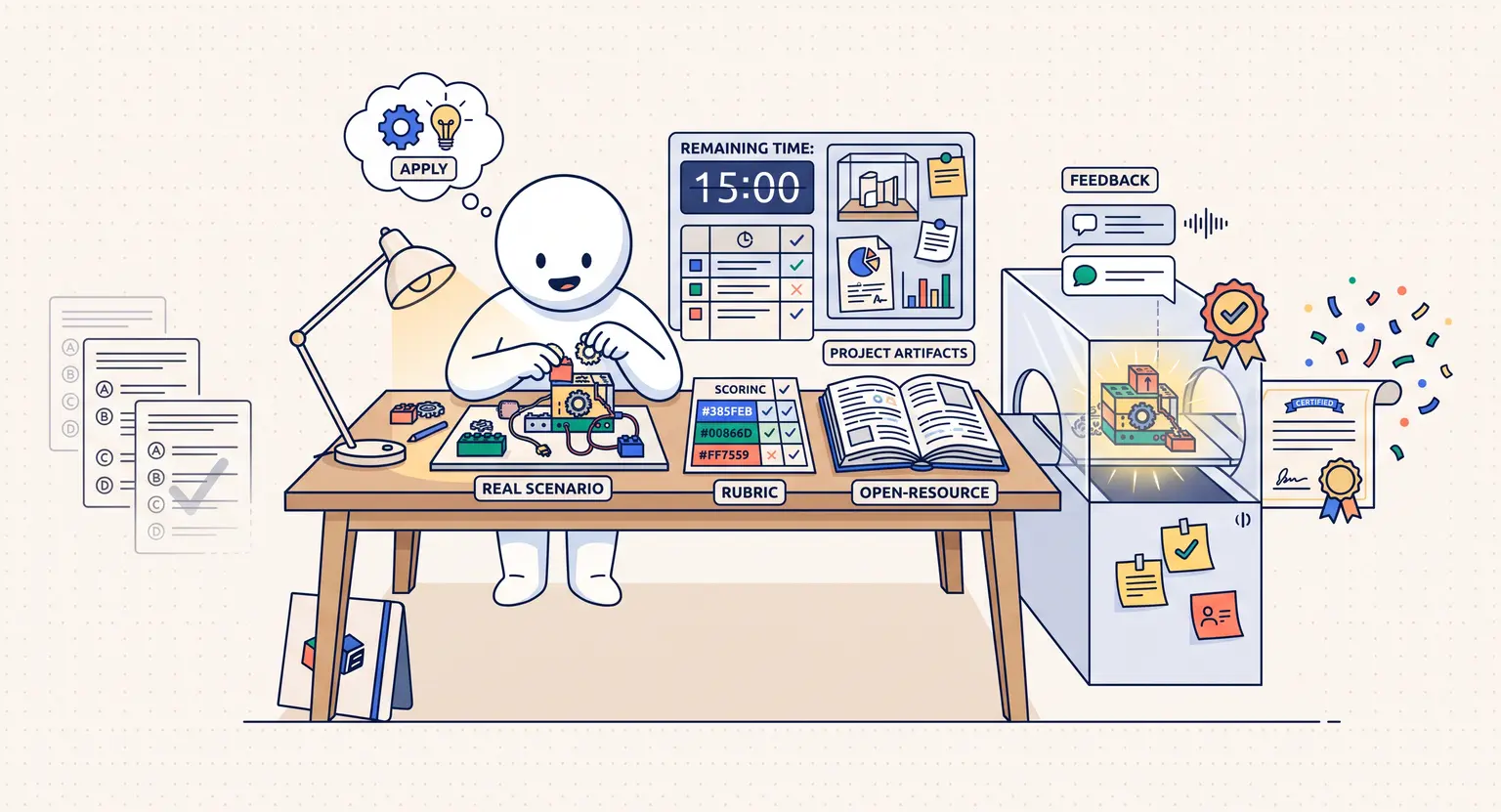
Embrace open-resource reality : build prompts assuming learners have full access to search engines and course notes.
-
Leverage modern infrastructure : build seamless testing environments on an integrated platform like the LearnyBox all-in-one ecosystem to automate certification upon passing.
-
Offer structured redemptions : allow timed retakes with randomized question banks to encourage mastery over anxiety.
Aligning Your Exam with Core Learning Outcomes
Before you write a single test prompt, pull up your course curriculum outline. Every single question or task on your final exam must trace directly back to a stated learning objective.
If you promised students that your course would teach them how to audit a paid ad campaign, do not quiz them on the history of online advertising platforms.
Ask them to analyze a simulated spreadsheet containing broken ad metrics, diagnose why the campaign is burning cash, and propose three immediate corrective actions.
Educators often refer to Bloom's Taxonomy when categorizing cognitive skills.
While introductory modules may touch on remembering and understanding, your final exam should operate firmly within the realms of applying, analyzing, and evaluating :
-
Remembering : "What does CAC stand for?" (Avoid on final exams.)
-
Understanding : "Why is customer retention important?" (Too generic for a capstone.)
-
Applying : "Calculate the CAC for this dataset and determine if the channel is viable." (Better.)
-
Evaluating & Creating : "Given this campaign performance breakdown, reallocate the quarterly budget to maximize profitability while cutting underperforming assets." (Ideal final assessment.)
When you force students to manipulate real information, you remove the temptation to cheat because simple search queries will not yield a straightforward answer.
Selecting the Ideal Assessment Format
Online courses vary wildly in format, length, and subject matter. A coding bootcamp demands a completely different evaluation strategy than a course on emotional intelligence or acoustic guitar fundamentals.
Choosing the wrong format leads to grading bottlenecks or disappointed students who feel their practical abilities were never truly evaluated. Let's look at the primary assessment structures you can deploy.
1. Authentic Scenario-Based Quizzes
If you have high student volume and need automated grading, scenario-based multiple-choice questions are your best friend. Instead of asking isolated factual questions, present a short vignette describing a realistic dilemma.
Provide four plausible responses where only one demonstrates best-practice execution.
2. The Capstone Project
Capstone projects require students to produce a comprehensive artifact.
For a copywriting course, this might be a full launch email sequence; for a web development course, a deployed web application.
Capstones provide students with portfolio-ready assets, creating immediate tangible value from their enrollment.
3. Case Study Breakdown
Provide a comprehensive case study of an organization, client, or situation facing multifaceted challenges.
Have students submit a written audit or short video walkthrough addressing root causes and outlining strategic remedies.
4. Live or Recorded Practical Demonstrations
In soft-skills, sales, or performance disciplines, recorded submissions work wonders.
Ask learners to record a three-minute video handling an aggressive customer objection or demonstrating a vocal warm-up routine, then submit the link for instructor or peer review.
Evaluating Exam Formats Against Operational Realities
Every assessment format comes with trade-offs between grading workload, student experience, and cheating vulnerability.
Selecting the right fit depends on your course price point and student volume.
| Exam format | Primary skill tested | Grading effort | AI / cheating resistance | Best course type |
|---|---|---|---|---|
|
Scenario-based quiz |
Judgment & application. |
Zero (100% automated). |
Moderate to high. |
High-volume self-paced programs. |
|
Capstone deliverable |
Synthesis & creation. |
High (manual review). |
Extremely high. |
Premium cohorts & certifications. |
|
Case study critique |
Analysis & diagnosis. |
Medium to high. |
High. |
Professional & business strategy. |
|
Peer-reviewed project |
Execution & evaluation. |
Low (distributed). |
High. |
Community-driven group courses. |
|
Video demonstration |
Communication & technique. |
Medium. |
Near immune to AI. |
Coaching, fitness & language. |
Writing AI-Resistant and Thought-Provoking Questions
You cannot stop students from opening another browser window - trying to lock down their devices with intrusive proctoring software often creates technical friction, triggers privacy concerns, and ruins the learning mood.
Instead of policing your students, make the exam naturally impervious to lazy shortcuts.
First, integrate personal reflection or project-specific data. If students are asked to apply your framework to their own personal website, their specific industry, or a custom dataset generated during module three, generic search tools become useless.
Second, use negative phrasing and diagnostic reasoning. Ask questions like : "Review this project pitch. Identify two fatal assumptions in the financial forecast and explain why Option B is riskier than Option C."
Third, present realistic constraints. Give students limited resources in the hypothetical prompt.
For instance, tell them they only have twenty hours of developer time and a four-hundred-dollar budget to fix a broken landing page - forcing decisions under pressure tests true competence.
Establishing Time Limits, Retakes, and Exam Availability
How much time should you give students to complete the test? Timing directly influences stress levels and performance quality.
For automated quizzes containing 30 to 40 scenario questions, 60 minutes is usually generous enough for prepared students while preventing people from researching every single answer.
Always add a 15% buffer to accommodate non-native language speakers or those with reading difficulties.
If you run time-sensitive cohorts or need to sync final tests with module schedules, ensure you understand how to set course access expiration dates so students have adequate time to prepare before losing their testing privileges.
What about retakes? Strict single-attempt exams often encourage cheating because the stakes feel paralyzingly high.
Allowing two or three attempts, with a mandatory 24-hour waiting period between tries, turns the exam into an educational event.
Use a randomized question pool so each retake serves up a fresh combination of prompts.
Crafting Transparent Scoring Rubrics
If your final assessment involves subjective grading - such as an essay, business plan, design mockup, or audio clip - you need an airtight rubric. Without one, grading feels arbitrary to students and exhausting for you.
A crystal-clear rubric breaks down the total score into four or five distinct criteria, each evaluated across specific performance levels :
-
Technical accuracy (30%) : did the student follow the methodology correctly without factual or structural errors?
-
Strategic justification (30%) : did they clearly explain the reasoning behind their choices?
-
Execution & polish (20%) : is the submission well-organized, readable, and professional?
-
Creativity & adaptability (20%) : did they adapt the baseline template to the unique challenges of the assigned problem?
Publish this rubric right inside the exam instructions before students start working. When expectations are completely transparent, student satisfaction skyrockets and grade disputes plummet.
Delivering Constructive and Timely Feedback
A final score of "84%" by itself tells a student almost nothing. It produces zero educational closure.
For automated quizzes, write comprehensive explanations for both correct and incorrect choices in your LMS question builder.
If a student chooses an incorrect option, the feedback screen should instantly explain why that specific choice fails in real-world scenarios and point them back to the exact video lesson that explains the concept.
For manually reviewed capstone submissions, provide a two-minute personalized audio or screen-recording note using tools like Loom.
Hearing your encouraging voice point out specific strengths alongside one or two areas for refinement makes learners feel seen, valued, and proud of finishing your course.
Setting Up the Technical Infrastructure for Success
Technical glitches during an exam cause immense frustration. A student whose browser crashes during question twenty-nine should not lose their entire progress.
Make sure your learning platform automatically saves student responses on every question transition. Clearly display a remaining time indicator on the screen, and provide an explicit review page before final submission so learners can double-check flagged answers.
Finally, connect your exam completion triggers to automated digital certificates and digital badges.
When a student crosses your designated passing threshold, celebrate their victory immediately with an automated congratulations email and an official downloadable certificate of completion.
Explore Further Resources
-
Master enrollment pacing with our guide on how to manage course enrollment deadlines effectively.
-
Segment your student experience by discovering how to create different access levels for online course students.
Frequently Asked Questions
How long should a final exam be for an online course?
For self-paced asynchronous courses, an exam taking between 45 and 90 minutes strikes the right balance between comprehensive coverage and cognitive fatigue.
Capstone projects or case study submissions should give students anywhere from three to seven days for thorough preparation.
Should I make my online final exam open-book?
Yes, designing an open-book exam is usually the smartest move for online education.
Because students have instant access to search engines and AI tools, building questions around synthesis, decision-making, and scenario analysis tests true mastery instead of simple recall.
How do I prevent students from sharing answers online?
Use large question pools where the platform pulls a random subset of questions for each student, randomize both question order and answer choices, and implement strict time constraints per question to minimize answer trading.
Can I automate the grading of complex written final assessments?
You can automate objective sections like scenario-based multiple selection questions, while using structured rubrics, peer evaluation systems, or customized assessment tiers to streamline manual evaluation for deep analytical responses.



 How to Create a Course Refund Policy (Templates & Best Practices for 2026)
 How to Run a Beta Version of an Online Course (2026 Guide)
 How to Create a Cohort-Based Online Course (2026 Guide)
 How to Sell an Online Course With a Quiz Funnel (2026 Guide)
 How to Sell an Online Course Through a Sales Call (2026 Guide)