








 French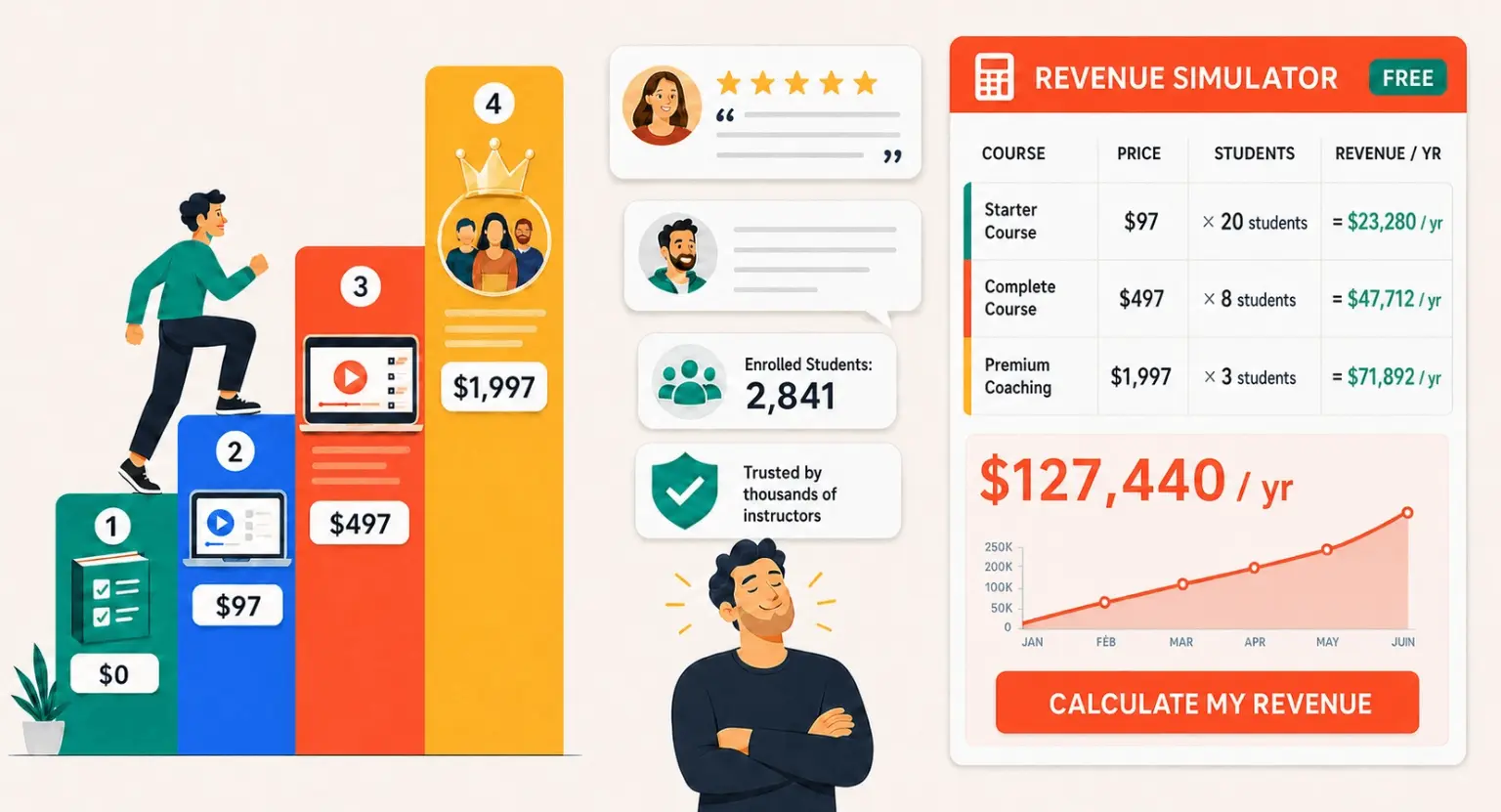
How to price your Online Course in 2026 ?
How to Price Your Online Course?
Key takeaways :
-
The price of your course should reflect the promised transformation, not the time spent creating the course.
-
Perceived value, ROI, problem urgency, and competition directly influence the acceptable price.
-
Your price is a marketing signal : pricing too low is as harmful as pricing too high.
-
A course revenue simulator is available at the end of this article to help you.
You have created an online course. Weeks of work, nights spent recording, rewriting, perfecting. And now, you find yourself facing an empty field on your sales page : the one where you need to enter a price.
And there, you're stuck.
Too expensive, no one buys. Too cheap, you're underselling your expertise - and paradoxically, you might sell even less...
So you look at what your competitors are doing, you get lost in forums, and you end up putting a random number, hoping it works.
Except that price is not a matter of chance... It's a strategic decision. And it relies on specific principles that most infopreneurs ignore when launching their online course.
In this article, you'll understand how to set the price of your online course methodically - not by copying your competitors, not by calculating your hours, but by starting from what really matters : the value you bring to your learners.
Find at the bottom of this article our simulator to estimate your annual course revenue based on your course pricing.
Why Your Course Price Has Nothing to Do with the Time You Put Into It
Here's the first mistake almost all course creators make : they calculate their price based on the time spent creating the content.
"I spent 4 months preparing everything, so it's worth at least 500 €."
It's human, logical... and completely off the mark.
Your Clients Don't Buy Content, They Buy a Transformation
When someone buys your online course, they're not paying for 12 hours of video or 47 modules.
They're paying for the result they hope to achieve at the end. The transformation. The difference between the "before" and the "after".
An online course that helps a freelancer land their first clients in 30 days is not worth the same as a course on calligraphy - even if both are exactly 8 hours of content.
It's not the volume that creates value : it's the urgency of the problem solved and the extent of the promised change.
Ask yourself this question : if your learner applies everything you teach, what is the concrete result in their life or business in 3 months?
If the answer is "they earn 2,000 € more per month", then your online course is worth much more than 97€ (for example).
The Trap of Time-Based Calculation
Setting the price of your online course based on the time you invested is adopting an employee's logic - not an entrepreneur's. You're not paid by the hour : you're paid for the value you create.
And let's be honest : an online course created in 3 weeks by someone who perfectly masters their subject can be much more effective than a course cobbled together over 6 months by someone still discovering their field...
Time spent is definitely not an indicator of quality, let alone perceived value.
The 4 Factors That Really Determine Your Online Course Price
If it's not time spent, then what? There are four levers that directly influence the price you can charge - and that your customers will be willing to pay.
Perceived Value and Your Brand Positioning
Perceived value is what your client believes your online course is worth before even taking it.
This perception is directly linked to your positioning : who you are, how you communicate, the quality of your free content.
A trainer who publishes pointed advice every week, who has solid testimonials, who takes care of their brand image can charge 497 € where an unknown person will struggle to sell at 97 €.
Same content / different price : Because the trust is not the same.
The Urgency and Pain of the Problem Solved
The more painful and urgent the problem you solve, the more people are willing to pay to make it disappear. It's as simple as that.
An online course on "how to stop procrastinating" addresses someone who may have been suffering from this flaw for years.
Another on "how to optimize your macros for competition" addresses someone who has a specific goal in a near deadline.
In both cases, the urgency is different - and so is the acceptable price.
The Concrete ROI Your Learner Can Expect
If your online course helps someone generate an additional 5,000 € per year, then 500 € price is an investment with a 10x return on investment in 12 months.
It's obvious to your client (provided you show them clearly).
This is where many trainers shoot themselves in the foot : they talk about their content, not the results.
Yet, ROI is the most powerful sales argument there is - and it's also what justifies a high price.
The Level of Competition in Your Niche
If your niche is saturated and 50 trainers offer exactly the same thing, you can't afford to ignore the market. Not to copy prices - but to understand the range your potential client is used to buying in.
Competition sets a reference frame in your buyer's mind. Your job is to position yourself in that frame by differentiating - not to extract yourself completely from it.
Price Ranges by Type of Online Course
Here's what most articles on the subject never give you : a concrete reference table, by product type - Because "it depends" is not a useful answer when you need to put a number on your sales page...
The Mini-Course or Entry Product (7 € to 97 €)
This is your lead product.
Short, targeted, ultra-actionable.
It solves a specific problem in 1 to 3 hours. Its role is not to make you rich - it's to turn a stranger into a customer, prove your value, and lead them to your more significant offers.
At this price level, volume is your friend.
Beware of psychological thresholds : going below 17 € sends a signal of low quality.
Between 27 € and 47 €, you're in the ideal zone for a serious entry product.
The Complete Course (97 € to 997 €)
This is your main offer. It covers a topic in depth, offers a structured learning path, and promises a significant transformation. The majority of B2C online courses fall within this range.
Below 97 €, you risk being perceived as "too basic". Beyond 997 €, you enter premium program territory - and your customers' expectations change radically.
The comfort zone for a well-positioned complete course is between 197 € and 497 €.
The Premium Program with Support (997 € to 5,000 €+)
Here, you're no longer just selling content. You're selling access to the source - you : individual coaching, group sessions, personalized follow-up, private community...
The high price is justified by proximity and guarantee of results.
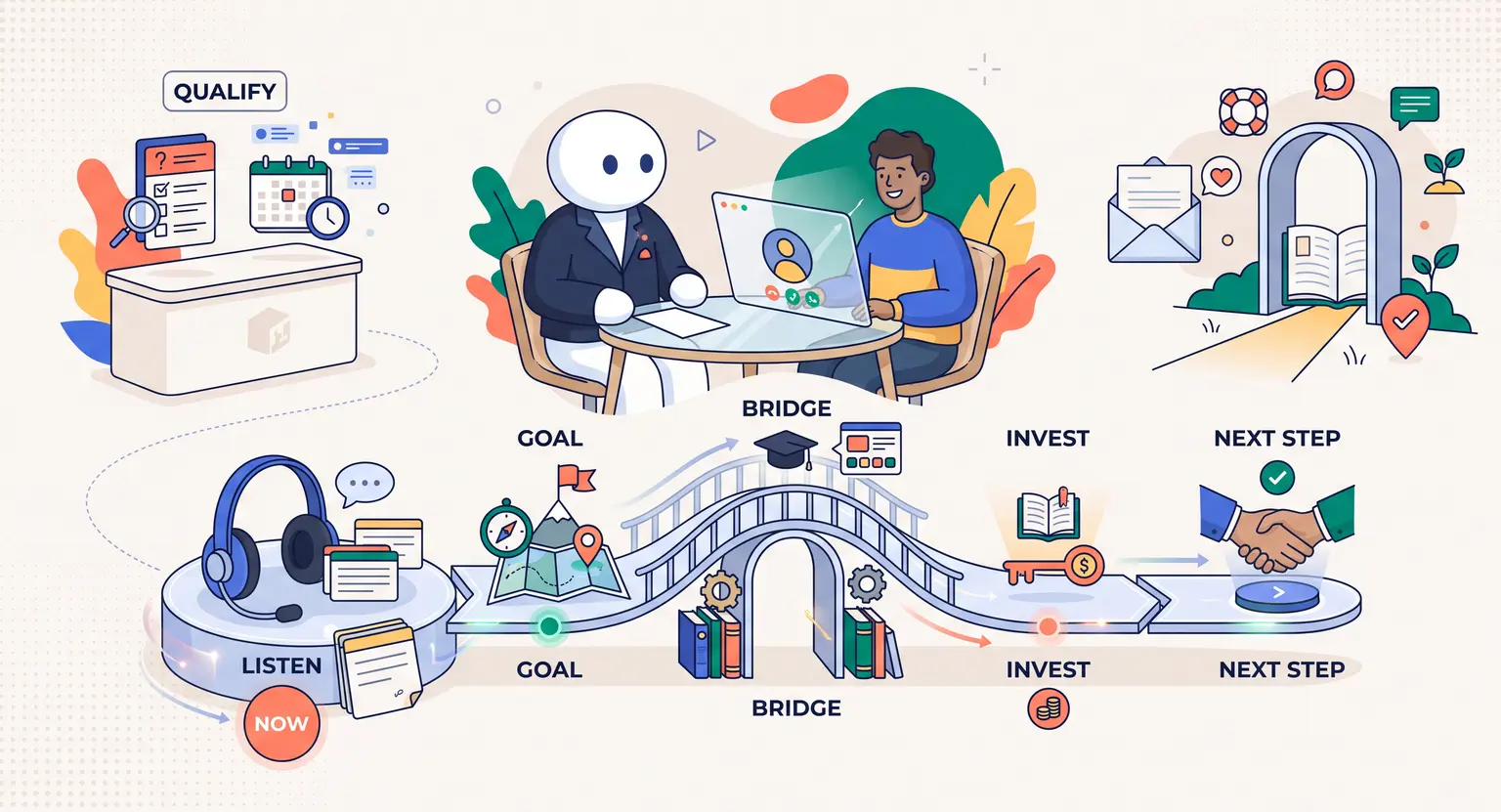
At this level, the sale is no longer made through a simple sales page - it goes through a discovery call, a value demonstration, a trust relationship established beforehand.
The Subscription or Membership (9 € to 97 €/month)
The recurring model is often underestimated by beginner infopreneurs. Yet, a membership at 27 €/month with 200 active members is 5,400 € in predictable monthly revenue - without launching a sales campaign every month.
The key to a successful membership : value must be renewed constantly (new courses, live sessions, active community...).
If you can't commit long-term, don't launch a subscription.
The Psychology of Price - What Your Rate Says About Your Online Course
Price is not just a number. It's a signal. And your customers interpret it before even reading your sales page.
The Veblen Effect - Why a Higher Price Can Sell More
The Veblen effect is the phenomenon whereby a high price increases the desire for a product, because it is perceived as a sign of superior quality.
In the world of online courses, this effect is real and documented.
An online course at 997 € inspires more confidence than a course at 97 € on the same subject - even if the content is identical.
Why? Because your customer thinks : "If it's this expensive, it must really work."
It's irrational yes... It's human.
Psychological Thresholds (97, 197, 297, 497, 997...)
Online course prices follow very specific thresholds in buyers' minds. These are not random numbers - they are perception thresholds.
-
97 € : accessible, serious entry product.
-
197 € : complete course, moderate commitment.
-
297-497 € : premium course, strong commitment.
-
997 € : transformational program, thoughtful purchase decision.
-
1,997 €+ : personalized support, sale by call.
Avoid "round" prices like 100 €, 200 € or 500 €. They sound arbitrary.
A price at 197 € seems to have been calculated - which unconsciously reassures your buyer.
Prices Ending in 7, 9 or 0 - What Studies Say
Consumer psychology studies show that prices ending in 9 generate on average 24% more sales compared to round prices - it's the "left-digit" effect.
The 7 is a convention inherited from American marketing of the 2000s, without proven advantage.
The 0 (e.g. 500 €, 1,000 €) is reserved for very premium offers where price precision would be perceived as a sign of weakness.
For a standard B2C online course : end with 7 or 9. Not with 0, unless you're selling above 2,000 €.
How to Calculate Your Launch Price
The launch price is not your final price. It's your validation price. And it follows a different logic.
The Launch Price Formula - Between 30 and 50% Below Your Target Price
Your launch price has two objectives : generate your first sales quickly, and collect testimonials that will justify your final price. It must therefore be attractive - but not cheap.
The empirical rule : launch between 30% and 50% below your target price.
If you're targeting 297 € in the long term, launch at 147 € or 197 €.
If you're targeting 497 €, launch at 247 €, and clearly communicate that it's a launch price, limited in time or number of spots - which creates legitimate urgency.
How Many Sales Do You Need to Validate Your Course?
Before moving to your final price, you need two things : sales - to prove the market exists, and testimonials - to prove it works.
A minimum of 10 to 20 sales at launch price is generally sufficient to validate an online course. Beyond that, you have enough feedback to improve the content and justify a price increase.
When and How to Increase Your Price After Launch
Raising your price is scary. And yet, it's one of the most profitable decisions you can make - provided you do it at the right time.
Signals that indicate you can raise : you have 5 solid testimonials, your conversion rate is above 2%, and you regularly receive questions like "is this still available?".
In that case, increase by 20 to 30%, announce it to your list, and observe. If sales continue, you've found your new floor.
Building Your Online Course Value Ladder : From Entry Product to Premium
One single price is one single sales opportunity. A well-built value ladder is three or four entry points into your universe - and as many chances to convert different profiles.
The Tripwire or Low-Price Lead Product
The tripwire (or lead product) is a very low-resistance offer - between 7 € and 47 € - whose sole purpose is to turn an email subscriber into a buyer... Because someone who has already pulled out their credit card once for you is infinitely more likely to do it a second time!
This product must be short, ultra-targeted, and deliver immediate value. A template, a mini-guide, a 90-minute workshop...
Not a complete online course - just enough for your customer to say "if the entry product is already this good, I can imagine what the complete course must be like."
The Main Offer - Your Core Course
This is where you make most of your revenue. Your main online course should be your best offer in terms of value/price ratio.
It must promise a complete transformation, be well structured, and include enough elements to justify its price - without being overloaded to the point of discouraging your learners.
Golden rule : your main offer should be the one you would recommend to 80% of your customers. If you're hesitating between two versions, you haven't found the right balance yet.
The Upsell or Premium Program to Go Further
Some of your customers will want to go further. Faster. With you. You're creating your premium offer for them - individual coaching, access to a private community, live Q&A sessions, personalized follow-up.
This offer doesn't need to be sold to everyone. It's aimed at the 10 to 20% of your most motivated customers. And often, this offer will represent 50% of your total revenue - with only 10% of your customers.
The 5 Costly Mistakes Online Course Creators Make
Let's be clear : almost everyone makes these mistakes at least once. The goal here is that you don't make them twice.
Mistake 1 - Setting a Price Too Low for Fear of Not Selling
This is mistake number one. And it's counterproductive in two ways.
First, a low price decreases the perceived value of your online course - your customer wonders why it's so cheap, and doubts the quality.
Then, a low price forces you to sell much more to reach your revenue goals, which exhausts your marketing resources.
A concrete example : if you're targeting 3,000 € in monthly revenue, you need 300 sales at 10 €, 60 sales at 50 €, or 10 sales at 300 €.
Which of these three options seems most realistic and least exhausting?
Mistake 2 - Copying a Competitor's Price Without Knowing Their Positioning
Looking at competition is useful. Copying their prices is dangerous. Because you don't know their audience, reputation, costs, or overall strategy.
A competitor selling their online course at 97 € may have an audience of 50,000 subscribers and a 5% conversion rate.
You, with 500 subscribers and an equivalent course, need a different positioning - not an identical price.
Mistake 3 - Offering Too Many Price Options (Choice Paralysis)
Three offers is the maximum. Beyond that, you create confusion and slow down the purchase decision.
The paradox of choice is well documented : the more options you give, the less people choose.
Two or three well-differentiated formulas are enough - and even then, make sure one of them clearly stands out as "the best option".
Mistake 4 - Never Raising Your Price Despite Testimonials and Demand
You have 30 enthusiastic testimonials, your online course is selling well, and your price hasn't moved in 18 months.
That's money left on the table. Each solid testimonial is social proof that justifies a price increase. Use them.
Mistake 5 - Slashing Prices During Promotions Without Strategy
Promotions can be a powerful tool - provided they're used sparingly and intentionally.
A 50% discount every month sends a clear signal to your audience : "wait for the promo, it's not worth full price."
Result : your sales at normal price collapse, and you become dependent on promotions to sell.
If you do promotions, limit them to two or three times a year, with a clear reason (anniversary, launch, Black Friday), and a short duration (48 to 72 hours maximum).
How to Test and Optimize Your Price Over Time
The right price isn't found on the first try. It's calibrated. And data is your best ally.
Signals That Indicate Your Price Is Too Low
-
Your conversion rate is above 5% on your sales page.
-
Your customers never negotiate.
-
You receive comments like "it's really cheap for everything you give."
-
Your premium customers tell you they would have paid more.
If you check two of these boxes, increase your price by 20 to 30% at your next launch.
Signals That Indicate Your Price Is Too High
-
Your conversion rate is below 0.5% on your sales page.
-
You receive frequent discount requests.
-
People visit your page multiple times without buying.
-
Your prospects systematically ask "do you offer payment plans?"
In this case, two options : either you slightly lower your price, or - and this is often the best solution - you work on your sales page to better justify the value.
The 10% Method - Gradually Increasing Without Losing Customers
Want to raise your price but afraid of losing sales? Apply the 10% method : increase by 10% at each new launch or renewal of your sales page.
If your sales hold, increase again. If they drop by more than 30%, return to the previous price.
This progressive approach allows you to find your optimal price without ever taking a brutal risk - and it forces you to stay attentive to your sales data, which is a good habit anyway.
Setting the price of your online course is not an exact science. But it's not a matter of gut feeling or chance either...
It's a strategic decision based on four pillars :
-
the transformational value you bring,
-
your buyer's psychology,
-
your market positioning,
-
your ability to test and adjust over time.
Start with a solid launch price - neither cheap, nor intimidating. Collect your first testimonials.
And then gradually increase, relying on data, and build your value ladder so that each buyer profile finds an entry point into your universe.
The right price is the one that honestly reflects the transformation you promise - and that your customer is willing to pay because they understand what they'll get in return.
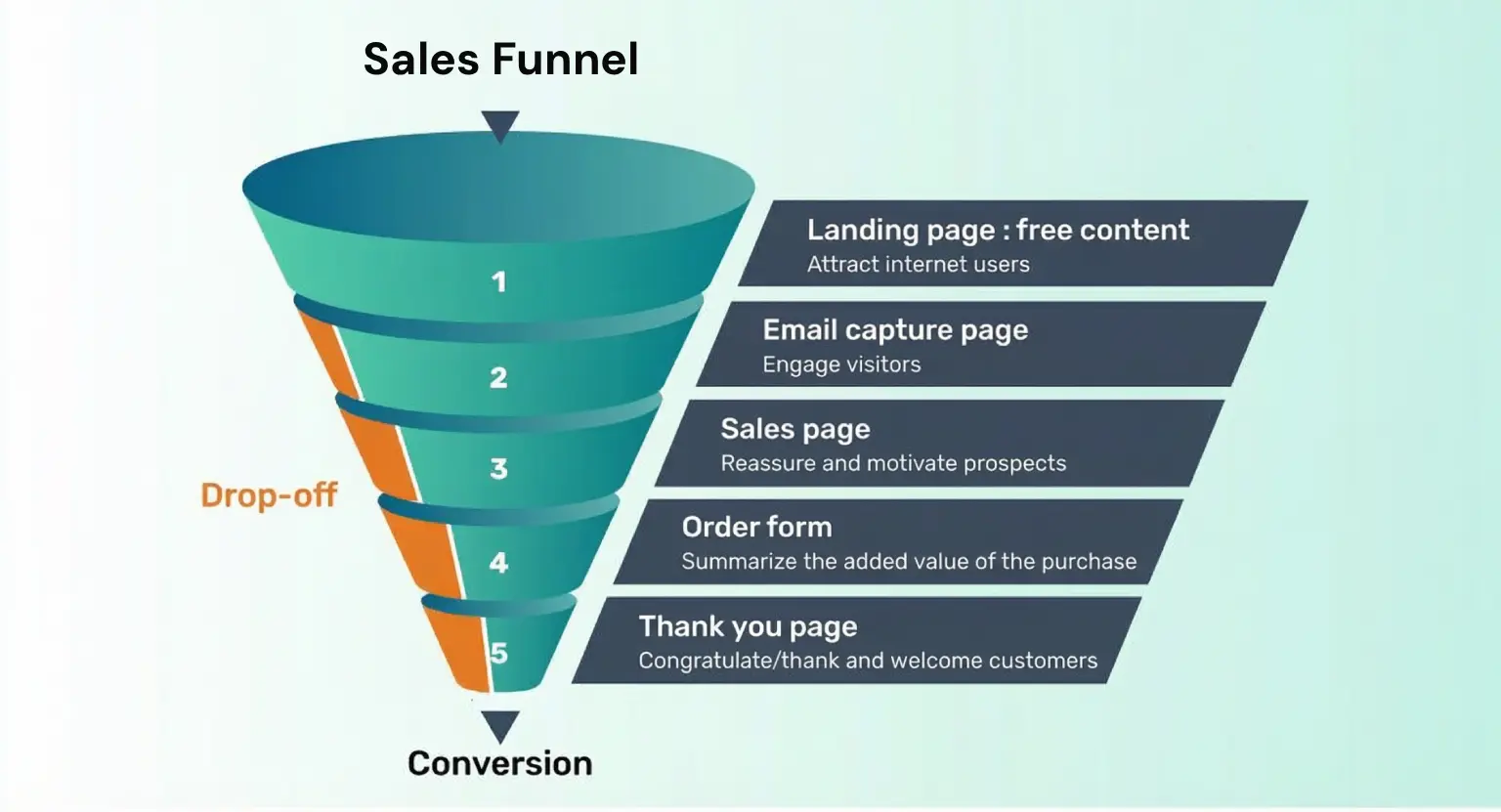
To go further, discover how much an infopreneur earns, and how to create a sales funnel that converts.
Simulate Your Online Course Revenue
You now know how to define a consistent price for your course. But how much could you really earn?
Play with the simulator below and estimate your business revenue potential over a year.
Revenue Simulator
Estimate your revenue based on your offer scale
Annual revenue breakdown
Ready to start your Creator's journey ?
✨ Get started on Learnybox for free ✨
FAQ - How to Price an Online Course
What is the minimum price for an online course ?
There is no legal minimum price, but below $17, your online course risks being perceived as a simple PDF or mini-guide - not as a serious course.
For a complete online course with a real transformation promise, the reasonable floor is around $97.
Below that, you'll need to sell large volumes to reach your revenue goals, which is exhausting long-term.
Should you offer discounts or promotions ?
Yes, but strategically. Promotions are effective for creating urgency during a launch or special event (Black Friday, anniversary).
However, if you constantly discount, you devalue your online course and train your audience never to pay full price.
Limit yourself to two or three promotions per year, with a short duration and a clear reason.
How do you justify a high price when starting out ?
By being transparent about your journey and highlighting the results of your first clients - even if they are few.
A solid testimonial from someone who achieved a concrete result thanks to your method is worth more than ten generic reviews.
If you don't have clients yet, offer your online course to a small test group at a reduced price, in exchange for detailed testimonials.
Can you sell an online course for free to gain visibility?
A free online course can be an excellent lead generation tool - provided it's short (less than an hour), very targeted, and naturally leads to a paid offer.
However, giving free access to your main online course is rarely a good idea : it devalues your expertise and attracts uncommitted learners who generally don't complete the content.
What's the difference between a launch price and a final price?
The launch price is a temporary rate, offered during your first sales to validate your online course and collect testimonials.
It is generally 30 to 50% lower than your target price. The final price is what you apply once the course is validated, testimonials are collected, and your positioning is stabilized.
It's important to communicate clearly about this distinction to your first buyers.
Should you display your price on your sales page?
Yes, in the vast majority of cases. Hiding your price creates distrust and increases abandonment rate.
The only exception : very premium offers (above $3,000) sold through discovery calls, where price is discussed in context after establishing value.
For all other online courses, display your price clearly, accompanied by value justification (expected results, testimonials, guarantee).





 How to Create a Course Refund Policy (Templates & Best Practices for 2026)
 How to Run a Beta Version of an Online Course (2026 Guide)
 How to Create a Cohort-Based Online Course (2026 Guide)
 How to Sell an Online Course With a Quiz Funnel (2026 Guide)
 How to Sell an Online Course Through a Sales Call (2026 Guide)