







Tax Deductions for Online Course Creators (2026 Guide)
Tax Deductions for Online Course Creators
Every dollar you generate selling educational content is exciting. But when tax season rolls around, self-employment tax and income brackets can take a massive bite out of your profits if you are not prepared.
Most course creators overpay their taxes simply because they fail to track ordinary, necessary expenses. If an expense helps you plan, film, host, market, or manage your digital curriculum, the IRS and local tax authorities generally allow you to deduct it from your gross revenue.
Lowering your taxable income is not about finding shady loopholes. It is about understanding tax codes designed to encourage business reinvestment and knowing exactly what you are entitled to claim.
Key Takeaways for Course Creators
-
Track every digital tool and subscription you use to sell online courses efficiently.
-
Hardware and studio gear can often be written off entirely in year one under Section 179.
-
Home office deductions require regular and exclusive business use of that specific square footage.
-
Ad spend, contractor payments, and affiliate payouts directly offset your gross earnings.
-
Review your margins and see how to manage cash flow when selling online courses to keep your quarterly estimates on track.
1. Home Studio and Dedicated Office Space
If you record modules, host live student Q&As, or edit videos from home, you might qualify for the home office deduction. This write-off remains one of the most misunderstood areas in creator taxes.
The golden rule is straightforward : the space must be used regularly and exclusively for your business. A dedicated corner desk or spare room converted into a recording studio qualifies without issue. A dining room table where your family eats dinner does not.
You have two ways to calculate this deduction :
-
Simplified option : multiply the square footage of your dedicated workspace (up to 300 square feet) by the standard IRS rate of $5 per square foot. That yields a clean maximum deduction of $1,500 without complex math.
-
Actual expense method : calculate the percentage of your home's total square footage dedicated to your workspace. Apply that percentage to your rent or mortgage interest, property taxes, homeowners insurance, utilities, and general maintenance.
For creators paying high rent or utilities in major metropolitan areas, the actual expense method often delivers a substantially higher deduction.
2. Hardware, Cameras, and Recording Equipment
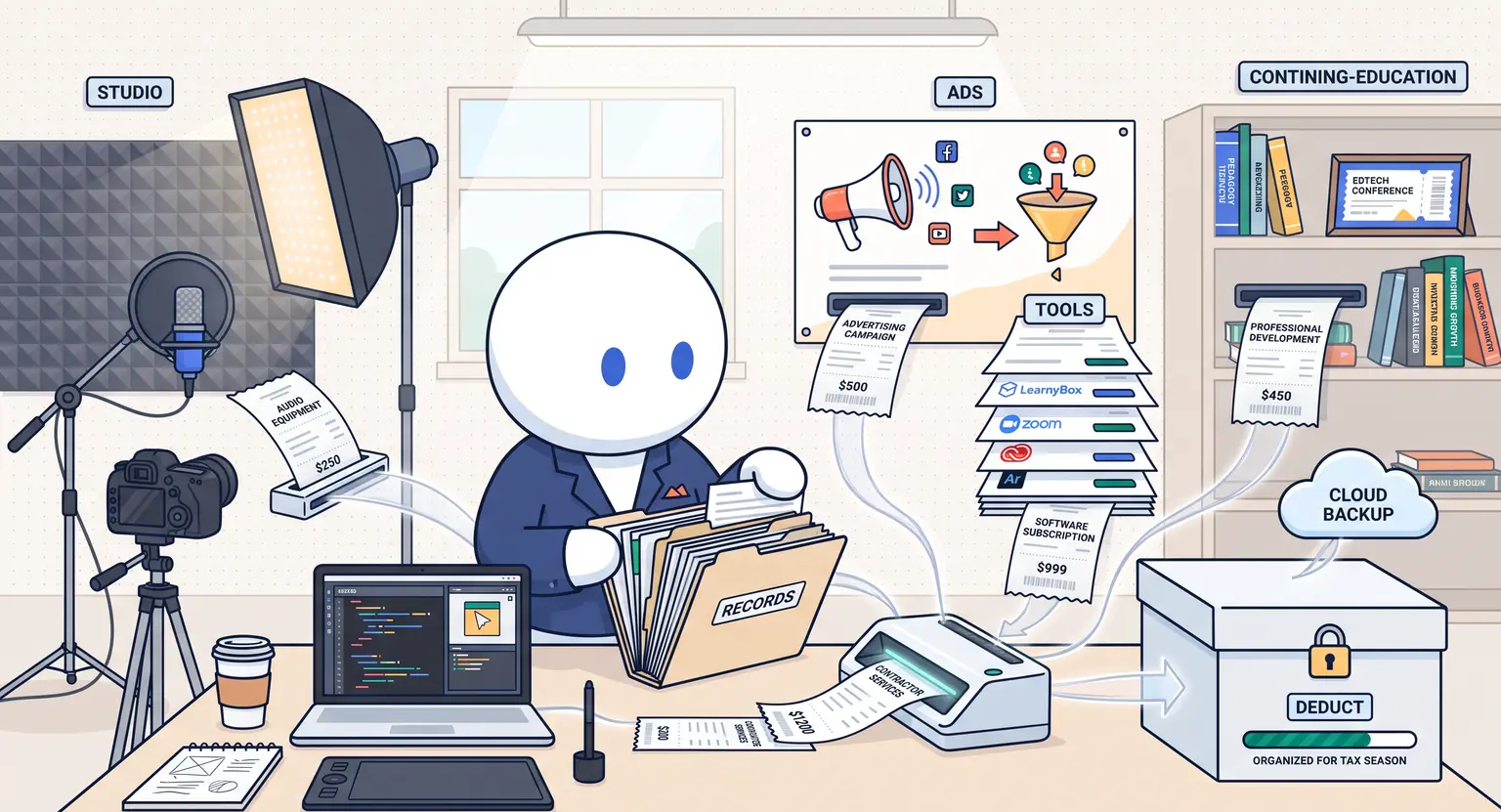
High-production courses demand quality gear. Microphones, ring lights, 4K cameras, teleprompters, acoustic wall panels, and high-performance computers all qualify as legitimate business assets.
Under current tax provisions like Section 179 expensing and bonus depreciation rules, you do not need to spread out the tax benefit of expensive cameras over five to seven years. You can write off up to 100% of the purchase price in the exact tax year you placed the equipment into service.
Be honest about mixed-use assets. If you buy a $3,000 laptop and use it 80% for course creation and 20% for personal entertainment, you can only write off $2,400 of the cost. Keep a quick log of your business equipment purchases to ensure your records hold up under scrutiny.
3. Software, Web Hosting, and Tech Stack Costs
Digital educators run on software. Nearly every monthly or annual software subscription you maintain to create content, deliver modules, and manage students is 100% tax deductible as an operational expense.
Common software write-offs include :
-
Course hosting and learning management systems.
-
Video editing software, screen recorders, and audio engineering suites.
-
Cloud storage backups for raw video footage and project files.
-
AI copywriting, graphic design, and slide presentation software.
-
Project management, password vaults, and customer relationship tools.
Keep invoices for all recurring SaaS subscriptions organized in an email folder or accounting software so you never miss recurring annual renewals.
4. Marketing, Paid Ads, and Promotion Costs
Getting your curriculum in front of students requires steady outreach. Every marketing dollar you spend to build your audience, generate leads, and drive enrollments is fully deductible against your gross revenue.
Paid traffic is often a creator's largest variable line item. Ad spend on search engines, social media channels, and sponsored newsletters qualifies as a direct business expense. Keep monthly ad receipts clearly categorized so your bookkeeper can separate creative testing from direct conversion campaigns.
Do not forget promotional assets. If you hire a freelance copywriter to craft high-converting sales emails or work with a graphic designer for custom thumbnails, their invoices are ordinary business write-offs. Similarly, transaction fees associated with referral programs and affiliate partner payouts reduce your taxable revenue directly.
5. Professional Services, Legal, and Financial Fees
Running a professional education brand requires expert guidance and reliable transaction infrastructure. Many creators forget that third-party service fees count as direct write-offs.
Deductible professional expenses include :
-
CPA, bookkeeping, and tax preparation fees.
-
Legal fees for drafting your terms of sale, privacy policy, and trademark filings.
-
Business bank account maintenance fees and wire transfer charges.
-
Merchant processing and transaction fees deducted directly from customer payments.
-
Virtual assistant and video editing contractor invoices.
If you pay any US-based independent contractor $600 or more in a calendar year, remember to collect a W-9 form upfront and issue a 1099-NEC before the January deadline.
6. Continuing Education, Research, and Industry Events
To teach cutting-edge skills, you must keep your own knowledge sharp. The tax code allows you to deduct costs associated with maintaining or improving skills required in your current business.
You can write off :
-
Industry books, audiobooks, and specialized research reports.
-
Competitor courses and online masterclasses purchased for market research or skill upgrading.
-
Tickets to industry conferences, workshops, and educational summits.
-
Mastermind group memberships and professional networking community dues.
When attending in-person conferences, you can also deduct associated travel expenses like airfare, lodging, and local transit. Business meals consumed during travel or with prospective partners are generally deductible at 50% under standard tax rules.
| Expense category | What qualifies | What does not | Required record |
|---|---|---|---|
|
Home office |
Exclusive studio room or dedicated recording space. |
Shared living room or kitchen table workspaces. |
Floor plan dimensions and utility bills. |
|
Production gear |
Cameras, microphones, lighting, studio computers. |
Personal gaming consoles or family tablets. |
Itemized receipts and date put in service. |
|
SaaS & platforms |
Hosting suites, video editors, email marketing tools. |
Personal entertainment or music subscriptions. |
Monthly recurring digital invoices. |
|
Professional education |
Industry workshops, coaching, skill-specific courses. |
Courses qualifying you for an unrelated new career. |
Receipt and syllabus showing relevance. |
|
Paid promotion |
Social ads, search campaigns, sponsored content. |
Personal account boosts without business intent. |
Ad platform statements and billing logs. |
Common Overlooked Deductions and Costly Traps
Beyond the obvious tech and marketing line items, several everyday expenses slip through the cracks for online instructors.
Your cell phone and home internet connections represent consistent monthly write-offs. Determine the proportion of time you spend conducting business calls, responding to student community messages, and uploading video lessons. Apply that percentage to your monthly invoices.
If you operate as a sole proprietor or single-member LLC and turn a profit, you may also qualify for the self-employed health insurance deduction. This allows you to deduct 100% of your health, dental, and qualified long-term care insurance premiums directly on Form 1040, provided you are not eligible for a plan through a spouse's employer.
Watch out for red flags that trigger audits :
-
Writing off 100% of a vehicle when you use it for personal errands and groceries.
-
Claiming round-number estimates for travel and meals rather than precise receipt totals.
-
Classifying personal clothing as "on-camera wardrobe" when the clothing is suitable for everyday wear.
-
Failing to report small sales spikes or secondary revenue streams like digital downloads and affiliate commissions.
Bulletproof Recordkeeping Habits for 2026
A deduction is only as strong as the documentation backing it up. If an auditor asks for proof three years from now, a credit card statement showing a vendor name is often insufficient; they want the itemized invoice detailing what was purchased.
Open a dedicated business checking account and credit card immediately. Funneling all course sales into one account and paying every business expense from the same card eliminates hours of messy reconciliation work at year-end.
Use modern cloud accounting software to sync your bank feeds daily. Snap photos of paper receipts from business meals or travel and attach them directly to the corresponding transactions. Setting aside 30 minutes on the last Friday of every month to categorize expenses keeps your books clean and stress levels low.
Explore Further Resources
-
Check the best equipment for recording online courses to plan your deductible hardware upgrades.
-
Compare the best online course platforms to streamline your software overhead.
-
Learn how to build a sales funnel and structure your deductible marketing campaigns.
-
Master email marketing for course creators to grow your student base predictably.
-
Read our guide on how to calculate the break-even point for an online course to protect your net profit.
-
Scale paid traffic profitably with our breakdown of paid ads for online courses.
-
Explore ways on how to make money with online courses while keeping tax burdens manageable.
-
Set up an affiliate army by learning how to start an affiliate program today.
-
Review your launch steps with our comprehensive course creation checklist.
-
Protect student transactions using LearnyPay secure payments.
Frequently Asked Questions
Can I deduct the cost of courses I buy from other educators?
Yes. If the course directly improves skills related to your current business operations, curriculum development, marketing, or technical production, it is fully deductible as continuing professional education.
What is the difference between writing off gear versus depreciating it?
Under Section 179 and bonus depreciation guidelines, you can generally deduct the full cost of qualifying gear like cameras and computers in the year of purchase rather than spreading deductions across multiple tax years.
Can I write off my home internet and cell phone bill?
You can deduct the business-use percentage of both. If you use your home internet 60% for your online course business and 40% for personal streaming, you can write off 60% of the annual bill.
Are payment gateway processing fees tax deductible?
Yes. Merchant processing fees, chargeback costs, and transaction charges from payment gateways are ordinary business operating expenses that reduce your overall taxable revenue dollar for dollar.









 How to Create a Course Refund Policy (Templates & Best Practices for 2026)
 How to Run a Beta Version of an Online Course (2026 Guide)
 How to Create a Cohort-Based Online Course (2026 Guide)
 How to Sell an Online Course With a Quiz Funnel (2026 Guide)
 How to Sell an Online Course Through a Sales Call (2026 Guide)