







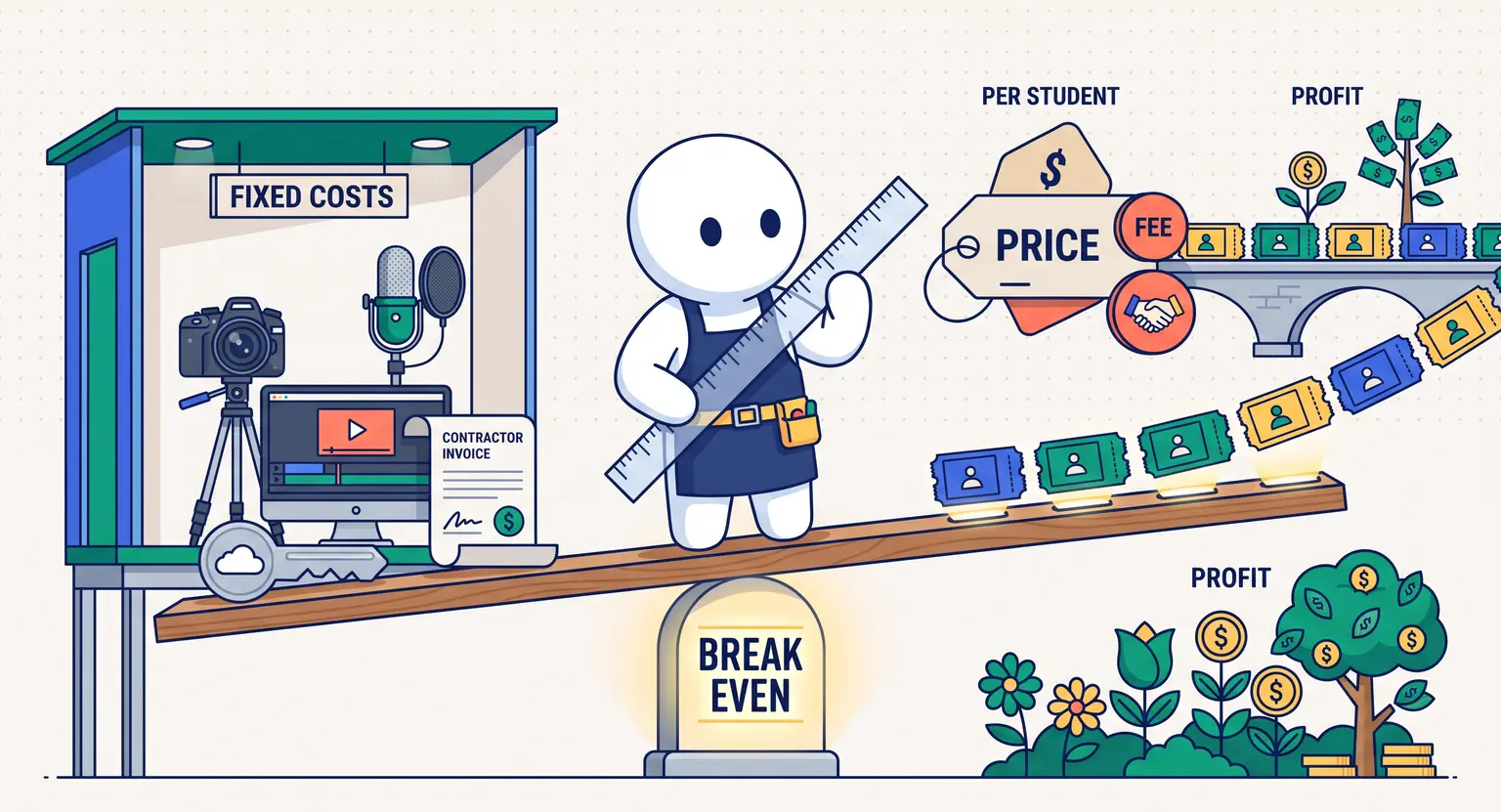
How to Calculate the Break-Even Point for an Online Course
How to Calculate the Break-Even Point for an Online Course
There is a persistent myth floating around the creator economy : digital products carry zero overhead. You record a series of videos, slap them behind a checkout page, and everything that lands in your Stripe account is pure profit. Sounds dreamy. But anyone who has actually built a digital education business knows reality looks a little different.
You pay for editing software. You buy lighting gear. You invest in web hosting, payment gateways, and design templates. And if you run ads or reward affiliate partners, every single sale costs money before it brings money in.
If you do not know your exact financial baseline, you are flying blind. You might celebrate hitting fifty students while quietly bleeding cash on tech subscriptions and customer acquisition costs. Let's fix that right now.
Key Takeaways
-
Break-even metric : it shows the precise enrollment threshold where your total revenue equals all production, marketing, and operational expenses.
-
Two cost buckets : fixed setup costs (microphones, editing, platform fees) stay flat, while variable costs (merchant cuts, affiliate payouts) scale per student.
-
The core equation : divide your total fixed overhead by your contribution margin per student to reveal your required sales volume.
-
Strategic advantage : running these figures before you build keeps you from underpricing and helps you protect your cash flow during early rollout phases.
Step 1 : Separate Your Fixed Costs from Variable Costs
To run an accurate break-even analysis, you must categorize every penny you spend into two distinct buckets : fixed overhead and variable unit costs.
Fixed costs remain static regardless of whether you enroll one student or one thousand students. You pay these expenses upfront or on a regular billing cycle whether anybody buys your program or not.
Variable costs, on the other hand, kick in only when a sale actually happens. Every new student adds a small layer of expense to your ledger.
Your fixed course expenses
These are your sunk creation and operational investments :
-
Studio & hardware : USB microphone, 4K webcam or mirrorless camera, ring light, and acoustic panels.
-
Platform subscriptions : your learning management system, community platform, and domain hosting.
-
Production & freelancers : video editors, copywriters, slide designers, or instructional designers.
-
Legal & administration : business filing fees, contract templates, and trademark searches.
Your variable costs per student
These scale alongside your enrollment volume :
-
Payment gateway fees : standard credit card processing (typically 2.9% plus $0.30 per successful charge).
-
Affiliate payouts : revenue share promised to promotional partners (often 20% to 50% per referred sale).
-
Direct support overhead : physical workbooks, welcome swag boxes, or 1-on-1 onboarding calls.
-
Refund reserves : a modest 3% to 7% allocation set aside to cover inevitable return requests.
When you prepare your launch budget, consult your course creation checklist to make sure you have not overlooked hidden production expenses.
Step 2 : Understand Contribution Margin
Before running the complete break-even equation, you need to understand one vital financial concept : the Contribution Margin.
Your contribution margin represents the actual cash left over from a single sale after subtracting that individual sale's direct variable expenses. This remaining amount "contributes" toward paying down your total fixed overhead.
Here is the formula : Contribution Margin = Course Sale Price - Variable Cost Per Student
Let's look at a quick example. If you sell your course for $200, and your payment processing plus affiliate fees total $35 per enrollment, your contribution margin is $165. That means each new buyer injects $165 into your business to help eliminate your initial startup bills. Once those startup bills hit zero, every subsequent $165 becomes net operating profit.
Step 3 : The Online Course Break-Even Formula
Now we connect the pieces into a straightforward, actionable calculation. There are two ways to express your break-even milestone : in unit sales (how many students you need) and in total revenue dollars.
Break-Even Point (Units) = Total Fixed Costs / (Sale Price - Variable Cost per Student)
To find your break-even gross revenue, simply multiply the required units by your retail price :
Break-Even Revenue = Break-Even Units x Sale Price
Let's run the math on a realistic scenario. Suppose your total production, software, and editing costs equal $3,300. You price your course at $250. Your variable fees per transaction run at $25.
First, calculate your contribution margin : $250 minus $25 equals $225. Next, divide $3,300 by $225. That gives you 14.66. Because you cannot sell a fraction of a seat, you round up to 15 students. At 15 sales, your total gross intake is $3,750. After subtracting variable costs ($375) and paying off your $3,300 setup investment, you stand at net-positive territory.
Comparing Break-Even Numbers Across 3 Course Models
Your break-even target shifts dramatically depending on your course structure, delivery format, and pricing tier. The table below highlights three typical course frameworks and their corresponding financial metrics :
| Course model | Retail price | Total fixed overhead | Variable cost / sale | Required students |
|---|---|---|---|---|
|
Mini-workshop (self-recorded slide deck) |
$47 |
$450 |
$4.50 |
11 students |
|
Signature masterclass (pro video, custom assets) |
$297 |
$2,800 |
$35.00 |
11 students |
|
Cohort hybrid (live coaching & community) |
$997 |
$5,500 |
$120.00 |
7 students |
Notice how higher ticket prices allow you to break even with far fewer transactions, even when production budgets scale up. Deciding on the right price point requires analyzing audience purchasing power through a comprehensive online course pricing strategy.
Four Practical Ways to Lower Your Break-Even Hurdle
The lower your break-even requirement, the faster you de-risk your business. If you need fewer enrollments to cover expenses, your launch stress drops immediately. Here are four concrete adjustments you can make to pull that break-even number closer to zero :
1. Pre-Sell Before Full Production
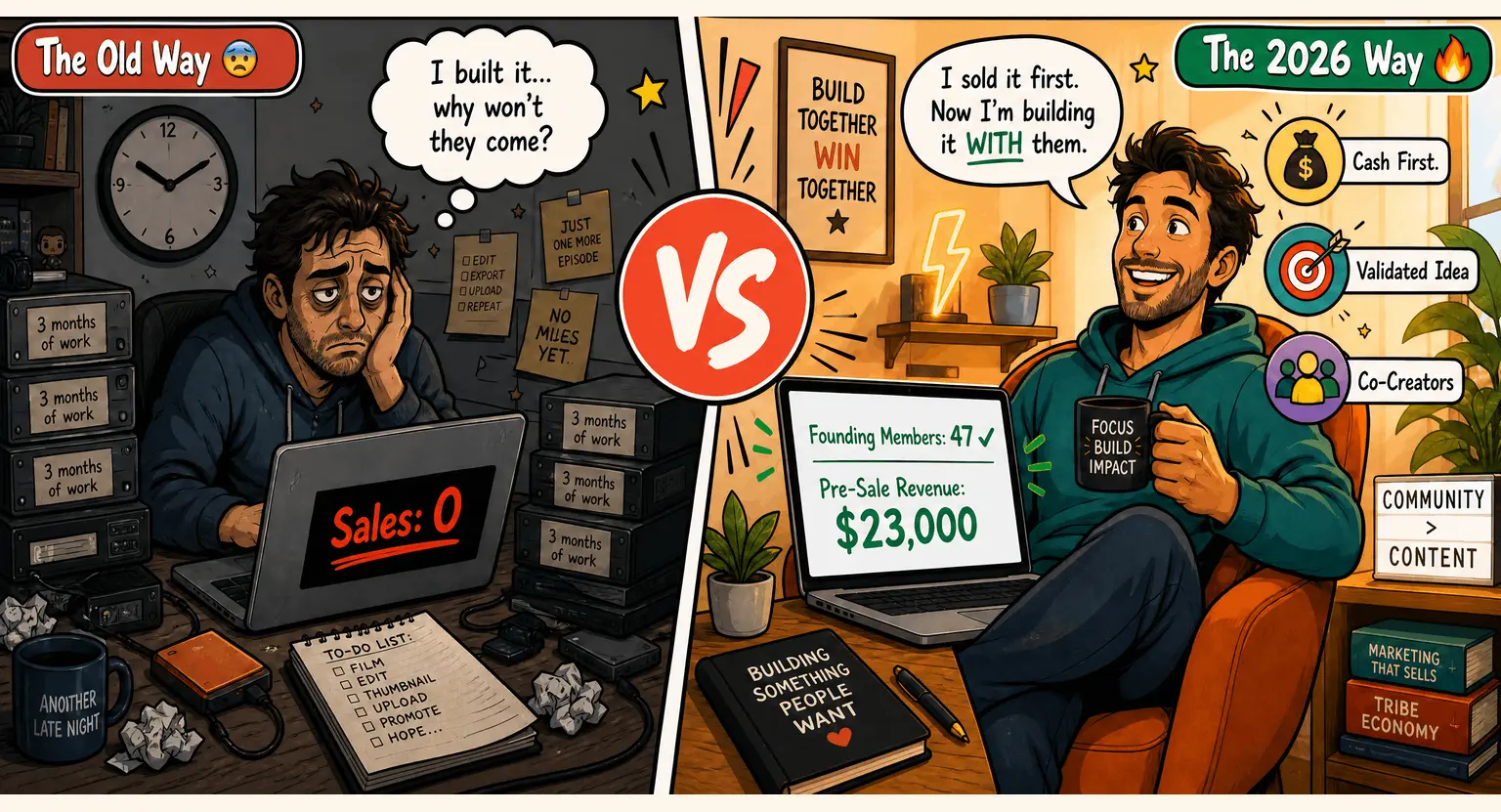
Do not spend weeks editing twenty video modules for an unproven topic. Outline your curriculum, draft a landing page, and validate demand beforehand. Knowing how to pre-sell your course lets incoming buyer deposits fund the production equipment, wiping out fixed startup debt before lesson one goes live.
2. Consolidate Your Tool Stack
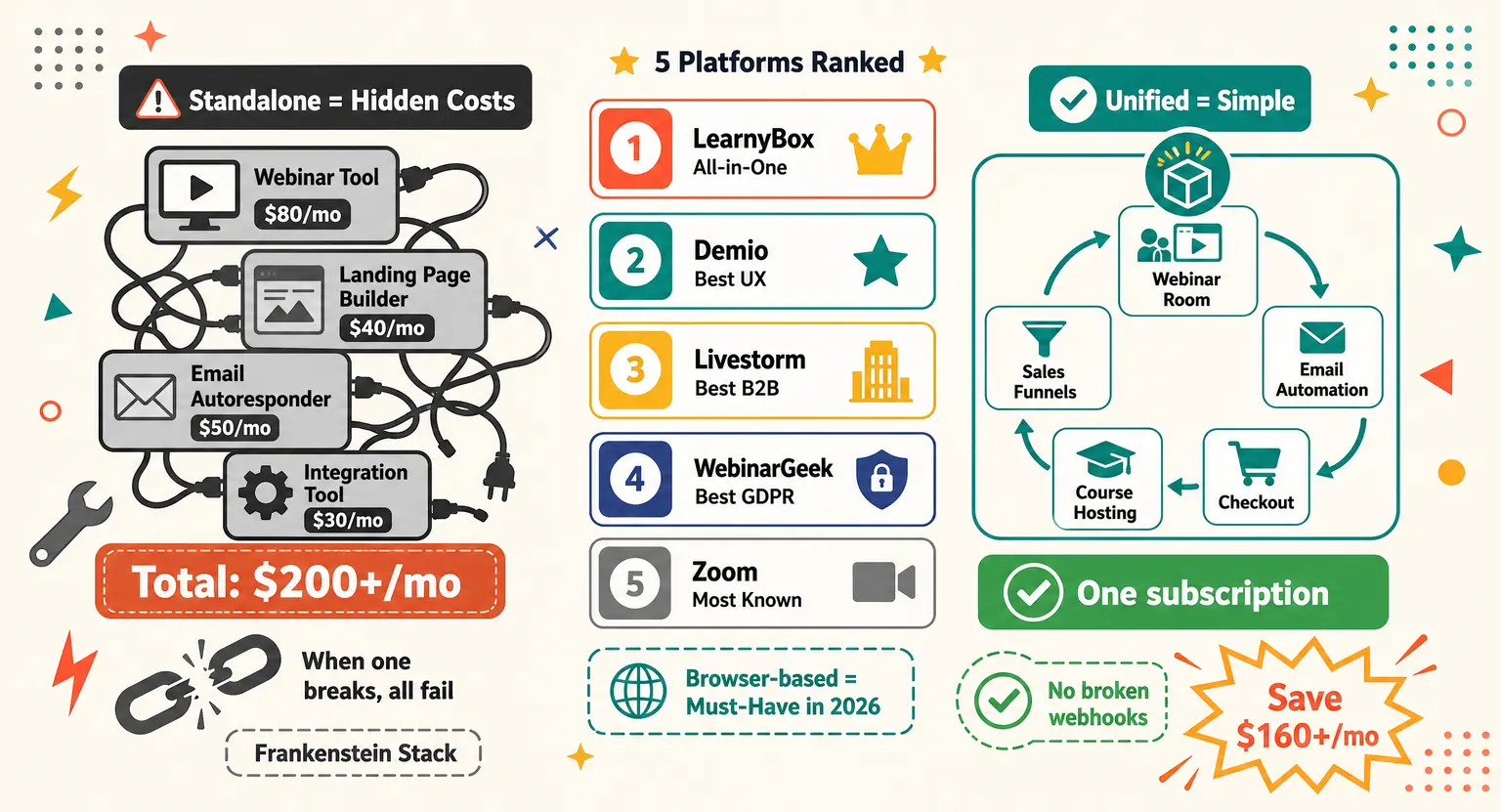
Paying separately for video hosting, checkout software, email builders, and affiliate trackers bloats monthly fixed costs. Choosing a unified platform to sell courses reduces recurring software bills into a single predictable invoice.
3. Introduce Order Bumps and Upsells
An order bump - like an audio version, template pack, or workbook checklist offered directly at checkout - lifts your average order value without adding acquisition expenses. Implementing smart upsell and order bump tactics widens your contribution margin immediately.
4. Deduct Eligible Business Expenses
Every dollar you legitimately save on your end-of-year tax bill improves your operational margin. Review verified tax deductions for course creators to ensure you write off camera gear, office space, and software subscriptions correctly.
Factoring Paid Advertising into Your Equation
Organic promotion through an existing newsletter or social following keeps variable marketing costs close to zero. But what happens if you plan to rely on paid traffic?
Paid marketing changes your variable cost calculation completely. If you spend an average of $60 on digital ads to acquire one paying student (Customer Acquisition Cost or CAC), that $60 must be added directly into your variable cost per unit.
If your course costs $150, and your payment fees plus ad acquisition total $75, your contribution margin gets cut in half to $75. To stay profitable when utilizing paid ads for online courses, you must continuously optimize conversion rates and lead funnels to prevent acquisition costs from overtaking your margins.
Explore Related Financial Guides
-
The step-by-step master plan for rolling out your digital program : how to launch an online course.
-
How to package enterprise licenses and land high-margin corporate contracts : B2B course sales.
Frequently Asked Questions
What is the simplest break-even formula for an online course?
The basic formula is : Break-Even Units = Total Fixed Costs divided by (Price per Student minus Variable Cost per Student). This tells you the exact number of course sales required to reach net-zero profit.
Do online courses have variable costs if delivery is digital?
Yes. Even though hosting digital files is inexpensive, you still pay payment processor fees per transaction, affiliate commissions, dynamic ad spend per acquisition, refund allocations, and occasional direct student onboarding costs.
Should I include my personal labor hours in fixed launch costs?
For strict tax accounting, creator time is often treated as sweat equity. However, for honest business sanity, setting an hourly opportunity cost helps you evaluate whether your course is genuinely outperforming your consulting or coaching rates.
How often should I recalculate my course break-even point?
Recalculate your break-even threshold whenever you adjust your price, sign up for new software, hire additional team members, or shift from organic promotional channels to paid advertising.






 How to Create a Course Refund Policy (Templates & Best Practices for 2026)
 How to Run a Beta Version of an Online Course (2026 Guide)
 How to Create a Cohort-Based Online Course (2026 Guide)
 How to Sell an Online Course With a Quiz Funnel (2026 Guide)
 How to Sell an Online Course Through a Sales Call (2026 Guide)