







How to Create Quizzes for Online Courses: The 2026 Expert Guide
How to Create Quizzes for Online Courses : The Expert Guide
Let's be honest for a second : most people hear the word "quiz" and immediately start having school-day flashbacks of dusty classrooms and ticking clocks.
But here in 2026, the game has completely changed for those of us teaching online.
Quizzes aren't just a way to see if someone was paying attention anymore; they are a psychological tool to cement learning, boost engagement, and make your students feel like they are winning.
If your current course just has a generic ten-question multiple-choice dump at the end of a module, you are leaving a lot of student results (and money) on the table.
So, how do we fix that and build something that actually gets people excited to click the "start assessment" button?
And it really starts with changing your mindset about what an assessment is designed to do.
Instead of thinking about it as a barrier to the next lesson, think of it as a checkpoint where the student gets to prove to themselves that they've actually leveled up.
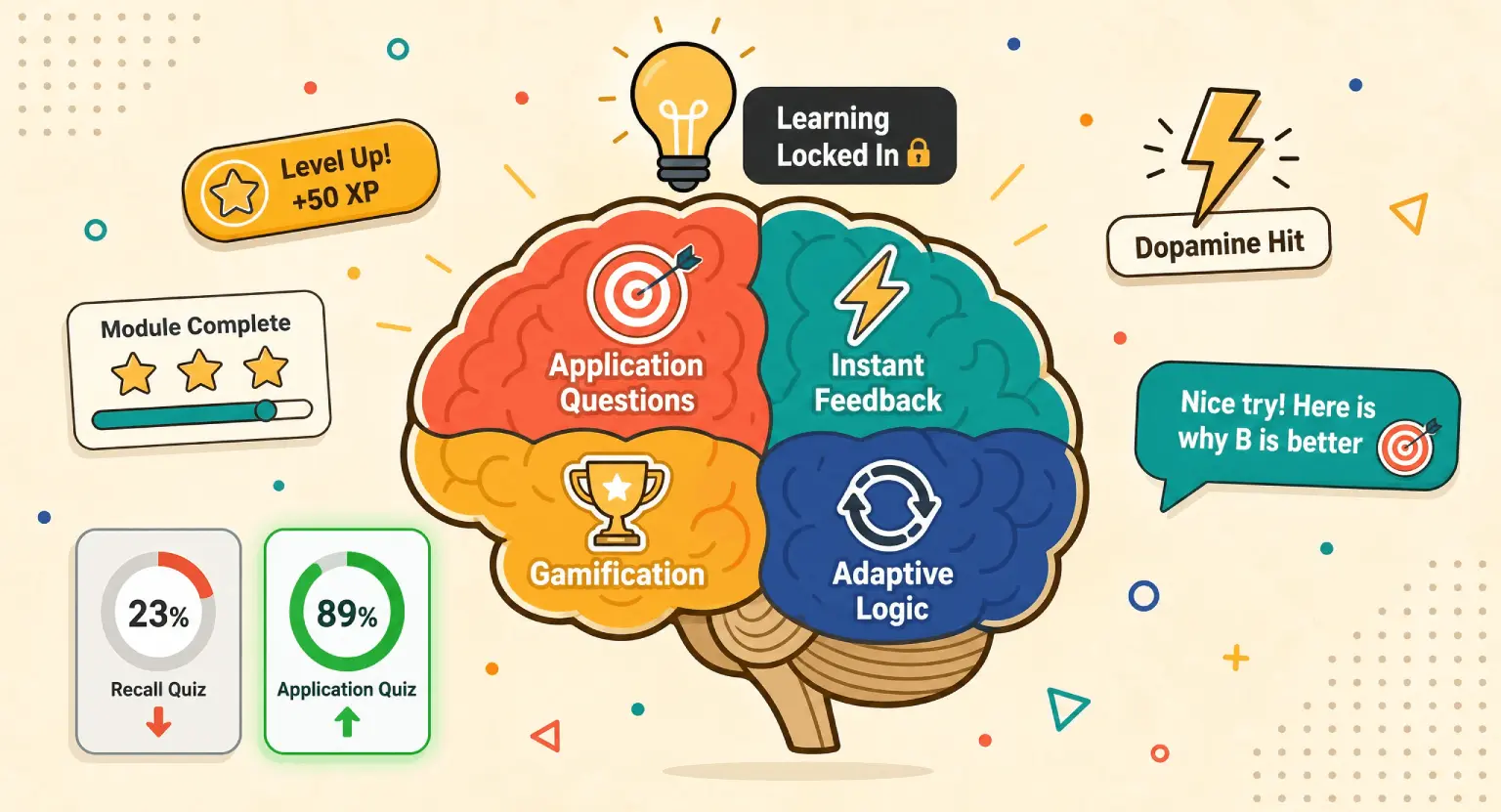
When someone answers a question correctly, their brain releases a tiny hit of dopamine. If you can string enough of those hits together, you create a learner who is addicted to your content and hungry for the next challenge.
But to get there, you need a strategy that goes deeper than just picking A, B, or C. You need a structure that mirrors the way we actually process information in the digital age.
Key Takeaways for High-Impact Quizzes
-
✅ Focus on Mastery : quizzes should help students learn, not just grade their performance.
-
✅ Diversity Rules : mix branching scenarios, matching, and open-ended reflections.
-
✅ Timing is Everything : insert mini-checks every 10 minutes to prevent mental fatigue.
-
✅ Actionable Feedback : never just say "incorrect"; explain why and link back to the lesson.
-
✅ Strategy First : plan your assessments during the phase of releasing your digital program for maximum impact.
Defining Your Quiz Purpose : Formative vs. Summative
Before you even open your course builder, you have to decide what each specific quiz is trying to achieve.
Are you checking if they understood the last five minutes of video, or are you certifying them as an expert in the entire topic?
In the educational world, we call these formative and summative assessments, and they serve two wildly different masters.
Formative quizzes are your "low-stakes" friends; they happen during the learning process and are meant to catch misunderstandings before they turn into bad habits.
They should be quick, punchy, and offer immediate feedback so the student can correct their course without feeling like a failure.
But you have to be careful not to make them too easy, or the student will just go on autopilot and stop truly engaging with the material.
On the other hand, summative assessments are the big finales. These are usually much more comprehensive and determine if a student has earned their certificate or passed the course.
In 2026, we've learned that these shouldn't just be a rehash of the smaller quizzes.
They need to challenge the student to synthesize all the information together.
Think about how you can use supplementary student study guides to help them prepare for these larger milestones. It creates a cohesive journey where the student feels supported rather than tested.
And when they finally pass that big summative exam, the pride they feel becomes the best marketing tool you could ever ask for because they will go out and tell everyone how much they actually learned from you.
So, take a look at your curriculum right now.
Do you have a healthy mix?
If you only have one giant test at the very end, your students are likely struggling with "cognitive overload" halfway through the course.
They need those smaller breadcrumbs of validation to keep their momentum.
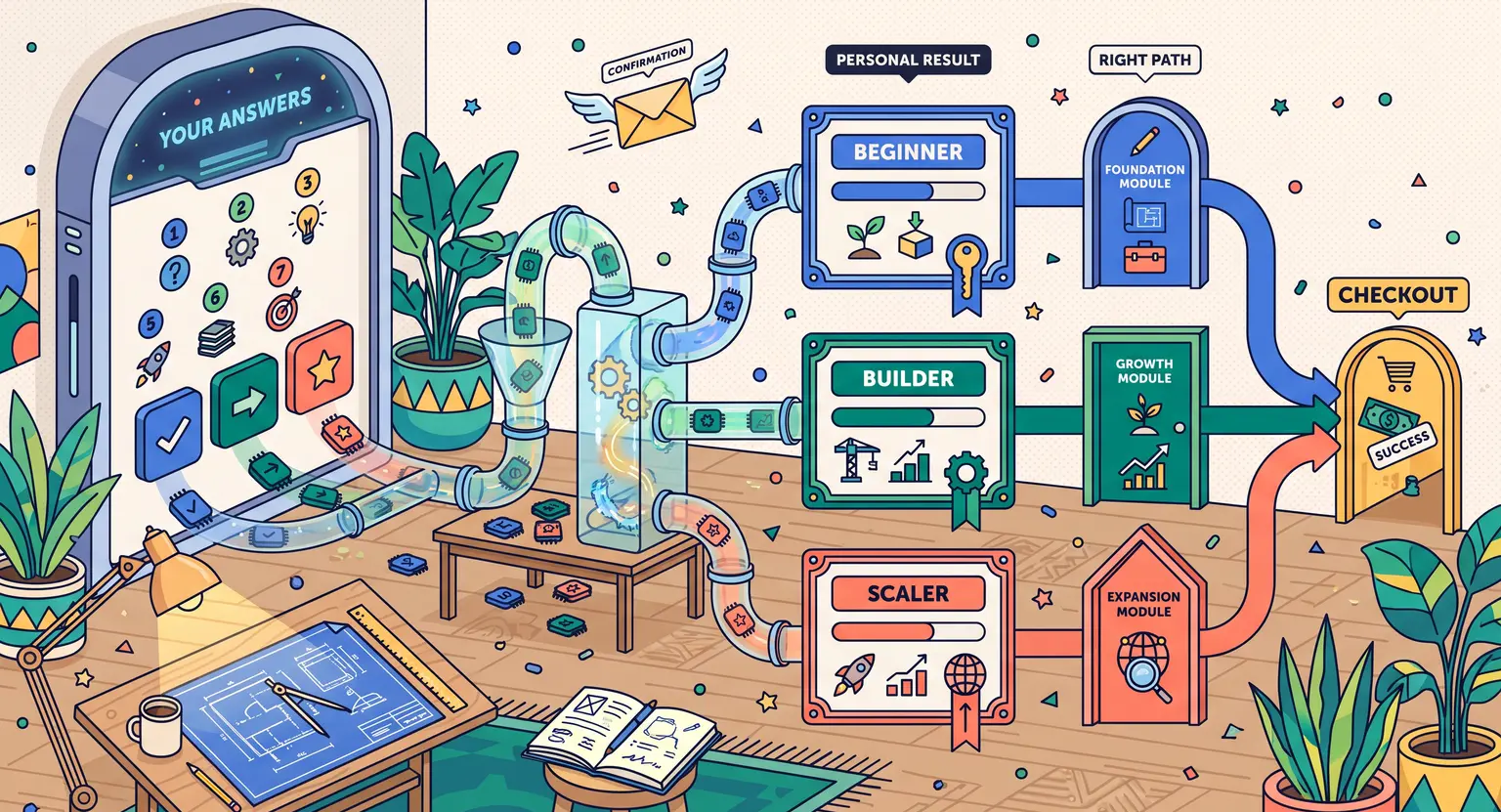
It's also worth considering how a diagnostic quiz at the very beginning of the course could set the stage.
By knowing what they already know, you can sometimes even point them to specific modules, saving them time and increasing their respect for your expertise.
That kind of personalized attention is what separates a world-class course creator from someone just selling a bunch of videos on a landing page.
Crafting Questions That Actually Challenge the Brain
Most course creators fall into the trap of asking "recall" questions.
These are things like "What year was the airplane invented?" or "What is the third step of this process?"
While those have their place, they are frankly a bit boring.
If you want your course to stick, you need to ask "application" questions. Instead of asking what the third step is, describe a messy real-world situation and ask the student to decide what they would do using that third step.
This forces the brain to move the information from short-term memory into long-term storage, but keep the language conversational.
Avoid using overly academic jargon that makes the student feel like they are taking a legal exam unless, of course, you are actually teaching law.
The distractors (that's the fancy term for the wrong answers) are just as important as the correct one. If you have three obviously wrong answers and one correct one, the student isn't really learning; they are just using the process of elimination.
Good distractors should represent common misconceptions that students usually have.
When someone picks a "good" wrong answer, it's a golden opportunity for your feedback system to step in and say, "Hey, I see why you picked that, but here is why this other option is actually better in this scenario."
This transforms the quiz from a judging machine into an active mentor.
It's about building a relationship with the learner through the screen, making the technology feel human and intuitive.
But don't stop at just text. We are in the age of visual and interactive media.
Use images in your questions!
If you're teaching photography, show two similar photos and ask which one has better composition.
If you're teaching software, show a screenshot of a common error and ask for the fix.
And for the love of all things holy, please stop using "All of the Above" or "None of the Above."
Research shows these are the weakest types of questions because they give away the answer or confuse even the smartest students.
Instead, try "Multiple Response" where they have to check all the boxes that apply without knowing exactly how many are right.
It's tougher, sure, but it's way more rewarding when they get it right.
| Assessment style | Engagement level | Ideal use case | Tools needed |
|---|---|---|---|
| Branching Scenarios | High (90%) | Decision-making & Leadership | Comprehensive digital teaching toolkit |
| Rapid-fire Quizzes | Medium (65%) | Vocabulary & Basic Principles | Standard LMS Mobile App |
| Video Hotspots | Very High (95%) | Technical / Hands-on Training | Interactive Video Editor |
| Sorting & Matching | High (80%) | Process Steps & Categories | Drag-and-Drop Quiz Builder |
| AI-Adaptive Logic | Maximum (98%) | Personalized Learning Paths | Advanced 2026 Engine Platforms |
The Psychology of Instant Feedback and Gamification
We live in a world of instant gratification. If a student takes a quiz and has to wait three days for you to grade it, the "learning moment" has already passed. They've moved on to dinner, or work, or another course.
You need to leverage the power of automated, instant feedback loops - But don't just give them a score. That's where many people fail.
Use that moment to reinforce your concepts.
If they get it right, congratulate them with a bit of personality - maybe a joke or a relevant fun fact.
If they get it wrong, give them a hint and encourage them to try again.
This creates a safe space to fail, which is exactly where the most profound learning happens. And it keeps them moving forward without the fear of hitting a brick wall.
And speaking of moving forward, let's talk about gamification. It's not just a buzzword anymore; it's a necessity.
By adding small elements like progress bars, badges, or even a leaderboard (if your audience is the competitive type), you turn the course into a journey.
You can even implement interactive learner engagement techniques that unlock special "bonus" content only after a certain quiz score is achieved.
This creates a massive incentive for students to not just "get through" the material, but to actually master it.
It changes the dynamic from "I have to do this" to "I want to earn that." It's a simple psychological shift that can double or triple your course completion rates overnight.
But be careful not to overdo the "games" to the point where the actual learning gets lost in the noise. The goal is always the student's transformation.
Every badge earned should represent a real skill they've acquired. I've seen courses where there are so many bells and whistles that the students get distracted by the points and forget why they signed up in the first place.
Balance is key here.
Your quizzes should feel like a natural part of the conversation you are having with your students. They should be challenging enough to feel earned, but accessible enough that the student doesn't feel like they need a PhD just to pass the first module.
Keeping that "Goldilocks" zone of difficulty is the hallmark of a true expert trainer.
Implementing Your Quizzes Within an LMS
Now, how do you actually build this without losing your mind? In 2026, you shouldn't be duct-taping three different pieces of software together to make a quiz work.
You need an all-in-one platform that handles the video hosting, the student community, and the assessment engine under one roof.
When your quizzes are natively integrated into your LMS, you get access to data that would be impossible to see otherwise. You can see exactly which question everyone is failing, which might mean your video for that section wasn't clear enough.
This kind of "backend intelligence" allows you to constantly refine your course and make it better for the next batch of students.
It's a virtuous cycle of improvement that keeps your brand at the top of its game.
But when you're setting these up, think about the mobile experience too. More than 70% of students in 2026 are taking these quizzes on their phones while they are on the bus or waiting for a coffee.
If your "drag and drop" question is tiny and hard to click, they will get frustrated and quit.
Test everything on your own phone first.
Does it feel smooth?
Is the font big enough?
Does the "Congratulations" gif load quickly?
These small technical details might seem minor, but they represent the level of care you put into your student's experience.
And remember to avoid typical instructional design errors like having too many questions on a single page, which can lead to data loss if their internet blips for a second.
Another great feature to look for is the ability to create "Question Banks." Instead of every student getting the same ten questions, the system pulls randomly from a pool of thirty.
This makes it much harder for people to just share the answers on a forum, and it also makes "retaking" the quiz much more valuable because the student might see new challenges the second time around.
It increases the longevity of your content and adds a layer of professional polish that students really appreciate.
Plus, if you ever decide to scale your training into a corporate environment, these robust testing features are often a requirement for high-ticket B2B deals.
It's an investment in your platform's future as much as it is in your current students' success.
Common Mistakes to Steer Clear Of
One of the biggest blunders I see is making the quizzes too long.
People have short attention spans, especially online. If your quiz takes thirty minutes to complete, you've turned your course into an ordeal. Keep it snappy!
Another mistake is being too tricky with the wording. You aren't trying to "catch them out" or prove how smart you are. You are trying to confirm they understand the concepts.
If a student understands the material but misses the question because of a double negative or a confusing sentence structure, you've failed them as a teacher.
Keep it clear, keep it simple, and keep it focused on the core transformation you promised when they bought the course.
Finally, don't ignore the data. If 40% of your students are dropping off at a specific assessment, there is a reason for it.
Maybe the quiz is too hard, or maybe the previous lesson didn't provide enough information to answer the questions. Use those analytics as a map for your next update.
Your course should be a living entity, not a static file that you forget about the moment you hit "publish."
By listening to what the quiz results are telling you, you can craft an experience that is so effective, your students will naturally become your biggest advocates...
And that is the true secret to long-term success in the digital education world.
It's not about the fancy graphics; it's about the results your students achieve.
Wrapping things up, remember that quizzes are an extension of your teaching voice. They should feel helpful, encouraging, and occasionally a little bit challenging.
When you take the time to build assessments that truly respect the learner's time and effort, you aren't just giving them a grade; you're giving them the confidence to go out and use what they've learned.
This builds a legacy of success that far outweighs the initial effort of setting up the quizzes.
So, go back through your modules, find those key learning "pivot points," and build a quiz that makes your students say, "Wow, I actually get this now!"
That is the moment they transform from a customer into a lifelong fan of your work.
And if you are looking for more ways to enhance your digital presence, don't forget to look into things like successful masterclass events to complement your quiz-based learning.
The more ways you can connect with your audience, the more robust your educational business will become.
It's all about creating an ecosystem of value that supports your students at every single step of their journey. Now, go get started on those questions!
FAQ : Designing High-Value Assessments
How many questions should a course quiz typically have?
For standard lesson-level assessments, keep it between five and ten highly focused questions to prevent fatigue.
If you are doing a final certification exam, twenty to thirty questions are acceptable, provided they are split into manageable sections.
In 2026, the trend is moving toward shorter, micro-assessments placed every ten minutes of video content to maximize neural retention.
Quality always trumps quantity when you want your students to actually remember what they just learned. You can even mix these with successful masterclass events to keep engagement high.
Should I allow multiple attempts on my course quizzes?
Yes, absolutely allow multiple attempts if your goal is mastery rather than just filtering students out.
Most successful educators in 2026 use a two-attempt limit with mandatory review periods or randomized question pools for the second try.
This encourages students to dig back into the materials they missed without the high-stakes pressure of failing permanently.
It turns a 'test' into a 'learning tool,' which is much more effective for building long-term brand loyalty and student satisfaction.
Can I use quizzes to help sell or launch my course?
Quizzes are actually one of the highest-converting lead magnets for any digital product launch.
By creating a 'diagnostic quiz' that identifies a prospect's specific pain point or skill level, you can offer a personalized recommendation for your course.
This tailored approach makes the student feel seen and understood before they even open their wallet. It's a great way to start monetizing your expertise even before the main course is finished.



 How to Create a Course Refund Policy (Templates & Best Practices for 2026)
 How to Create a Cohort-Based Online Course (2026 Guide)
 How to Sell an Online Course Through a Sales Call (2026 Guide)