






How to Interview Potential Online Course Students (2026 Guide)
How to Interview Potential Online Course Students
Key Takeaways
-
Identify true pain points : before writing a single slide, make sure you identify the biggest problems your course should solve to ensure immediate market viability.
-
Avoid leading questions : do not ask if they would buy; ask how they currently spend money solving their issues.
-
Target active searchers : focus on people already testing or buying alternative solutions, not passive lurkers.
-
Map common patterns : group recurring frustrations into syllabus pillars and write high-converting sales copy using their vocabulary.
Discovery interviews bypass guesswork to build a business speaking directly to paying students.
You have a brilliant idea for an online course. You are excited, your slides are halfway done, and you can already hear sales notifications landing in your inbox…
But let us halt right here. Are you absolutely sure real people want what you are building?
Too many creators skip talking to real, living human beings. They spend months locked away filming hours of high-definition video only to launch to absolute, crushing silence. It is heartbreaking, expensive, and completely avoidable.
In 2026, the online market is busier than ever.
Standing out requires deep empathy, not flat surveys.
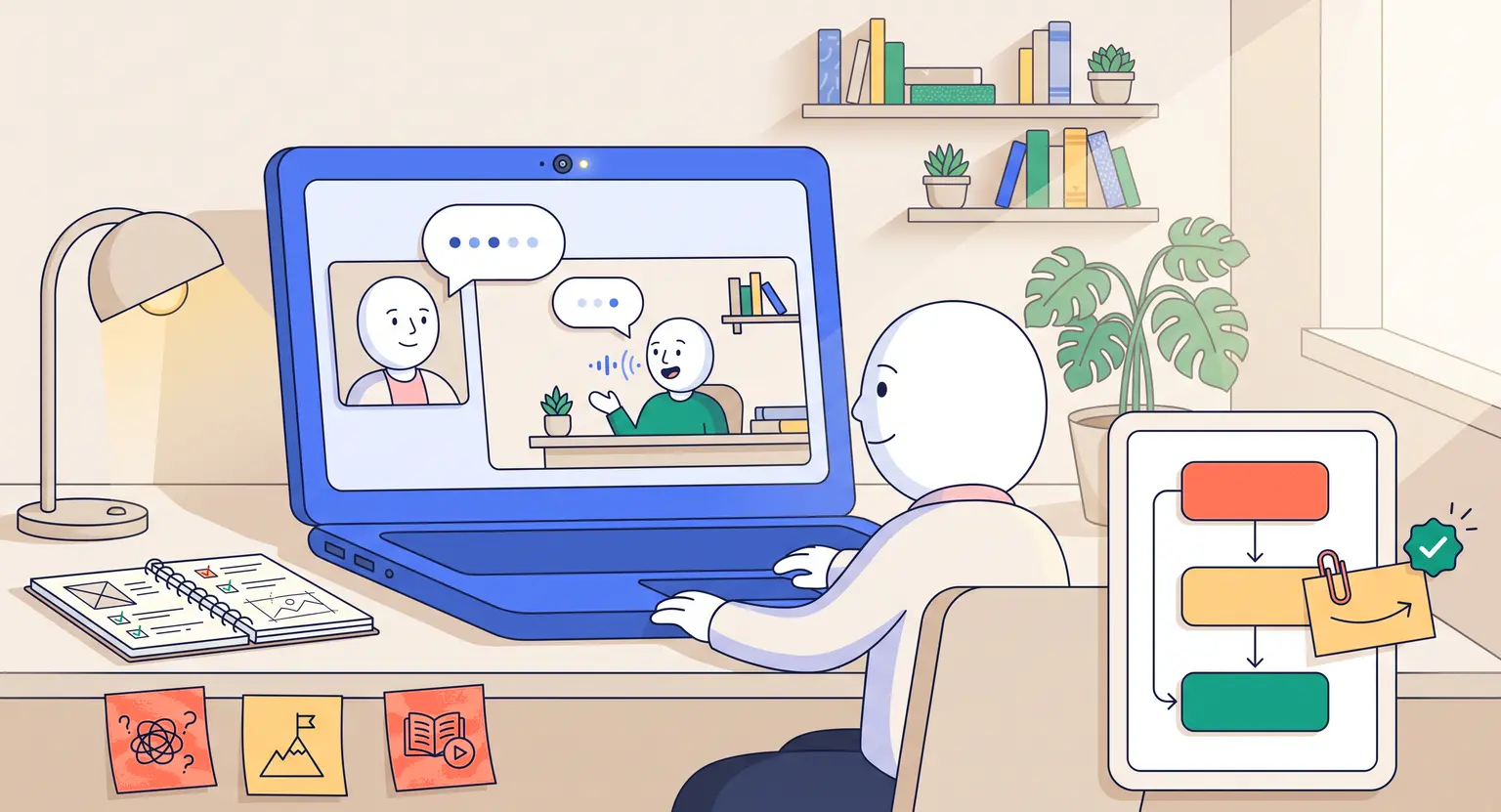
You need to look your potential students in the eye - even if it is through a laptop screen - and run structured, high-value discovery interviews. By asking the right questions and shutting up long enough to listen to their answers, you will understand exactly how to position your offer.
You will discover their deep-seated fears, daily struggles, and the exact language they use when they complain.
Let us explore the exact blueprint for setting up, running, and analyzing student interviews to make your course launch a massive success.
The Trap of the Polite Lie and Why Surveys Fail
When you ask followers, "Would you buy this course?" they almost always say yes to be supportive… But a verbal commitment costs them absolutely nothing. It is a polite lie. Even surveys are not much better because they lack depth, giving you dry, flat data.
If you want a highly successful offer, transition from abstract data to real human emotion. Conversational interviews allow you to dig into the "why".
When an interviewee says, "I tried learning JavaScript but gave up,"
a survey just records a "no."
An interview lets you ask : "What happened the day you quit?"
That is where the gold is hidden.
But how do you find these passionate, talkative individuals without wasting weeks of your valuable time? It always starts by actively hunting in the right high-intent digital neighborhoods.
Finding and Filtering the Right People to Interview
Never interview just anyone : talking to the wrong people fills your head with bad data that misleads your curriculum. Your goal is to find active searchers.
These are people who are actively trying to solve the problem your course addresses but are failing to get results. They are buying books, watching random video tutorials, or signing up for cheap online workshops.
If you want to sell online courses to businesses, you want to interview department heads who are actively losing money due to inefficient training systems.
Where do you find these magical interviewees? Hang out in niche communities, Reddit subreddits, Facebook groups, or Slack channels… Do not jump in with a sales pitch; offer value and make a simple, vulnerable request for a quick 15-minute chat about their learning journey.
Before booking, filter them. Ask : "What have you tried in the past to solve this?" If they say "nothing," do not jump on a call with them. They do not feel the pain deeply enough.
While scouting forums, research competitors before selling an online course to see what platforms and methods your target students complain about.
The Four Golden Rules of Student Discovery Calls
To get honest, actionable data, you must follow some ground rules. If you run your interview like a sales pitch, your subject will clam up or try to please you.
First, talk about their life, not your idea. As soon as you say, "I am building a program on oil painting, what do you think?" you have contaminated the well - they will start predicting the future, and humans are notoriously terrible at predicting their own buying behavior.
Second, ask about the past and the present. Past behavior is the only reliable predictor of future purchases.
Don't ask, "Would you pay $500 for a course?"
Ask, "What is the most you have spent on a learning resource in the last year?"
Third, embrace silence. If your interviewee stops speaking, do not rush to fill the void. Give them three seconds - often, they are collecting their thoughts, and the most profound, raw insights come right after a brief, slightly uncomfortable pause.
Finally, take meticulous notes but focus on the exact words they use. Record the sessions so you can review them later.
The specific vocabulary they use to describe their struggles is the exact copy you will use on your landing page. Let us look at a few interviewing methods you can use depending on your current level of audience access.
Comparing Different Audience Research Formats
Before choosing your approach, let us map out the different ways you can talk to your future students.
While we strongly advocate for one-on-one video calls as the gold standard for discovering core problems, using a mix of methods on the LearnyBox platform can help you paint a complete, realistic picture of your target audience and their educational preferences.
| Format | When to use it | Major advantages | Key disadvantages |
|---|---|---|---|
|
1-on-1 video calls |
During initial validation and curriculum planning. |
Highest emotional depth; lets you read facial expressions. |
Time-consuming to schedule and execute. |
|
Written surveys |
After 1-on-1 calls to confirm patterns at scale. |
Highly scalable; provides clean quantitative data. |
Lacks nuance; prone to people typing polite lies. |
|
Direct message audits |
In early community stages for organic conversations. |
Extremely low friction; quick to start. |
Hard to go deep into complex behavioral trends. |
|
Focus groups |
To observe common debates and terms inside a niche. |
Shows social dynamic and group agreement trends. |
Heavy risk of groupthink; loud voices dominate. |
|
Live beta sessions |
When you have a loose draft of the curriculum ready. |
Real-time execution feedback on your teaching style. |
Requires a built-in audience or high marketing effort. |
Using these formats strategically guarantees you gather clean, high-conviction insights from different segments of your potential student base.
The Script : Questions That Spark Deep Revelations
You do not need a list of fifty questions. You need a few highly targeted, open-ended prompts that let the other person steer the story.
Start with context : "What is the hardest part about [Topic] for you right now?" This helps you establish their primary barrier.
Follow up with a probe into their history : "Can you tell me about the last time you ran into that issue?" This forces them to recall a specific, real-life event rather than speaking in vague generalities.
Next, investigate their search for solutions : "What have you tried to do to fix this problem?" If they have done nothing, they do not actually care about solving it. But if they spent hours searching Google, bought a book, or hired a coach, you know they are serious.
Then, address the gaps : "What did you dislike about the solutions you tried?" This question is your golden ticket to beating your competitors. They might say the book was too dry, or the lectures were outdated.
Lastly, clarify the emotional and financial driver : "How does this nagging difficulty affect your day-to-day life or your overall business?" This simple question helps you identify the exact emotional narrative for your sales pages, laying bare the high stakes involved in their everyday operations.
Translating Interview Insights into Your Course Curriculum
Once you have successfully conducted ten to fifteen discovery interviews, your mind will probably feel quite scrambled with endless stories, complaints, and quotes - do not let those messy notes gather digital dust. It is time to look for clear patterns.
Grab a physical whiteboard or a clean document and write down the core frustrations from every single call. Group them into thematic categories.
You will quickly notice that while every student brings a unique narrative, they almost all struggle with the same three or four fundamental roadblocks.
These clusters of frustration are the pillars of your syllabus.
If five people tell you, "I struggle to set up my environment," that becomes Module 1 of your course.
If they complain, "I hate feeling like I am doing this alone," you know you need to include a community space or live Q&A sessions.
This systematic process is how you create an irresistible online course offer. You are no longer guessing what sounds enticing. You are using their exact struggles, frustrations, and goals to build a perfect solution that practically sells itself.
Avoiding Common Interview Mistakes
Even seasoned course creators make mistakes during student discovery calls. Keep this practical checklist of what you must absolutely avoid during your next conversation :
-
Pitching instead of listening : if you spend half the call talking about your curriculum features, you have failed. The spotlight belongs to them.
-
Asking leading questions : avoid saying, "Don't you think an online course on this would be helpful?" People will default to nodding.
-
Interrupting stories : when they are telling a story about a bad experience, let them finish. The detours they take often contain the most valuable golden nuggets.
-
Not pressing for details : if they say, "It was hard," do not move on. Ask, "What specifically made it feel hard?"
-
Treating feedback as law : remember, you are looking for patterns. Do not rebuild your entire course syllabus based on a single loud, opinionated person's feedback.
Frequently Asked Questions
How many students should I interview before I build my course?
Aim for ten to fifteen in-depth interviews.
If you carefully analyze your notes and realize you are hearing the exact same struggles, matching emotional phrases, and identical objections over and over again, you can stop.
That pattern of repetition means you have officially hit saturation.
Should I pay people or offer incentives for these interviews?
Sometimes a simple, honest appeal to help you design a great educational resource works on its own.
However, offering a small $15 or $20 digital Amazon gift card for a quick 15-minute Zoom call actively respects their time and will significantly boost your booking rates.
How do I handle interviewees who just complain and offer no constructive feedback?
Always take their loud complaints with a grain of salt but always search deeply for the root cause of their emotional frustration. Even pure complaints contain absolute gold; they lay bare the raw feelings that serve as the narrative engine for high-performing sales pages.
What if potential students refuse to get on a video call?
If video calls feel high-friction, offer a text-based DM interview instead. Try to secure an audio call if possible. Hearing their real voice and hesitations is extremely valuable for deep validation.




 How to Create a Course Refund Policy (Templates & Best Practices for 2026)
 How to Run a Beta Version of an Online Course (2026 Guide)
 How to Create a Cohort-Based Online Course (2026 Guide)
 How to Sell an Online Course With a Quiz Funnel (2026 Guide)
 How to Sell an Online Course Through a Sales Call (2026 Guide)