






How to Protect Your Intellectual Property as a Course Creator
How to Protect Your Intellectual Property as a Course Creator
Key Takeaways for Securing Your Educational Assets
Your educational content represents your most valuable corporate and digital asset, built through endless study and personal struggle. Leaving it exposed is a risk you cannot afford.
-
Automatic rights vs. filed rights : while you own your creative assets immediately under standard copyright law, registering your work officially serves as a nuclear deterrent in court.
-
Enforceable contracts at checkout : do not rely simply on honor codes. Use modern checkout agreements to define the boundaries of personal use.
-
Secure video playback : ditch basic file storage integrations and work only with advanced players to protect an online course from piracy effectively.
-
Halt login handouts : restrict system vulnerabilities and prevent students from sharing paid course access with non-buyers.
-
Proactive action pays off : when infringement occurs, a structured, calm takedown plan acts faster and costs far less than a full legal war.
Imagine waking up to an automated alert showing your signature training program is being traded on a shadowy forum for five dollars. Even worse, suppose a former student has taken your exact PDF worksheets, slapped their brand on them, and launched a competing coaching business…
For online course creators in 2026, these scenarios are real operational struggles. In a landscape where anyone can spin up a storefront overnight, content safety is paramount.
The digital era has made distributing digital products incredibly fast, which also means your intellectual property can be scraped and shared within minutes of release.
But here is the good news. Securing your course doesn't require a master's degree in cybersecurity or an expensive legal retainer. By building a balanced defense that merges smart platform tech with simple, legally binding rules, you can protect your revenue and sanity.
This guide provides the exact steps to build a bulletproof shield around your online curriculum, your worksheets, and your brand reputation, keeping your hard work exactly where it belongs : in your hands.
Understanding Your Legal Intellectual Property Elements
Before setting up digital gates, understand how the law defines your digital assets. Under standard online course copyright rules, copyright protects your specific expression of ideas, not the ideas themselves.
This means anyone can legally teach your general topic, but absolutely no one has the right to plagiarize your distinct video lectures, course outlines, workbook layouts, or written modules.
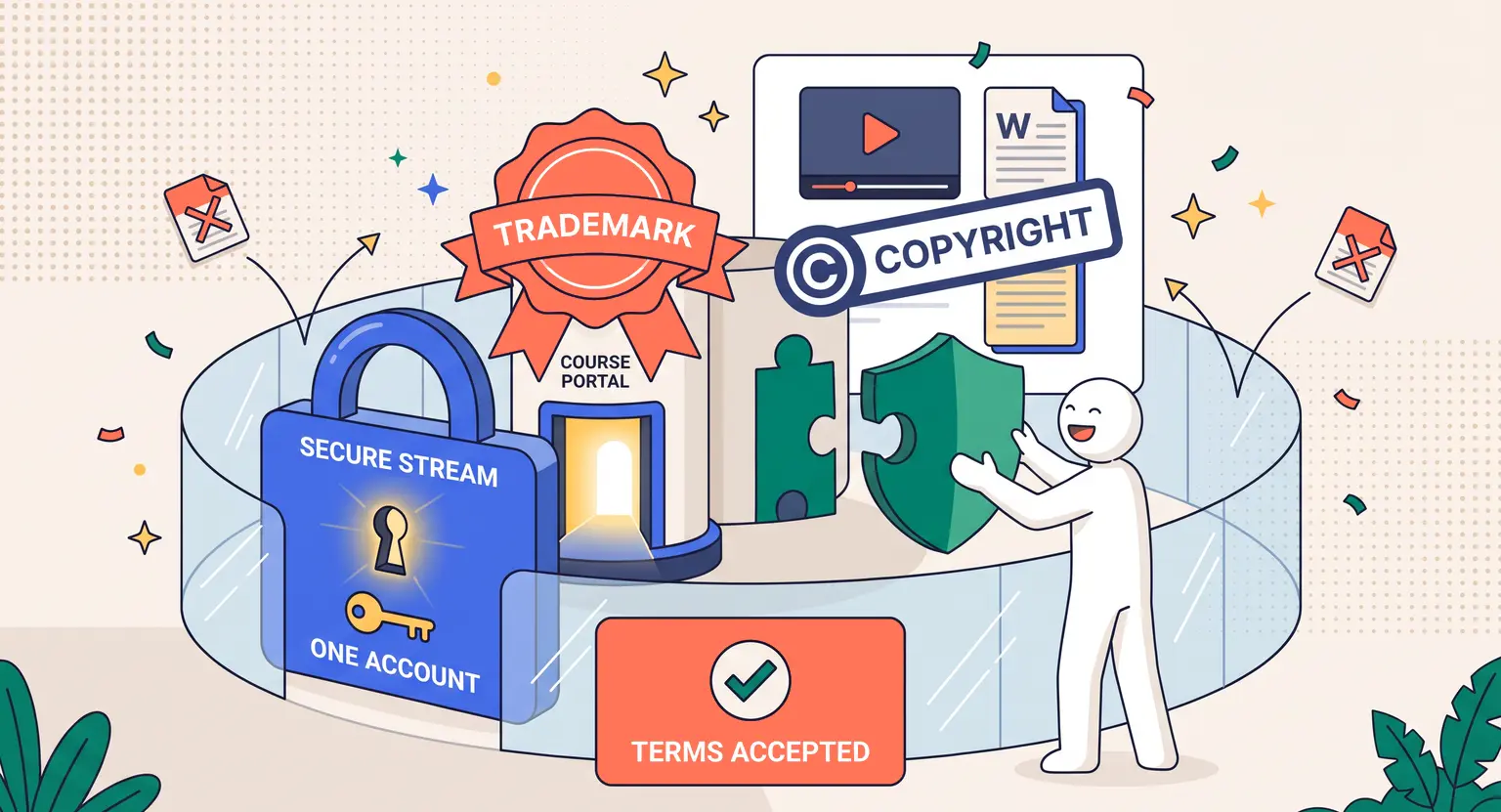
To protect your business effectively, classify your course into three main distinct legal elements :
-
Copyright : applies to video recordings, slide presentations, scripts, guides, and portal graphics. It exists automatically, but formal filing offers high damages leverage.
-
Trademarks : safeguards your unique course name, academy logo, and proprietary method designations. This blocks rivals from stealing your business identity to land sales.
-
Trade secrets : applies to hidden backend workflows, customer databases, or proprietary formulas that give your teaching platform a critical market advantage.
While automatic copyright protection acts as a friendly baseline safety net, you shouldn't rely on it alone - proactive safety requires building a real legal and technical framework. Working with specialized legal advisors to register your course code and primary text ensures that you have teeth when chasing down infringers.
Creating Legally Binding Student Agreements
Many educational creators focus entirely on design or sales while completely ignoring legal agreements, which is a dangerous trap. Your absolute best chance of winning an intellectual property battle starts long before anyone views their very first lesson.
When a prospective buyer purchases access to your digital files, they must enter into a formal contract.
This is where having a tailored terms of sale agreement becomes your primary shield. This specific document behaves as a bounding regulatory model between your business and the end consumer.
It details what actions are strictly forbidden within your portal. To make certain your pages meet regulations, evaluate what legal pages your website needs immediately. Your checkouts must include :
-
Non-transferable rights : state that each single login is for a single user only, establishing clear grounds for immediate account suspension if shared.
-
Anti-derivative bans : explicitly prohibit students from rewriting your curriculum formulas into competing frameworks or corporate coaching tools.
-
Governing jurisdiction : outline where legal actions must be settled and define the contractual penalties for copyright theft.
Adding a mandatory "I agree to the Terms of Service" tick box during checkout establishes clear agreement. This simple step ensures credit card processors and payment platforms will back your business during suspicious refund disputes and chargeback attempts.
Technical Barriers to Prevent Lesson Piracy
While solid legal agreements cover you in court, robust technical barriers prevent unauthorized sharing from occurring in the first place.
If your educational materials are incredibly simple to access or download, even well-meaning students might share them with colleagues. Securing your business means configuring specific advanced security parameters inside your course delivery platform.
Start by looking at where your media is hosted. Standard hosting solutions use basic players that store visible direct links inside the website source code. This makes ripping videos extremely easy. Instead, host your lectures on an all-in-one setup that utilizes encrypted media streams and restricts download options.
Next, review downloadable tools. When creating a course workbook, never distribute editable text formats - flatten your PDFs, apply secure tags to block direct copy-paste actions, and dynamically stamp each downloaded file with the student's name and account email to deter public file sharing.
Finally, implement multi-login prevention systems. These systems track active sessions, restrict access from multiple IP locations, and automatically freeze student accounts if simultaneous usage is discovered. This simple automated gatekeeping stops the casual distribution of login credentials to colleague groups.
Protecting Different Assets Across Your Academy
To help you build a highly targeted defense system across your entire school portal, here is a detailed digital asset matrix outlining the specific vulnerabilities of each content format alongside the precise legal protections and technical restrictions you should implement.
| Course asset family | Primary security danger | Optimal legal safeguard | Smart electronic guard |
|---|---|---|---|
|
Secure lecture videos |
Students ripping streams using browser tools. |
Strict and restricted personal learning license policies. |
Encrypted streams and dynamic onscreen user-watermarking. |
|
Course worksheets & PDFs |
Re-uploading unsecure clean files to public resource hubs. |
No commercial derivative training policies. |
Stamping unique emails and flattening file structures. |
|
Private student communities |
Automated scraping of premium student threads. |
Compulsory community rules agreements. |
Dynamic bot checking and modern access controls. |
|
Live coaching media |
Public posting of private class videos. |
Mandatory student group nondisclosure contracts. |
Expired login session player links. |
|
Slide presentation decks |
Plagiarizing distinct slide designs and sequences. |
Copyright text footers on slides. |
Exporting as flat, non-selectable visual PDF documents. |
Dealing with Copyright Violations Effectively
What happens if someone ignores your digital gates and copies your program? You must act with a cool head and a clear plan.
First, document the proof immediately. Capture timestamped screenshots of the unauthorized course offering, the checkout website domain, product prices, and any contact information listed. This paperwork establishes the legal trail needed to back your formal takedown requests.
Next, submit a formal digital notice. If you discover your stolen files hosted on a public cloud system or a pirate forum, use a standard Digital Millennium Copyright Act form. Major web hosting companies must remove stolen content once they receive this formal digital request. Learn how to handle copyright infringement dynamically to resolve ninety percent of your leaks without expensive legal suits.
If a student is the specific offender, terminate their portal access immediately. Send a firm, professionally drafted cease-and-desist letter detailing their specific checkout contract breach. Often, receiving legal letterhead is enough to make a copycat back down without further escalation.
Trademarking Your Brand Authority
Copyright stops competitors from copying your exact videos, but trademark law protects your distinct brand identity.
As you scale your education platform, register your unique course names and master slogans to stop copycats from tricking potential customers into purchasing fake programs.
Additionally, if you want to expand and discover how to sell online courses in Europe, having a secure platform is a legal and practical must. International expansion requires high-level corporate alignment to ensure your digital property remains fully protected under local European laws while keeping transactions entirely smooth.
Expert Compliance, GDPR, & Payment Safety Resources
Building a successful and secure digital training business requires having fully compliant operational frameworks. To continue protecting your online business assets on all legal levels, review these outstanding security and regulatory guides :
-
Secure your internal student database and metrics by implementing GDPR compliance guidelines.
-
Protect your income from fraudulent chargebacks by incorporating advanced, highly secure payment systems designed for online information selling.
Frequently Asked Questions
How does copyright law apply to my online course content automatically?
Your course content is automatically protected by copyright the moment it is recorded or written in a tangible medium.
Formal federal filing remains optional but provides critical statutory damages leverage if you ever need to pursue a copyright thief in a court of law.
Can I prevent students from sharing their portal logins with others?
Yes. Always protect your platform structure using a modern provider that actively tracks multi-location IP patterns, limits simultaneous connections, and flags suspicious active logins.
Legally, define single-user licenses clearly inside your terms of sale page to establish a basis for immediate account termination.
What is the best way to handle a student sharing copycat files?
First, document the infringement by capturing proof. Next, suspend the violating student's portal access immediately.
Send a professionally drafted cease and desist warning via your lawyer, outlining the strict sale policies they willingly accepted at checkout.
Should I register my core curriculum as a trademark?
If your creative educational program generates a steady income, file a formal trademark for your program name, catchphrases, and logos.
This legal step blocks competitors from copying your branding or tricking search engines with duplicate brand assets.






 How to Create a Course Refund Policy (Templates & Best Practices for 2026)
 How to Run a Beta Version of an Online Course (2026 Guide)
 How to Create a Cohort-Based Online Course (2026 Guide)
 How to Sell an Online Course With a Quiz Funnel (2026 Guide)
 How to Sell an Online Course Through a Sales Call (2026 Guide)