







How to Sell Online Courses in Europe: Legal & Sales Guide (2026)
How to Sell Online Courses in Europe
Key Takeaways
Selling digital programs inside the EU is highly lucrative but requires serious compliance.
-
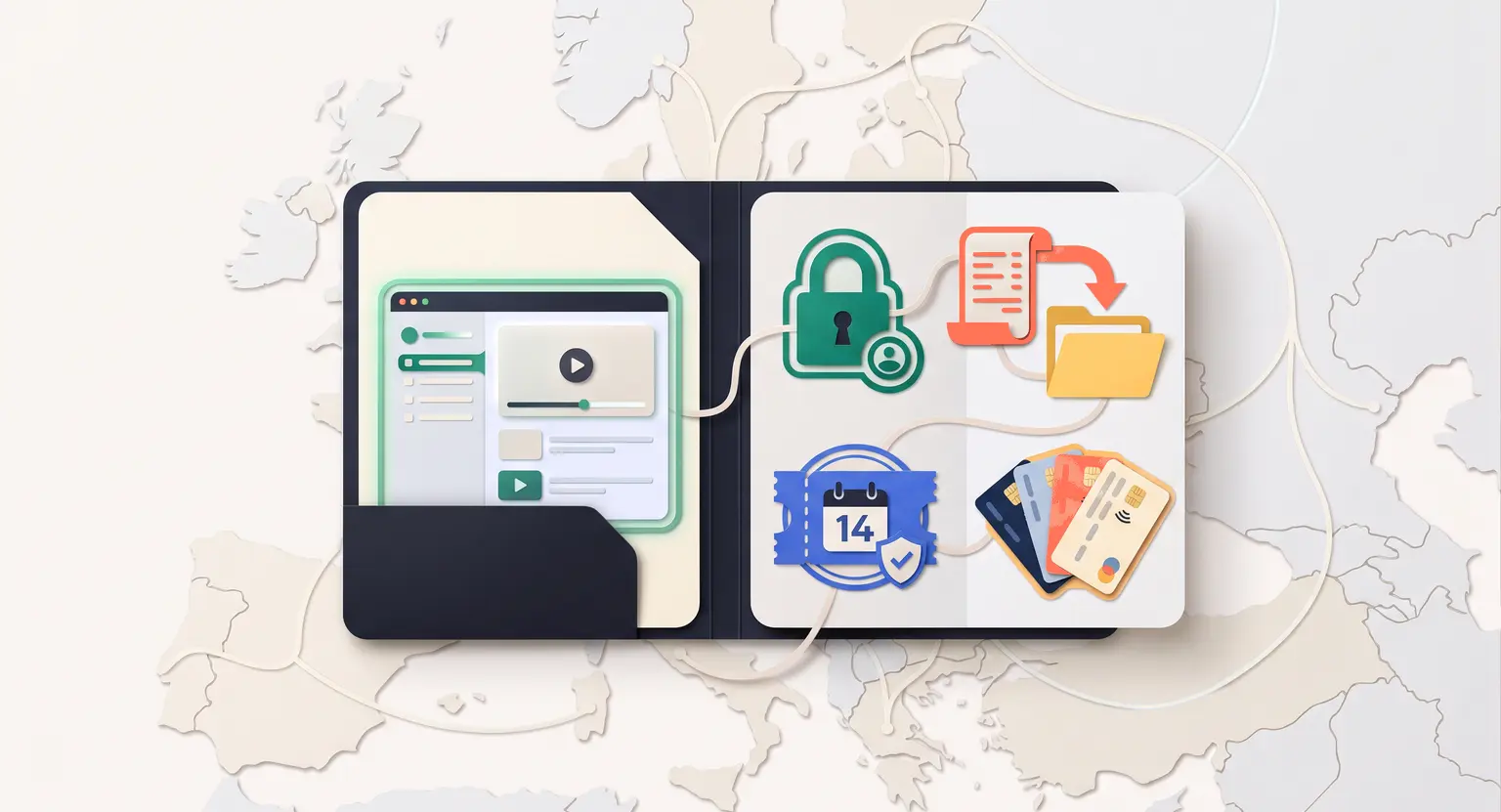
VAT OSS handles EU VAT : charge VAT based on the student's country and register via the One-Stop Shop portal to file cleanly.
-
GDPR is mandatory : protect student personal data and secure clear marketing consent.
-
Refund rights apply : EU buyers hold a 14-day refund protection window unless waived explicitly during the checkout process.
-
Local checkouts convert : European customers prefer localized bank options like iDEAL or SEPA bank debit over standard credit cards.
The European e-learning market is growing rapidly in 2026. If you possess unique professional knowledge to share, targeting motivated students in France, Germany, or Spain is a smart business move.
But researching European selling laws can feel overwhelmingly complex at first… After all, Europe holds a vast audience of students eager to advance their careers and easily learn practical new skills.
The rules do not have to block your progress. They are easy to navigate when you use the right systems.
Once you understand the digital market parameters in Europe, you can expand your reach confidently.
Let us break down how to safely and profitably sell your digital courses across the entire continent.
Mastering EU VAT without the Headache
The biggest worry for course creators in Europe is Value Added Tax (VAT).
If you reside outside the EU, you owe VAT from your very first consumer sale. There is no minimum threshold.
For EU-based creators, a threshold of €10,000 applies across the bloc. Once your cross-border sales surpass this, you must charge the rate of each individual consumer's country.
These rates vary significantly. Hungary requires 27% VAT, while Germany requires 19% and Luxembourg requires 17%. Finding a way to automate this tracking is your key to remaining sane while running your online academy.
How do you manage this without administrative headaches?
The easiest route is the One-Stop Shop (VAT OSS) portal. This lets you register in one EU country, file a quarterly return, and pay your due taxes in one batch.
Alternatively, checkout tools can automate this process. Reading VAT on Online Courses : What Creators Need to Know will clarify these rules.
Utilizing a secure checkout gateway like Learnypay secure payments identifies student locations automatically, ensuring tax calculations remain highly accurate and your native online transactions remain fully compliant.
GDPR and Student Trust
The General Data Protection Regulation (GDPR) mandates how you handle student files. When users sign up for your digital classes, you store their name, email, physical address, and billing information.
To stay fully compliant :
-
Secure active, unambiguous consent for marketing newsletters.
-
Present a clear, easily accessible privacy policy link directly on your checkout page.
-
Provide simple, direct options for students to delete their personal details.
Implementing these processes shows buyers you value their privacy. When students feel safe and realize you care about their data safety, your sales conversions naturally go up.
To draft correct policy texts, check out our guide on GDPR for Online Course Creators. Additionally, understanding what legal pages an online course website needs will guarantee you are compliant with administrative courts from day one.
Consumer Protection and the 14-Day Refund Rule
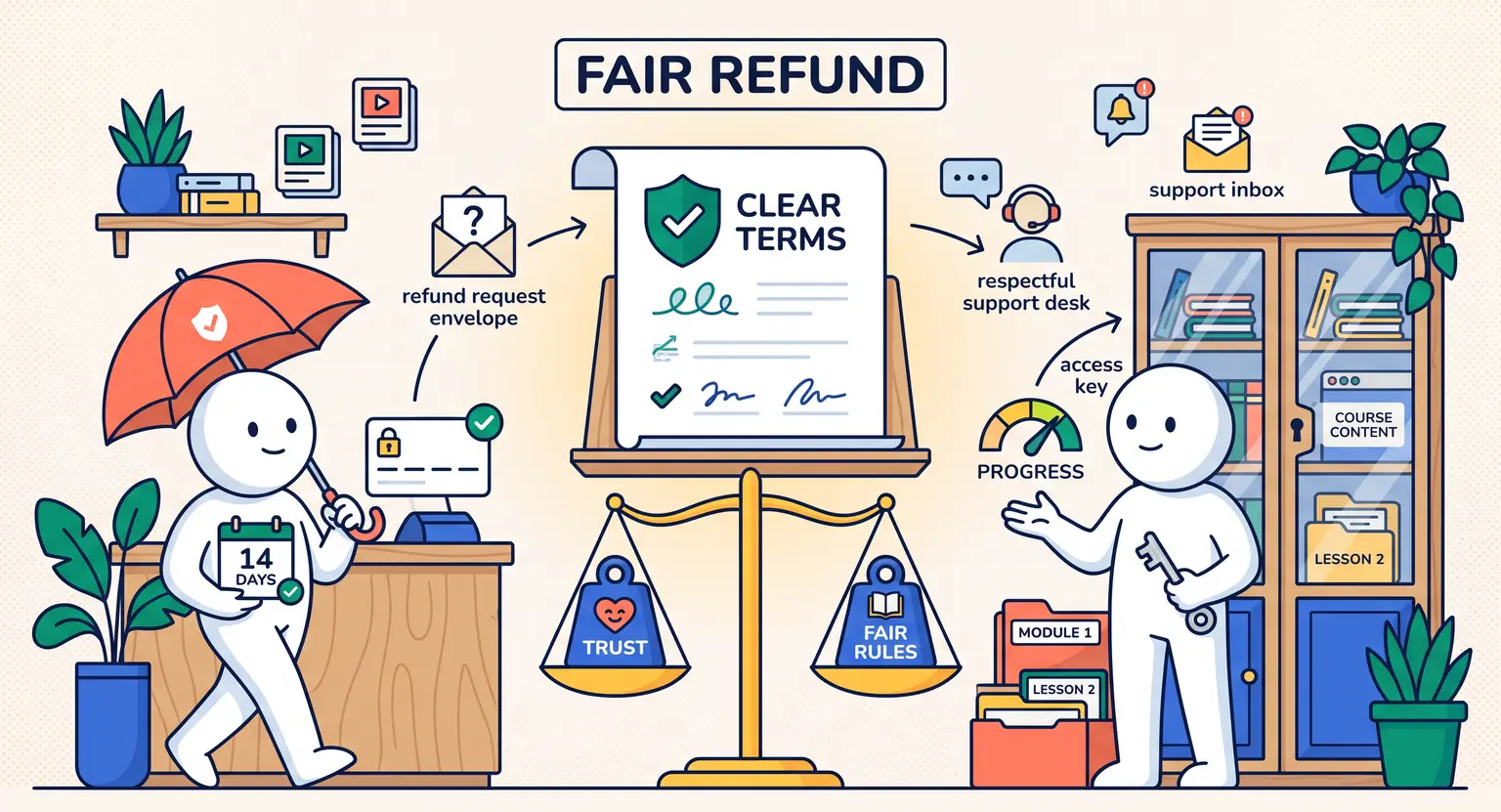
Under European consumer law, B2C buyers have a strict 14-day "Right of Withdrawal" to get a full refund. But what if they consume your entire digital course within a single day and ask for their money back?
The law allows you to protect yourself, provided you format your checkout correctly.
The 14-day refund right can be waived for digital content. To do this, add a mandatory check box at checkout. The statement must say that by accessing the content immediately, the student explicitly waives their 14-day refund right.
Of course, you can still easily offer standard money-back guarantees to build customer trust. But securing the legal waiver on your checkout remains your absolute best tool to defend your proprietary content against internet pirates.
Localization, Currency, and Payment Options
Do not assume all European clients prefer Mastercard or Visa. Only providing standard card fields will cost you business.
Europeans strongly prefer local payment systems :
-
iDEAL : dominates online purchases in the Netherlands.
-
SEPA Direct Debit : highly popular across Germany and France for recurring memberships.
-
Sofort / Klarna : extensively used for instant bank transfers in Central Europe.
While the Euro is widely used, countries like Poland, Sweden, and Denmark keep their own currencies. Offering localized pricing and payment methods dramatically reduces friction.
In fact, seeing familiar payment icons at checkout establishes instant trust. If a Dutch user sees the iDEAL logo, their purchase anxiety drops to zero.
Look for an all-in-one platform to sell online courses that natively supports these vital European integrations. Aligning these payment setups with your online course pricing strategy will maximize your European business revenue.
Comparing European Selling Options
Before launching your course, evaluate how different sales setups handle EU rules.
| Course hosting strategy | EU VAT responsibility | GDPR compliance level | Local European payments |
|---|---|---|---|
|
All-in-one hosted platform |
Direct checkouts simplify VAT OSS; automates user location tracking. |
High; features built-in privacy settings, cookie consents, and secure storage. |
Excellent support for SEPA, iDEAL, and multiple currencies. |
|
Merchant of record / marketplaces |
Platform collects and remits VAT automatically as "deemed supplier". |
Moderate; limits your database control and leads list ownership. |
Standard cards and global wallets; lacks localized payment customizability. |
|
Self-hosted / WordPress LMS |
Entirely your own responsibility; requires complex third-party tax plugins. |
Hard; requires manual database security and complex cookies setups. |
Varied; configuration requires high developer expertise. |
Launching and Recruiting Students in Europe
With your administrative compliance secured, you can focus on your direct marketing.
European buyers respond well to high-value, informative marketing methods. To fully capture this market, study how to validate an online course idea to verify your digital program fits local audiences.
Once validated, use a reliable best platform to sell online courses to build optimized, multi-language landing pages.
Building custom funnels that respect local languages is a game changer. If you make French or German pages, matching the cultural nuances speeds up your acquisition cycle enormously.
To fill your student roster, explore how to market an online course internationally. Leveraging modern digital tools lets you connect with European clients easily. If you are ready to scale, use LearnyBox to sell online courses on a platform engineered to manage European tax, data, and payment parameters natively.
Automating Your European Course Business
Running an international online education business can easily turn into a complex administrative puzzle.
Managing various tax filings, ensuring database security under GDPR, and manually following up with different buyers in multiple time zones will eat up your valuable creation time.
To avoid burnout, you should streamline your work. Using systems to automatically send invoices, dispatch tax confirmations, and enroll learners is key. Learn how to automate the administration of an online course business to save dozens of hours each week.
In addition, creating a premium student entry path ensures Europeans feel valued from their very first click. Spend time constructing a clear welcoming flow by following our guide on how to design an online course student onboarding experience to drastically reduce refund requests.
Setting up automatic email triggers will help you focus purely on course creation.
Frequently Asked Questions
Do I need to register for VAT in every EU country?
No, you definitely do not need to register everywhere. Instead, you can use the EU One-Stop Shop (VAT OSS) portal. This lets you register in one chosen member state, aggregate your digital sales across the entire EU bloc, and submit one combined quarterly VAT declaration.
What rules apply when selling courses to EU business clients (B2B)?
When selling to an EU business customer with a valid VAT registration, the "reverse charge" mechanism applies. You issue a 0% tax invoice, and the buyer assumes tax reporting liability. Your checkout must verify their company VAT details in real-time.
Can you safely ignore European compliance laws?
No, you cannot. Any creator marketing and selling digital courses to residents in the European Union must comply with GDPR and EU VAT laws. European tax authorities actively enforce rules on international sellers, making standard compliance the absolute safest strategy.







 How to Create a Course Refund Policy (Templates & Best Practices for 2026)
 How to Run a Beta Version of an Online Course (2026 Guide)
 How to Create a Cohort-Based Online Course (2026 Guide)
 How to Sell an Online Course With a Quiz Funnel (2026 Guide)
 How to Sell an Online Course Through a Sales Call (2026 Guide)