







Legal Basics for an Online Course Business (2026 Guide)
Legal Basics for an Online Course Business
Key Takeaways for Safe Course Launching
-
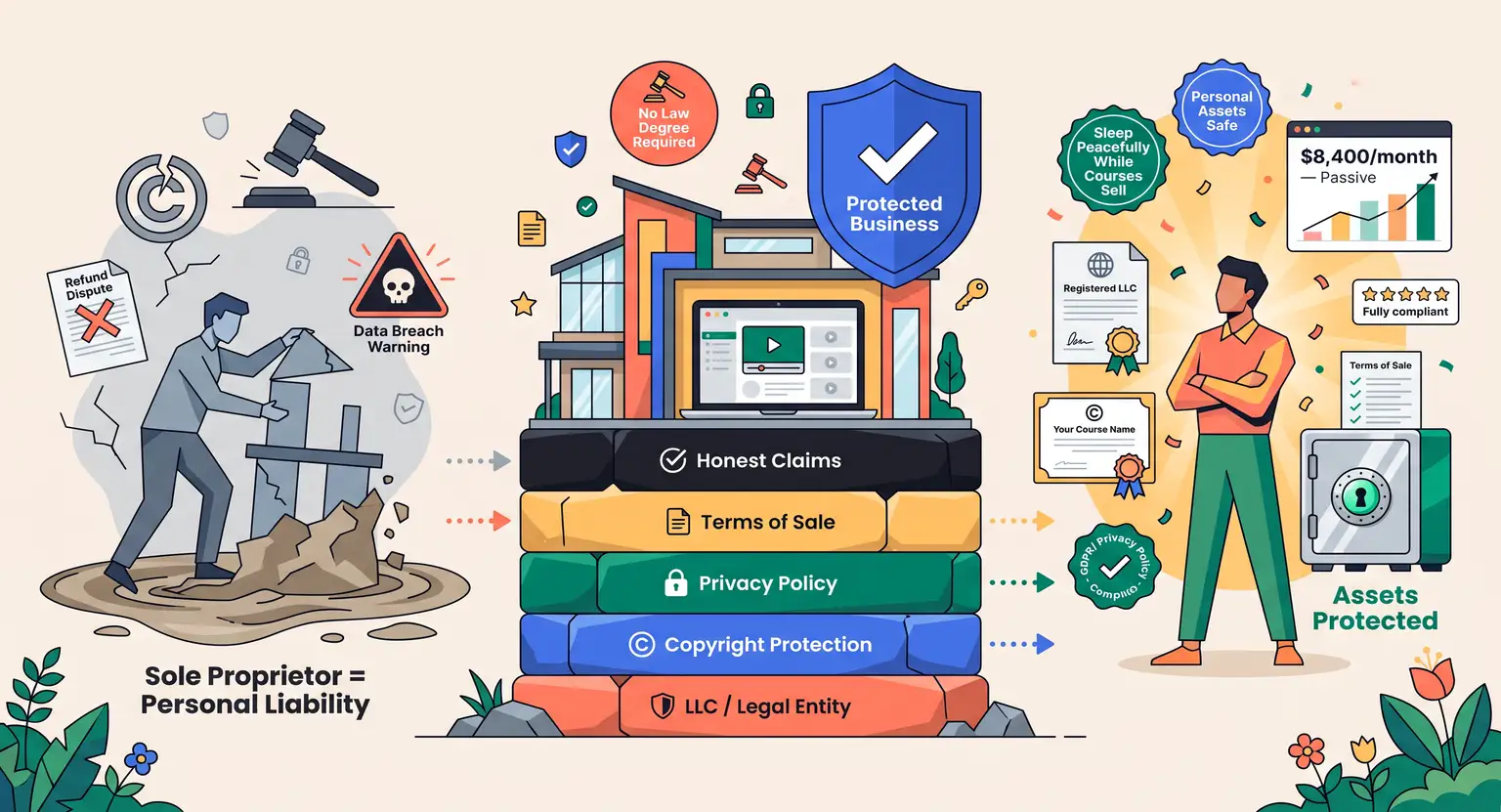
Separate your liability : moving from a hobbyist to a registered entity protects your house, savings, and personal assets.
-
Use custom legal agreements : never copy someone else's terms; a solid terms of sale ensures safe refund structures and dispute resolution.
-
Protect your data : a comprehensive privacy policy keeps you compliant with global laws like the GDPR and CPRA.
-
Protect your intellectual assets : implement copycat prevention strategies and claim clear intellectual property ownership rights.
-
Avoid misleading claims : frame your testimonials and outcomes around honest feedback to avoid legal pitfalls.
You have recorded your lessons, finalized your slides, and picked out a dynamic topic that you know will change lives…
Selling your knowledge online is one of the most rewarding businesses you can start today.
But amidst the excitement of designing course modules, launching marketing plans, and choosing your tools, there is a quiet elephant in the room - and that elephant is the complex matrix of legal rules.
Ignoring the strict legal side of your digital education business is like building a massive mansion on quicksand…
You might look highly professional on the outside, but one gust of wind, like a major copyright claim or a dispute over a massive refund request, can wash the whole structure away.
You do not need a fancy law degree to stay safe. By getting a handle on a few fundamental concepts, you can protect your intellectual work, defend your income, and sleep peacefully at night while your courses sell passively around the world.
Structuring Your Business : LLC vs. Sole Proprietorship
When you start accepting money for your courses, you are automatically operating a business. In the eyes of the government, if you have not registered a formal entity, you run things as a sole proprietor.
This is incredibly easy because you do not have to fill out any paperwork or pay registration fees, but there is a massive catch you need to look out for.
As a sole proprietor, your business and your personal life are legally identical. If a student feels that your advice caused them financial harm or physical injury, they can sue you personally - that means your bank account, your home, and your car could be at risk.
Let's say you teach a course on real estate investing or strength training. If someone loses substantial capital or hurts themselves following your instructions, a lawsuit could wipe out everything you own.
This is why forming a Limited Liability Company (LLC) or a local equivalent is a major step forward.
An LLC creates a clear, protective legal barrier between your personal life and your business. It acts as an energetic shield : if the LLC gets sued, only the assets owned by the LLC are on the table.
So, setting up a separate business bank account is also non-negotiable. If you mix your personal grocery money with your course revenue, courts can "pierce the corporate veil," making your LLC's protective shield completely useless.
Keep your money cleanly separated right from the start.
The Essential Website Legal Agreements (Your Defense Suite)
When prospective students or random visitors land on your pages, they enter your virtual store. To keep things safe, you need specific legal agreements.
Let's look at the big three :
The first is your Website Terms of Use.
This agreement dictates the rules of engagement for anyone surfing your pages. It outlines that your writing, logos, and layouts are yours.
It also allows you to ban trolls, block automated scrapers, and establish which state's laws govern your business if a dispute arises.
The second is your Privacy Policy.
It is not just a polite document; it is a global legal mandate.
If you use analytical tools, place trackers, or gather email leads, you are collecting personal data. You must disclose exactly what you collect, how you keep it safe, and who you share it with.
If you plan on implementing automated sequences, our guide on email marketing for course creators covers how to safely build communication channels while honoring international data guidelines.
The third is your Terms of Sale.
This is arguably the most vital document for a course creator. It acts as the direct contract between you and your paying students.
It answers the critical business questions :
How does the delivery of the modules work?
What is your policy on lifetime access?
When do you charge card details, and how do you handle recurring subscription fees?
If you ignore this, you run the risk of payment chaos.
Protecting Your Intellectual Property from Pirates
You poured your heart, time, effort, and specific expertise into building slides, writing workbooks, and filming deep video lessons, but what happens if some user buys your course, downloads all the PDFs, and hosts them on a public forum or shared drive?
Or worse, rebranded under their own name?
First, you must understand that federal copyright law protects your course materials the second you create them - you do not strictly have to register them with a government office to own them, though doing so does give you massive leverage in a courtroom.
To combat piracy, make your defense structural and legal. Write terms stating that buying your course grants only a limited, non-transferable, single-user license.
If a user shares their login credentials, your terms must give you the absolute right to terminate their account instantly without returning their cash.
Technological safeguards help too. Host your files on secure video players that block easy saving options. You can stamp your students' email addresses onto PDFs automatically.
But most of all, build a community that loves your live support, updates, and feedback. Pirates cannot steal the dynamic, human relationship you build with your students.
Advertising, Disclaimers, and FTC Compliance
Marketing your course requires enthusiasm. You want people to see how incredible your results are… But in 2026, regulatory agencies like the Federal Trade Commission (FTC) and consumer groups are more eagle-eyed than ever regarding truth in advertising.
You must completely avoid making wild, unsubstantiated claims. If you teach a trading course, you cannot promise students they will make ten thousand dollars in their first month.
If you showcase a stellar student testimonial, you must show what their actual circumstances were, or include a clear, readable disclaimer stating : "These results are not typical. Average outcomes vary based on individual effort and industry variables."
And do not bury these disclosures in tiny, invisible grey text at the bottom of the page. It has to be highly visible, clearly written, and placed right next to your success claims.
If you offer specialized coaching, you have to be particularly precise about your professional boundaries. Ensure your onboarding documents outline that you are a guide, not their official doctor, legal representative, or registered financial advisor.
This is a vital phase of your client onboarding for coaches process, helping you manage student expectations while creating an ironclad barrier against professional liability claims.
International Data Protection Laws (Going Beyond Borders)
The internet has no borders. When you upload a course, your student base could be a graphic designer in Munich, an accountant in Toronto, and a fitness enthusiast in San Francisco. This means you are suddenly interacting with global legal jurisdictions.
The primary regulations you must understand are Europe's General Data Protection Regulation (GDPR) and the California Consumer Privacy Act (CCPA/CPRA). These laws apply directly to where your students live, not where you are physically based.
If a European citizen signs up for your free training, you cannot just add them to a marketing automated list without their active, explicit opt-in.
Pre-checked checkboxes are completely illegal - you must offer a simple, immediate way to unsubscribe, and you must respect the "right to be forgotten" if they ask you to completely scrub their details from your databases.
Staying compliant might sound like an administrative burden, but utilizing smart software that handles tracking preferences makes this process seamless.
Setting up your business with the all-in-one platform course creators trust ensures you have integrated cookie consent banners, clean legal checkboxes, and secure databases that respect customer privacy frameworks automatically.
Clear Payment Arrangements and Ironclad Refund Structures
Let's talk realistically about the true lifeblood of your digital operation : your money.
Chargebacks occur when a customer files a dispute directly with their bank rather than talking to you. This hurts your reputation with payment processors, and if your chargeback rate gets too high, your merchant account can be frozen.
To stop chargebacks before they happen, use a super clear descriptor on your billing statement.
If your student sees "EDU-COURSE-99" on their bank statement instead of your company name, they might think it is fraudulent and report it. Make sure your checkout system uses a recognizable business name.
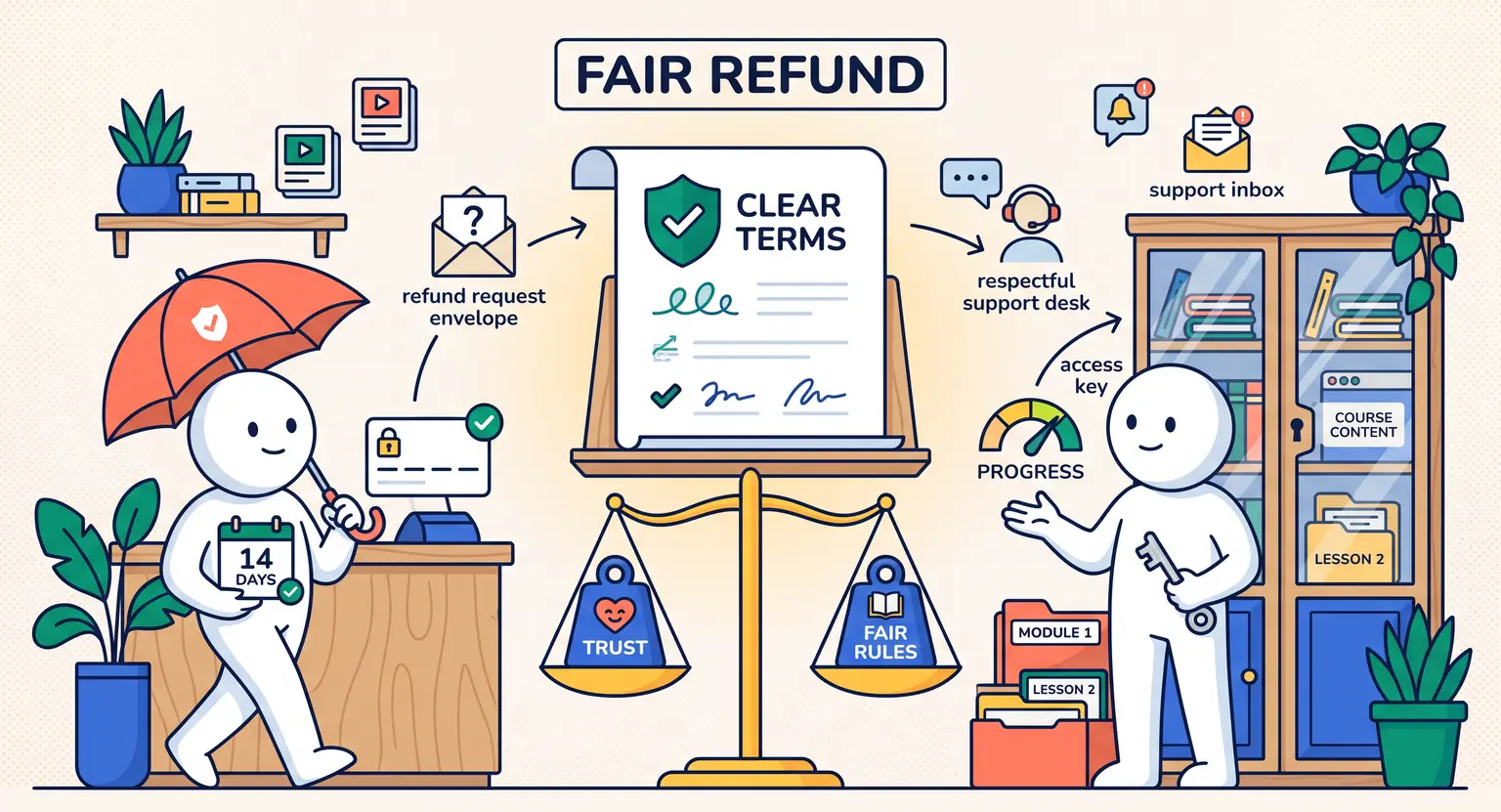
Your refund policy must be clear, easy to locate, and completely unambiguous.
Are refunds offered within 14 days?
Do you require students to show they actually watched the lessons and finished the worksheets before getting a refund?
Or do you have an absolute "no refunds, all sales are final" policy?
Either approach is fine, but you must clearly display it before they hit the buy button.
During checkout, require customers to check an unselected box stating, "I agree to the Terms of Sale and Refund Policy."
Our breakdown of how to set up payments for digital products outlines how to structure these gateways to guard against lost revenue while remaining hospitable to your customers.
The Five Core Legal Components of a Course Business
| Legal pillar | Main purpose | Key content elements | Risk level without it | Action step |
|---|---|---|---|---|
|
Business entity (LLC) |
Keeps your personal wealth entirely distinct from business liabilities. |
Articles of Organization, Operating Agreement, EIN registration documents. |
High (personal assets exposed). |
Register your LLC and open a distinct business bank account. |
|
Terms of sale (purchase policy) |
Sets clear agreements regarding licensing, payments, and refunds. |
Payment schedules, refund guidelines, single-use licensing clauses. |
Medium-High (merchant disputes). |
Apply terms of sale to checkout screens via mandatory click-wraps. |
|
Privacy policy |
Explains transparently how user data is gathered, tracked, and stored. |
Cookies usage, email data collection, third-party vendor transfers, GDPR/CCPA declarations. |
High (regulatory penalties). |
Publish a compliant privacy policy linked permanently in your website footer. |
|
Website terms of use |
Controls the rules of engagement for visitors browsing your site. |
Intellectual property declarations, dispute venue, prohibited site actions. |
Low-Medium (scraping and branding theft). |
Link it on all pages alongside your legal notices. |
|
Industry-specific disclaimers |
Removes professional liability for teaching results-oriented niches. |
Earnings disclaimers, health and fitness limits, clear results not guaranteed text. |
Medium-High (false advertising fines). |
Display near testimonials and during checkout processes as needed. |
Explore Further
-
Determine the perfect value proposition using our online course pricing strategy guide to establish sustainable price tags.
-
Avoid structural platform missteps by studying the common mistakes to avoid when creating online courses.
-
Choose a rock-solid, incredibly secure hosting framework through the best all-in-one course platform options available on the market today.
-
Protect your business at every level by visiting LearnyBox to design, host, and deliver secure masterclasses effortlessly.
Frequently Asked Questions Regarding Course Law
Do I need to register a business entity like an LLC before launching my online course?
While you can legally launch as a sole proprietor right now, registering a formal business entity like an LLC or S-Corp is highly recommended.
It creates a shield between your personal assets (like your home, savings, and car) and your business liabilities.
If a student decides to sue you over advice or a technical issue, they can only pursue business assets rather than your personal wealth.
Can I copy another platform's Terms of Sale or Privacy Policy if we sell similar courses?
No, copying term templates from competitors is both copyright infringement and highly risky.
Every online business has slight differences in their sales funnels, refund setups, regional taxes, and data collection models.
Using standard templates customized by a lawyer, or using built-in compliant generation tools inside your platform, is much safer and ensures you match actual local and global consumer laws.
How do I protect my course videos and worksheets from being pirated online?
Complete immunity to piracy is impossible, but you can deter it.
Use automated PDF stamping to print student emails on worksheets, choose a secure hosting platform that prevents easy video downloading, and write clear terms stating sharing login credentials is grounds for immediate account closure.
You can easily send standard DMCA notices if you catch your files hosted completely illegally.
Are email newsletters and landing pages subject to international privacy laws?
Yes, absolutely. Regulations like GDPR in Europe and CCPA and CPRA in California protect users based on where they are located, not where your business is registered.
If your landing pages collect email addresses from people worldwide, you must include a transparent privacy policy, obtain active consent for promotional marketing, and offer an easy opt-out option on every single communication.





 How to Run a Beta Version of an Online Course (2026 Guide)
 How to Create a Cohort-Based Online Course (2026 Guide)
 How to Sell an Online Course With a Quiz Funnel (2026 Guide)
 How to Sell an Online Course Through a Sales Call (2026 Guide)