







How to Verify Student Identity in an Online Course (2026 Guide)
How to Verify Student Identity in an Online Course
You just graded an exceptional capstone project. The writing was sharp, the analysis sophisticated, and the student nailed every rubric point. Then a nagging question hits you : did this person actually produce this work themselves?
In 2026, the integrity of online credentials depends largely on how confidently you can answer that question.
With AI generation tools readily available and content-sharing communities thriving across social platforms, verifying who is genuinely completing your coursework has never been more important.
This is not just about protecting your academy's reputation. It is about ensuring your graduates actually earned the skills your credential claims they possess.
Key Takeaways
-
Identity verification protects your certificate value and shields accreditation status from fraud risk.
-
Layered behavioral signals (login patterns, typing dynamics, and activity timelines) outperform one-time ID checks.
-
Assessment design is your strongest tool : linking tasks to personal project deliverables makes impersonation structurally impractical.
-
Proportionate verification keeps trust high without creating a surveillance-like environment that alienates good-faith learners.
Why Identity Verification Matters More Than Ever
Two converging pressures are making student identity verification an urgent priority for serious online educators.
The first is credential fraud. Professionals who hold unearned certifications end up in jobs they are not qualified for. That reflects poorly on the issuing academy and, depending on the field, can cause genuine harm to end clients or patients.
The second is accreditation accountability. Regulatory bodies require approved providers to demonstrate that the registered student is the one completing the learning.
If your platform allows shared accounts or proxy submissions without controls, you risk losing your approved provider status during an audit.
Fortunately, building a credible verification framework does not require invasive technology or a large compliance team. It requires smart instructional design layered with light technical safeguards.
Four Practical Identity Verification Methods for Online Courses
1. Authenticated Enrollment and Secure Login Systems
Your first verification layer begins before the student watches a single video.
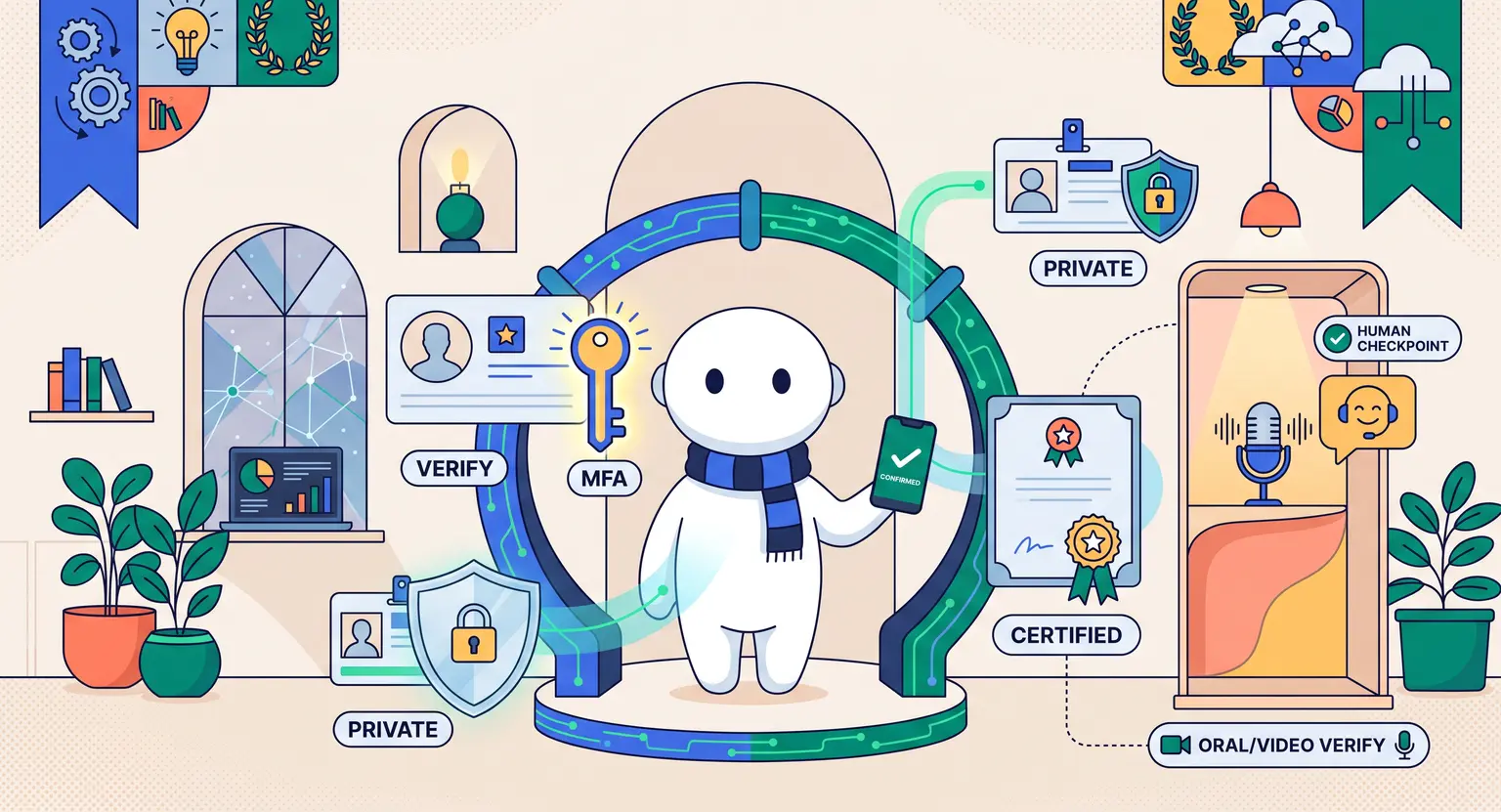
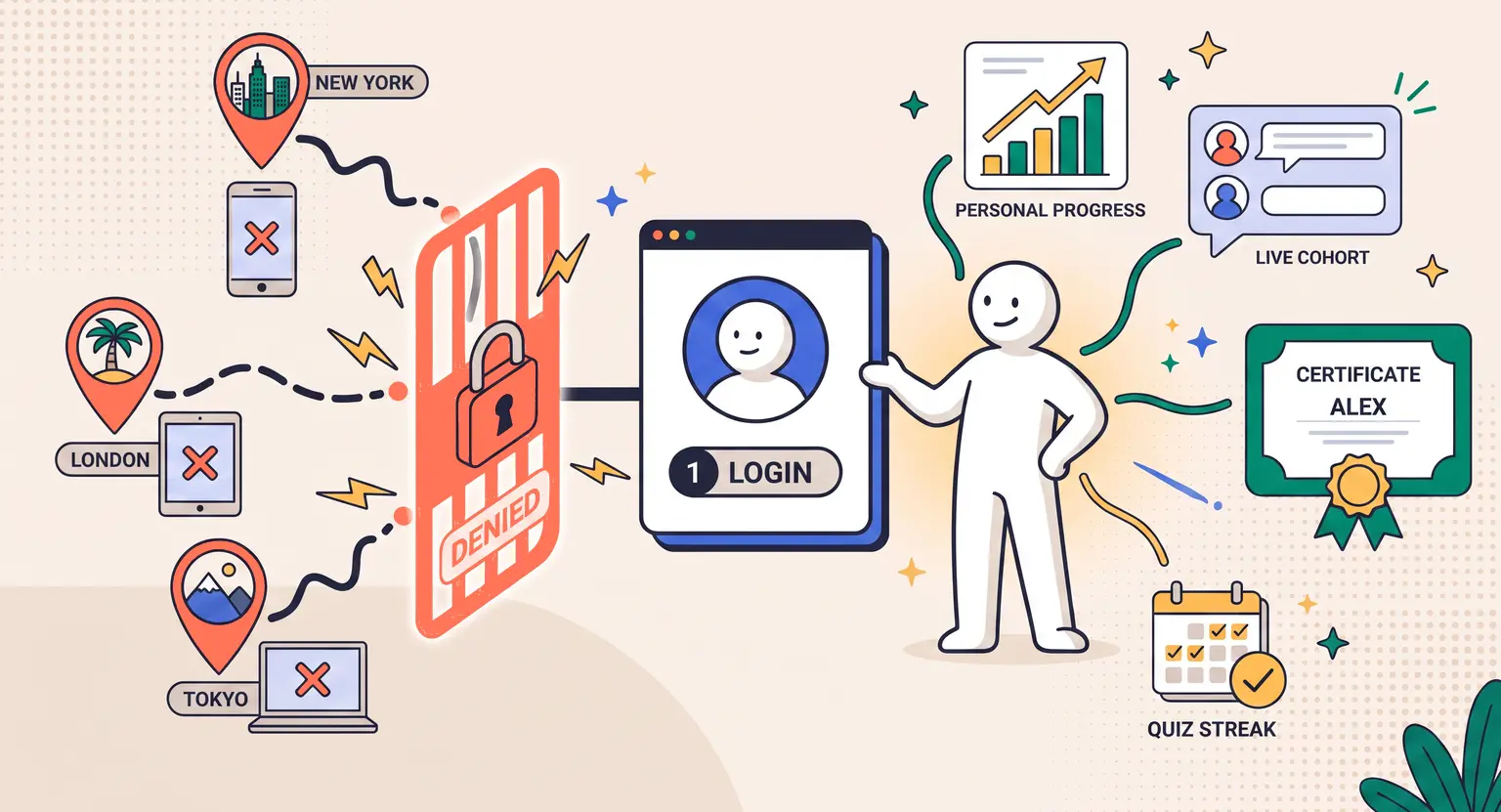
Enforce multi-factor authentication (MFA) on your student portal so that every login requires both a password and a secondary confirmation code - This prevents wholesale account sharing, where one person pays for a subscription and five colleagues use it simultaneously.
Also monitor for suspicious login patterns. If an account suddenly switches from an English-speaking country to a different region between Monday and Tuesday, that warrants a quick follow-up email confirming the account holder authorized the session.
2. Activity Tracking and Behavioral Analytics
Your LMS generates a continuous stream of behavioral signals.
A student who watches videos at three different realistic speeds, submits assignments at consistent daily intervals, and maintains stable session lengths is almost certainly one genuine person engaging with your curriculum.
Unusual patterns like fifty-percent video completion in under thirty seconds, immediate quiz submissions without replaying content, or wildly inconsistent activity bursts may indicate automated content scraping or proxy completion.
Flag these accounts for a brief human review before issuing any certificate.
3. Live or Asynchronous Identity Moments
Scheduled, low-stakes touchpoints during the course serve as natural verification checkpoints. Require students to participate in a short live orientation webinar at enrollment.
Host monthly Q&A calls where registered participants are expected to appear on video. Ask students to submit a brief audio or video check-in at the midpoint of the curriculum, with a quick response to a unique prompt related to the current module content.
These moments do not feel like surveillance because they are genuinely educational. They also create the social connection that drives higher completion rates.
4. Assignment Design as Your Primary Verification Tool
The most scalable identity verification strategy is embedding uniqueness directly into your assessments.
Generic multiple-choice quizzes are trivially outsourceable...
But an assignment that asks a student to apply your methodology to their own business, their specific industry dataset, or a custom problem scenario generated from their enrolled profile becomes nearly impossible to delegate to a proxy without extensive real collaboration.
Require audio narration over submitted work. Record a two-minute voice memo explaining your reasoning process. Reference something specific from last week's live call. These micro-requirements link the submission irrevocably to a specific individual.
Comparing Verification Approaches by Use Case
Not every course requires the same verification rigor. Here is how to match your approach to your program type :
| Verification method | Setup complexity | Student friction | Best suited for |
|---|---|---|---|
|
MFA / secure login |
Low (platform setting). |
Minimal. |
All course types as a baseline standard. |
|
Behavioral analytics |
Medium (LMS reporting). |
Zero (invisible to student). |
CEU programs and compliance training. |
|
Live video checkpoints |
Low to medium (scheduling). |
Low to medium (time commitment). |
Cohort masterminds and high-ticket coaching. |
|
Personalized assignment design |
Medium (curriculum redesign). |
Low (feels like deeper learning). |
All accredited and professional credentials. |
The Pedagogical Case for Proportionate Verification
One critical caution : the intensity of your verification approach should be proportional to the stakes your credential carries in the real world.
A hobbyist photography workshop does not warrant facial recognition checkpoints. That level of surveillance would feel invasive, would crush the learning atmosphere, and would drive capable students to competitor programs with less friction.
Scale your verification rigor to match three real-world factors :
-
Regulatory requirements : accredited CEU providers, state licensing boards, and medical training programs have mandatory verification standards that are not negotiable.
-
Credential market value : the more employers and clients rely on your certification when making hiring decisions, the more rigorously you need to protect it.
-
Course price point : a $49 introductory workshop warrants basic login security, while a $3,500 professional certification justifies multi-layered verification including portfolio evidence requirements and live identity touchpoints.
Explore Further Resources
-
Build meaningful assessments students actually complete using our guide on how to create practical assignments for online courses.
-
Develop a rigorous final assessment with our blueprint for designing a final exam for an online course.
-
Protect your credential value long-term by reviewing how to protect an online course from piracy.
-
Deliver verifiable, tamper-proof achievement records using our breakdown of how to create verifiable credentials for an online course.
Frequently Asked Questions
Is identity verification required for non-accredited online courses?
Not legally for consumer courses, but strong verification protects your certificate's market value.
Even a casual hobbyist course benefits from basic login security and assignment uniqueness requirements to prevent credential sharing.
Can I use AI detection tools to verify student-generated submissions?
AI detection is a useful signal but not a reliable sole measure.
Combine detection tools with submission-specific requirements like audio narration, personal case references, and activity audit logs to form a complete verification picture.
How do I verify identity without creating a hostile learning environment?
Frame verification as community standards rather than surveillance.
Explain from day one that your credential carries real career value, which is only possible when every graduate genuinely earned it.
What should I do if I suspect a student is sharing their account?
Send a friendly email noting that you noticed unusual access patterns.
Remind them of your single-user license terms and offer a group enrollment rate if they have a team interested in the program.
Most cases are innocent, and a warm approach resolves them without conflict.







 How to Run a Beta Version of an Online Course (2026 Guide)
 How to Sell an Online Course With a Quiz Funnel (2026 Guide)
 How to Sell an Online Course Through a Sales Call (2026 Guide)