






What Is SCORM and Do Course Creators Need It? (2026 Guide)
Key Takeaways :
-
Universal Compatibility : SCORM makes your courses playable on almost any standard corporate learning system.
-
The Enterprise Gatekeeper : If you sell your training to businesses, SCORM is a must-have.
-
Better Alternatives Exist : For selling to consumers, using an all in one platform is far simpler.
-
Next-Gen Comparisons : Understand matches by reading SCORM vs xAPI - What's the Difference for Online Courses?
Staring at technical terms can make anyone's eyes glaze over. If you hang around the digital education space for five minutes, you will encounter SCORM. It sounds like an alien species from a cheap movie, or an old tax form.
But in 2026, this standard still runs a massive chunk of digital learning. If you are preparing to package your expertise, let's break down whether you need this technical standard in friendly English.
What Actually Is SCORM?
Let's trace this back to the beginning. SCORM stands for Sharable Content Object Reference Model. Yes, it is a mouthful, which is exactly why everyone uses the acronym.
It is not a program you download, nor a specific website. Instead, it is a set of technical rules established by the United States Department of Defense.
They wanted their training materials to work seamlessly on any computer system, rather than having to rebuild every piece of content whenever they switched platforms.
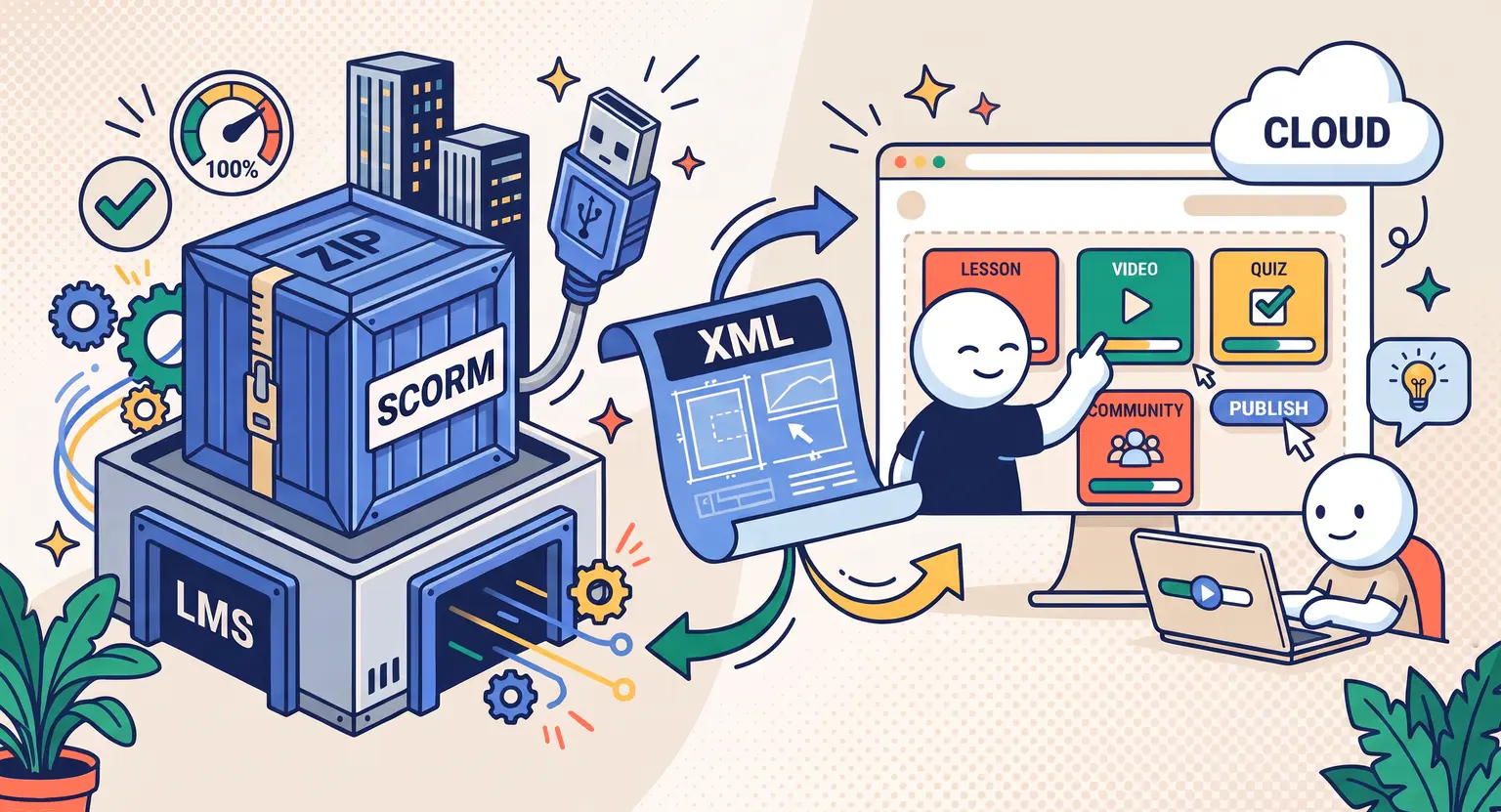
To understand it easily, think of it as the USB standard of the e-learning world. Before USB existed, you had to worry about whether a keyboard or a mouse would fit the exact socket on your computer. USB solved that by creating a universal connector. That is exactly what SCORM did for digital courses.
When you package a course using SCORM, you are wrapping it in a digital shipping container. This container holds your text, videos, and quizzes in a way that any Learning Management System can read instantly. There are two primary versions still active :
-
SCORM 1.2 : Released in 2001, this veteran format remains the absolute king of compatibility, representing over seventy percent of the packages uploaded today.
-
SCORM 2004 : A more advanced version that allows for complex sequencing, meaning you can lock certain lessons until others are completed.
How SCORM Works Behind the Scenes
Let's say you build an interactive lesson inside a specialized authoring tool like Articulate. You then export that lesson as a ZIP package.
Inside this folder, along with your slides, lies a file called imsmanifest.xml. This is the master blueprint that explains the entire structure of the course to an LMS.
Once you upload that ZIP archive to a platform, a technical dialogue begins. When your student launches the module, the player speaks with the host site. It reports specific, standardized variables :
-
The completion rate of individual sections
-
The raw score achieved on embedded testing
-
The precise total time spent inside the module
-
Whether the learner ultimately passed or failed
So instead of having to handle specialized coding, this protocol structures the background language for you. But there is a catch. This technology was designed in an era of desktop browsers. It was never built for mobile applications, offline tracking, or modern flexible video hosting.
That is why it can feel rigid for dynamic creators.
Why Traditional Course Platforms Built a Better Way
Unless you are working for a corporate giant or coordinating with university registrars, dealing with ZIP files and XML exports feels a bit like using a fax machine.
Traditional setups forced you to buy expensive licensing fees for desktop tools just to design slides and bundle them into complex packages.
But the industry shifted. When you use modern resources like LearnyBox, you are not forced into this tedious loop of exporting, debugging, and re-uploading every single time you want to fix a typo.
Cloud-first spaces let you create, structure, and modify your content directly in your web browser.
This shift simplifies the entire creation sequence. You can choose different online course formats - like video modules, text lessons, or community forums - without needing to figure out how to structure complex manifests.
And if you want to test your learners' comprehension, you don't need external interactive tools. You can learn how to create quizzes for online courses built directly into your interface.
Your platform handles all of the tracking, certificates, and student progress metrics organically under one roof, without any ancient protocols acting as the middleman.
|
Feature |
Traditional SCORM Packages |
Modern Cloud Platforms (LearnyBox) |
|
Course Upkeep |
Extremely slow. You must modify files in desktop tools, re-package, and upload a fresh ZIP file. |
Real-time. Simply open the browser edit interface, adjust the text, and hit save to instantly update. |
|
Setup Complexity |
High. Requires separate authoring tools (Articulate, Captivate) and an external hosting mechanism. |
Absolute zero friction. Build pages, secure checkouts, and content visually in one unified workflow. |
|
Target Audience |
Enterprise B2B buyers and internal corporate learning divisions with legacy compliance needs. |
Solo infopreneurs, coaches, and digital course marketers working directly with B2C consumers. |
|
Tracking Capability |
Basic metrics locked inside local systems, like section progress and raw quiz outcomes. |
Multi-dimensional activity logs, marketing pipelines, and instant customer behavior analytics. |
Do You Really Need SCORM in 2026?
Let's slice through the confusion. The choice boils down to a single question : who is paying you for your content?
If you are selling your courses directly to individual consumers (B2C), you absolutely do not need it. Independent students do not care about technical standards.
They want high-quality video content, downloadable resources, structured progression, and a smooth login experience.
In this scenario, building your school on a modern all in one platform gives you everything required to design, promote, and collect payments without ever touching a technical package file.
But the playing field changes entirely if you target B2B buyers. Corporate organizations, schools, or government bodies running an enterprise LMS elearning platform will rarely allow their employees to log into your external site.
They want your content hosted inside their existing private systems so they can track safety training, compliance, and employee progression natively.
In those lucrative B2B corridors, having a zip file package that complies with this classic protocol is the key that opens the door.
It makes you compatible with their security protocols and guarantees their internal systems can track completion rates correctly.
When making these structural decisions, it is also useful to plan how to protect your intellectual property as a course creator across both distribution models so your assets remain secure.
Frequently Asked Questions
Is SCORM still used in 2026?
Yes. Even though it is a legacy framework, it remains the primary technical communication bridge between third-party training content and internal corporate enterprise platforms.
Over seventy percent of automated lesson uploads still rely on the basic 1.2 specifications due to its universal system support.
Can I host a SCORM course on LearnyBox?
Absolutely. If you work with interactive training materials, you can coordinate and distribute them dynamically.
But if you are building everything from scratch, you will find it much faster to use the native editor to set up your chapters rather than compiling files externally.
You can review what is the best all in one course platform for your business setup to scale your operations.
What is the difference between SCORM 1.2 and SCORM 2004?
The 1.2 standard is simpler and focuses primarily on progress, basic marks, and completion status.
The 2004 framework introduces advanced sequencing, meaning you can establish paths where lessons become accessible based on previous performance. However, 1.2 is more universally supported.
Do independent creators need to worry about packaging standards?
No. If you sell classes directly to individual end-users (B2C), you do not need to compile packaging zip archives.
Normal web platforms handle all completion checks and progress tracking naturally behind the scenes.
This allows you to master how to design an online course student onboarding experience directly in the visual builder instead of fighting with manual zip modifications.



 How to Create a Course Refund Policy (Templates & Best Practices for 2026)
 How to Run a Beta Version of an Online Course (2026 Guide)
 How to Create a Cohort-Based Online Course (2026 Guide)
 How to Sell an Online Course With a Quiz Funnel (2026 Guide)
 How to Sell an Online Course Through a Sales Call (2026 Guide)