






Online Course Accreditation vs Certification: What's the Difference?
Online Course Accreditation vs Certification : What's the Difference?
Spend five minutes browsing online learning platforms and you will run into a dizzying wall of terminology : some programs promise formal accreditation, others issue certificates of completion, digital badges, or professional certifications.
For students, mixing up these terms can mean spending thousands on a course that fails to qualify them for a licensed career. For course creators, using the wrong label on a sales page can trigger consumer protection warnings or mismanage student expectations.
Let us clear up the confusion once and for all. Accreditation and certification sound similar, but they operate on completely different levels of the educational ecosystem. Understanding how they work will help you make smarter decisions as a student or build a more credible brand as an educator.
Key Takeaways at a Glance
-
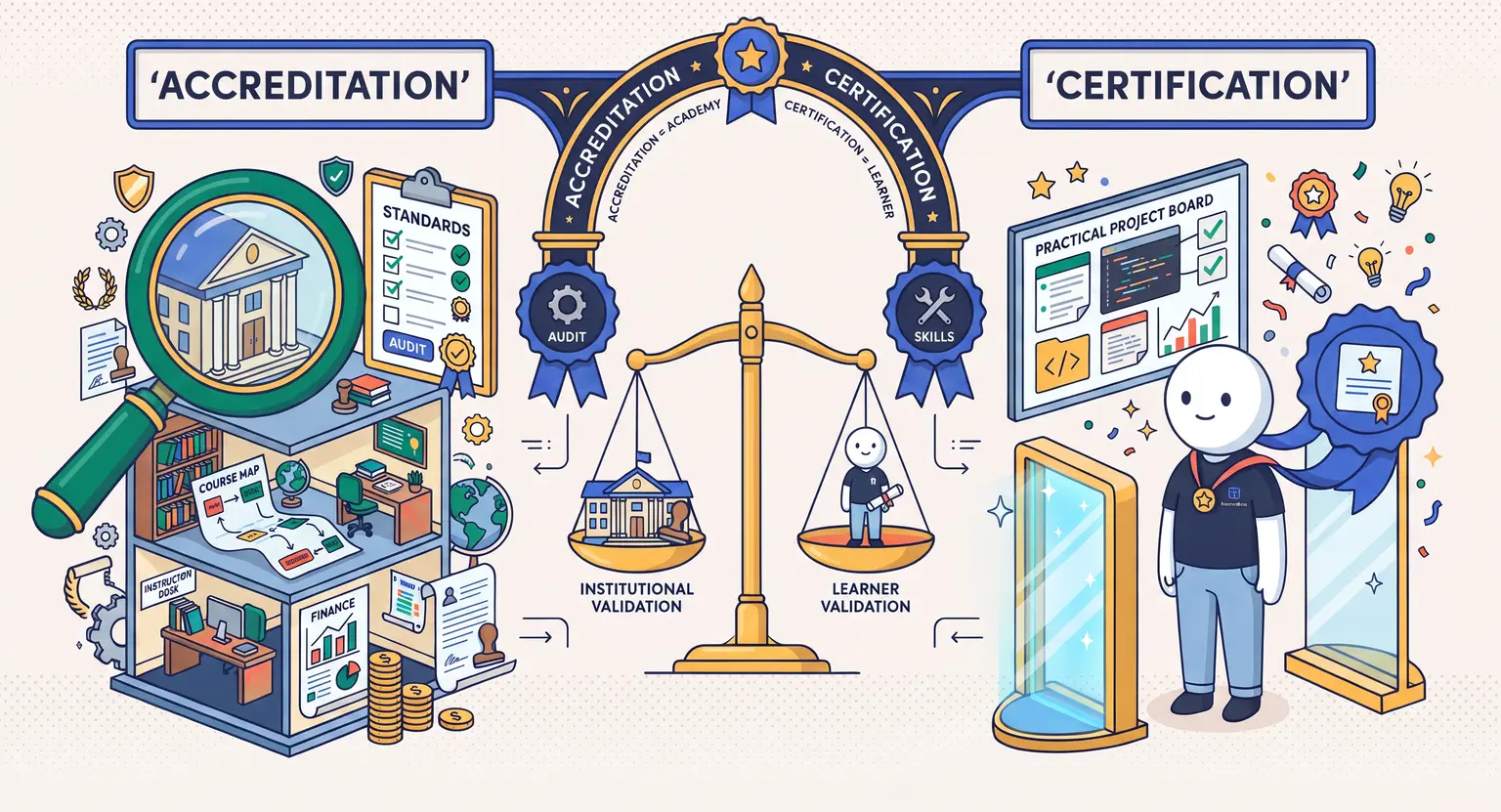
Accreditation evaluates the institution : it is a formal quality-assurance audit conducted by recognized external agencies.
-
Certification evaluates the individual : it verifies that a specific learner has mastered defined skills through assessments.
-
Legal requirements vary : regulated fields like nursing, law, and aviation require accredited education, while tech and marketing prioritize practical skill credentials. Explore how modern credentials & professional education work together.
-
Certificates of completion differ from certifications : simply finishing video modules does not equal passing an objective competency exam.
What Is Online Course Accreditation?
Accreditation is a formal validation process where an official, independent governing body audits an educational provider. The auditor checks whether the school, university, or training organization meets strict standards of academic quality, financial stability, and operational integrity.
Here is the golden rule to remember : accreditation applies to the organization or the broader curriculum, not to the individual student.
When an online degree program or vocational school earns accreditation, the accrediting board evaluates numerous backend variables :
-
Instructor qualifications and faculty oversight.
-
Curriculum relevance, depth, and learning outcomes.
-
Student support services, mentorship, and library resources.
-
Fair grading practices and assessment security.
-
Financial viability of the institution.
In the United States, legitimate institutional accreditation is recognized by the Department of Education or the Council for Higher Education Accreditation (CHEA). In Europe and other regions, national ministries of education handle this oversight.
Because the auditing process is exhaustive, expensive, and continuous, accredited institutions can offer college credits that transfer to other accredited universities. They also qualify students for government financial aid programs.
What Is Course Certification?
Certification operates in reverse. Instead of auditing the entire institution, certification evaluates and validates a specific person's knowledge, skills, and competencies.
When someone says, "I just got certified in cloud architecture," they do not mean their university got inspected. They mean that they sat for an examination, met predetermined benchmark standards, and proved they can perform a set of practical tasks.
Certifications can be issued by software vendors (like Microsoft, Google, or Cisco), professional associations (like the Project Management Institute), or reputable independent educators. They act as a verified stamp of skill for the job market.
However, we must make an important distinction here. There is a huge operational gap between a casual "Certificate of Completion" and a rigorous "Professional Certification" :
-
Certificate of Completion : a decorative document confirming a user reached the end of a video playlist. It proves attendance, not competence.
-
Professional Certification : a credential earned only after passing supervised quizzes, portfolio reviews, or practical projects. It proves measurable skill retention.
If you run your own training programs, learning how to build genuine verification layers is essential. You can discover the nuances between simple completion documents and advanced credentials in our breakdown of online course certificates vs digital credentials.
Side-by-Side Comparison : Accreditation vs Certification
To see how these concepts function in real-world scenarios, let us compare their primary attributes side by side.
| Feature | Accreditation | Professional certification |
|---|---|---|
|
Primary target |
The institution, school, or whole academic program. |
The individual learner's demonstrated skills. |
|
Governing authority |
Government agencies, regional boards, or national accreditors. |
Industry bodies, software vendors, or course creators. |
|
Credit transferability |
High (accepted by other colleges and degree programs). |
Low for degrees; high for direct workforce hiring. |
|
Verification method |
Multi-year institutional audits and faculty reviews. |
Standardized testing, practical tasks, or capstones. |
|
Typical expiration |
Permanent academic transcript record. |
Often requires renewal or continuing education (1-3 years). |
|
Tech implementation |
Traditional student records & registrar databases. |
Automated learning portals; see how to create verifiable credentials. |
Why Does This Distinction Matter in 2026?
The global online education market has evolved rapidly over the past few years. Self-paced learning is no longer an informal hobby; it is a primary avenue for career shifts, corporate upskilling, and professional licensing. Because learners are investing substantial money and time into digital programs, transparency is everything.
For the Student and Career Builder
If your goal is to land a job as an accountant, registered nurse, public school teacher, or civil engineer, you must check for formal accreditation. Employers in regulated professions are legally forbidden from hiring candidates who lack accredited degrees or board-certified credentials.
On the flip side, if you are studying digital marketing, front-end development, UX design, or video editing, formal academic accreditation matters far less. Employers in these industries care about your project portfolio, your technical skills, and recognizable industry certifications.
For the Independent Course Creator
Many course creators ask : "Should I get my online course accredited?" For 95% of independent educators, seeking formal higher-education accreditation is completely unnecessary. It involves massive regulatory hurdles, years of bureaucratic paperwork, and high renewal fees.
Instead, your real goal should be creating a stellar, high-standard certification program. When your students consistently get promoted, land freelance clients, or solve complex business problems, your certification builds strong organic market authority.
The Grey Zone : Unaccredited "Accreditation" Scams
As online learning exploded, an unfortunate industry of fake accreditation emerged. Unethical course sellers often display flashy golden badges claiming to be "Internationally Accredited by the Global Board of Online Educators" or similar made-up entities.
These fake accrediting bodies are essentially pay-to-play websites. Anyone can pay a fee to download a badge and claim external validation.
Why is this dangerous? Regulators are cracking down hard on misleading educational advertising. If you market an online course as "accredited" when your accreditor is not recognized by a legitimate government authority, you risk severe financial penalties.
Be radically transparent with your students. You do not need to fake accreditation to sell courses. Tell your audience that you provide practical, expert-led industry training designed for immediate workplace execution.
How to Build a Reputable Certification Program
If you want your certification to hold genuine value for your students' resumes, you need to build rigor into your curriculum. A credential only carries prestige if earning it requires real effort. Here are practical steps to make your online certification meaningful :
1. Design Objective Assessments
Do not just hand out credentials because a user scrolled through a video. Add graded assessments that test conceptual understanding and critical thinking. If you need help designing robust tests, review this practical guide on how to create quizzes for online courses to safeguard your testing integrity.
2. Require Practical Capstone Projects
Multiple-choice quizzes can easily be guessed or solved with AI tools. Require your learners to submit an actual deliverable : a coded website, a written marketing strategy, a financial spreadsheet, or a case study analysis. Manually grading or peer-reviewing final projects adds enormous real-world credibility to your certification.
3. Use Verifiable Digital Badges
Paper certificates saved as PDF files are easily modified with graphic editors. In 2026, standard practice is issuing blockchain-backed or URL-verifiable digital badges that employers can click to verify the recipient's name, issue date, and specific skills assessed.
4. Keep Curriculum Aligned with Market Demands
Tools and workflows evolve fast. If your certification covers software development or search engine algorithms, review and refresh your syllabus at least once a year. When employers know your graduates are up to date with modern standards, your badge becomes an industry asset.
Explore Further Resources
-
Master the architecture of learning outcomes with our blueprint on how to structure online courses.
-
Discover how to choose the right financial model using our online course pricing strategy.
-
Scale your entire training ecosystem using an all-in-one platform to sell online courses.
-
Turn your skills into scalable income when you sell online courses on your own terms.
Accreditation vs Certification : Which Should You Choose?
Choosing between these two educational paths depends on your personal role and long-term targets.
If You Are a Learner :
-
Choose accredited programs when you need transferable college units, government loans, or a legal license to practice (medicine, law, formal schooling).
-
Choose certified programs when you need fast, highly practical skills to build a portfolio, switch careers into tech, or gain promotions in the corporate sector.
If You Are an Educator or Creator :
-
Pursue formal accreditation only if you are founding a licensed vocational school, university department, or continuing education unit with institutional backing.
-
Build an industry certification if you are an expert sharing actionable knowledge, building a digital academy, or training teams in modern business skills.
Final Thoughts
The distinction between accreditation and certification comes down to institutional oversight versus individual skill proof. Accreditation validates the school; certification validates the student.
Do not let terminology trip you up. As an online educator, you do not need an official university seal to deliver massive transformation. Focus on high educational standards, verify student mastery through practical projects, and issue transparent credentials that your graduates can display with pride.
Frequently Asked Questions
Can an individual creator grant an accredited course?
No. Accreditation requires an extensive third-party review by a recognized governmental or industry accrediting board that evaluates institutional stability, curriculum rigor, and administrative oversight. Individual creators can, however, partner with accredited institutions or offer certified training programs.
Does a certificate of completion count as a professional certification?
Not automatically. A certificate of completion merely confirms that a student finished watching the lessons. A true professional certification requires rigorous assessment, demonstrated skill mastery, and alignment with standardized industry competencies.
Will employers accept an unaccredited online certificate?
Yes, especially in tech, creative arts, marketing, and business management. Employers increasingly prioritize verifiable portfolio work and recognized skill mastery over traditional institutional seals, provided the certificate issuer has a solid industry reputation.
How much does it cost to get an online program accredited?
Formal institutional or programmatic accreditation often costs tens of thousands of dollars and takes several years of auditing. For most independent educators, building a reputable professional certification program is far more practical and cost-effective.


 How to Create a Course Refund Policy (Templates & Best Practices for 2026)
 How to Create a Cohort-Based Online Course (2026 Guide)
 How to Sell an Online Course With a Quiz Funnel (2026 Guide)
 How to Sell an Online Course Through a Sales Call (2026 Guide)