







AI Course Outline Generator: Build Your Perfect Syllabus Instantly
AI Course Outline Generator : The Blueprint for Modern Online Creators
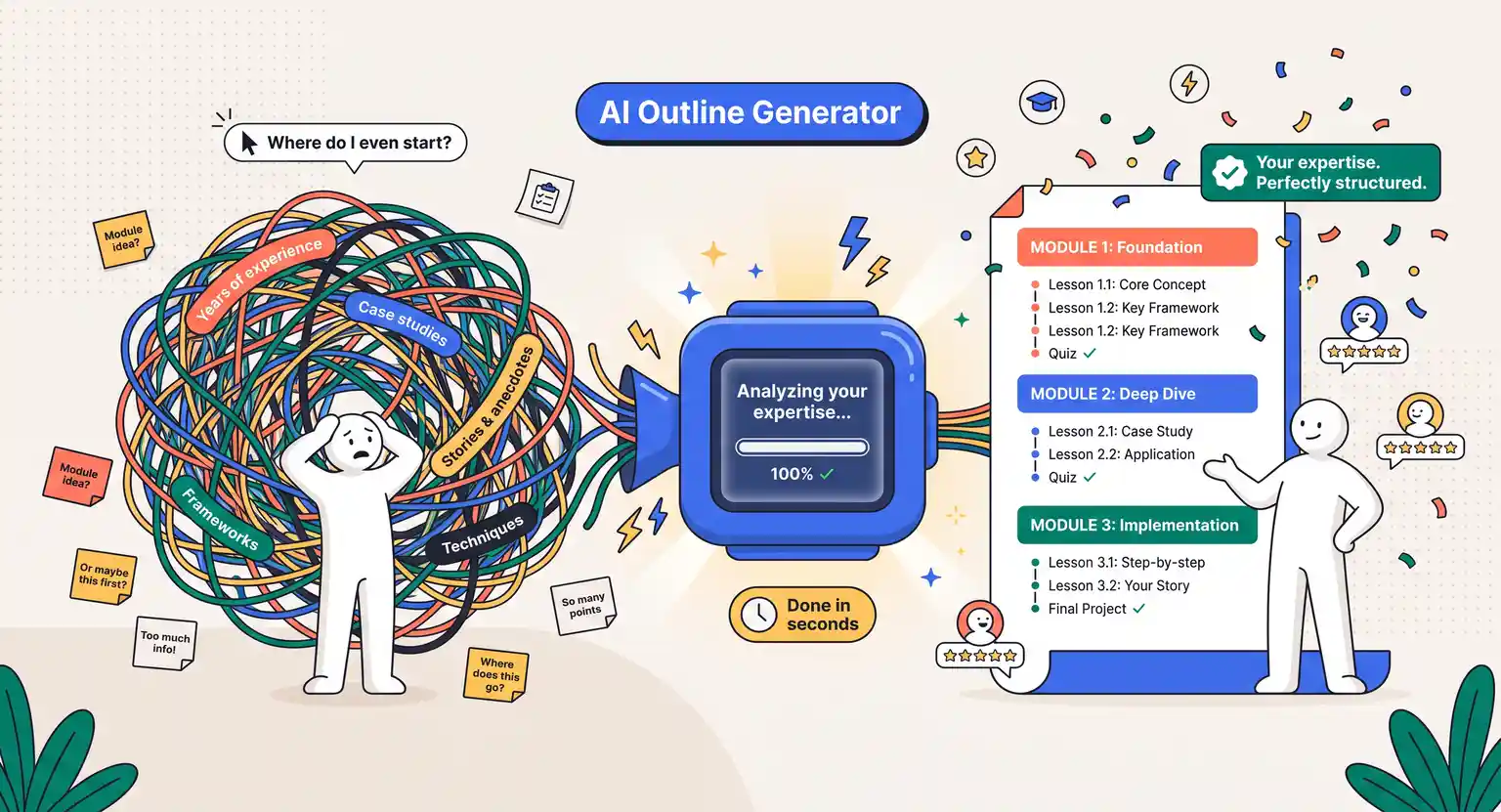
Remember that blinking cursor? We have all been there. You are sitting in front of a blank screen, trying to figure out how to structure weeks of your personal knowledge into a logical flow.
Honestly, it is the hardest part of launching any online program. You have years of valuable expert knowledge trapped inside your head, but organizing it into digestible, engaging lessons feels like trying to sort an enormous basket of tangled yarn.
But here is the good news : in 2026, you do not have to struggle through this creative block alone.
An AI course outline generator can take your messy pile of thoughts and turn them into a structured curriculum in seconds. It does not replace your human genius; it simply acts as an incredibly fast digital assistant that builds the blueprint for you.
If you are ready to get your program off the ground without wasting days on planning, let us talk about how to use these modern tools effectively.
And let us be honest : the online education market in 2026 is busier than ever. If you launch a course that has a chaotic layout, students notice immediately. They want clean, fast learning pathways that deliver immediate outcomes.
That is why planning your architecture is no longer optional; it is the absolute foundation of your business.
Quick Insights
-
Beat Writer's Block : AI outline generators turn a blank page into a structured curriculum in under a minute.
-
Quality Inputs Matter : the more specific you are about your target audience and learning goals, the better the output.
-
Human Touch is Vital : AI creates the skeleton, but your unique stories and expert experiences provide the actual value.
-
Ready to Launch? : once you have your structure, you can find the perfect home for it using the best online course platforms to host and sell your knowledge.
Why Starting with a Solid Outline is Non-Negotiable
Before we look at the tech, let us discuss why skipping planning is a recipe for disaster.
I have seen so many passionate creators start recording videos on day one. They hit record, talk for forty minutes, and end up with a disorganized mess that leaves students feeling completely overwhelmed.
A great curriculum should guide your student from point A to point B. It is a roadmap. If the map is confusing, people get lost, and lost students do not finish your lectures. They certainly do not leave glowing reviews or buy your next program.
So, how do you prevent this? By spending the necessary time to construct a clear roadmap first.
When you learn how to make a course outline, you are setting boundaries for yourself. You decide exactly what goes in and, more importantly, what stays out. This keeps your modules focused and stops you from over-delivering to the point of exhaustion.
How an AI Course Outline Generator Changes the Game
Think of an AI generator as your collaborative brainstorming partner - you supply the raw details : your target audience, their current struggle, and the ultimate result they want to achieve. In return, the engine drafts an organized schedule of modules and individual lessons.
It does this by analyzing patterns from thousands of successful programs online. It knows how adults learn best, how to sequence information from simple to complex, and where to naturally insert practice exercises.
They do not just guess what content should go where. They cross-reference successful syllabi from major platforms to optimize your lesson plan for high engagement rates.
So, when the assistant suggests a workshop module followed by an interactive assignment, it is following a proven formula for adult learner satisfaction.
But let us be realistic here. The AI is not going to magically build a multi-million-dollar program without your help. It needs your specific industry insights.
For example, if you are looking into ChatGPT for course creators, you know that the final product is only as good as the prompt you write.
Instead of accepting the first output as law, treat it as a solid first draft. It gives you something tangible to play with, rearrange, and improve.
Designing the Ideal Curriculum Model for Your Students
Not all education programs are built the same way. Depending on what you are teaching, you need a setup that matches how people consume information. A fast-paced masterclass looks completely different from a massive multi-month professional certification program.
Using a generator allows you to experiment with different design models. You can test out brief workshop layouts, linear action tracks, or comprehensive hybrid guides that combine self-paced lectures with group coaching calls.
Let's look at a few of the most popular structural frameworks you can generate, depending on your audience's needs :
| Structure type | Best suited for | Module count | Learning pace | Key goal |
|---|---|---|---|---|
|
Masterclass layout |
Single topic deep dives, busy professionals. |
1 to 3 modules. |
Rapid, self-paced, high density. |
Immediate conceptual understanding. |
|
Linear blueprint |
Technical workflows, teaching software. |
4 to 6 modules. |
Sequential, logical step progression. |
Build functional, repeatable hand skills. |
|
Comprehensive program |
Career transitions, full certifications. |
8 or more modules. |
Gradual, comprehensive over weeks. |
Complete mastery and expert practice. |
|
Action challenge |
Habit building, fast wins, fitness. |
Daily micro steps. |
Fast, daily active commitment. |
Overcoming entry friction and immediate output. |
|
Hybrid cohort |
High-ticket consulting, group guidance. |
Weekly blocks. |
Coordinated group tracking. |
Combining pre-recorded studies with real-time feedback. |
The 4-Step Prompt Framework to Get Elite Outlines
To get a truly phenomenal curriculum blueprint, you cannot just write a lazy prompt like "create an outline about photography." If you give the AI a generic input, you will get a generic, boring response that looks exactly like a hundred free blog posts.
Instead, follow this four-step prompt framework to generate something remarkable.
First, define your student persona : who are they? What is their current pain point?
Be hyper-specific. Instead of just "beginners," say "mid-career accountants who have never touched a professional camera but want to shoot clean portraits of their kids."
See how that completely shifts the target?
Second, set the ultimate goal. What will they be able to do at the end of the program? This is the transformation.
If you need help with this, reading a guide about structuring an online course can highlight how important milestone planning is. Make sure you state the exact goal clearly in your prompt.
Third, specify constraints and format. Tell the generator how long the program should be.
Do you want a 4-week fast track, a 30-day challenge, or a massive 12-week breakdown?
Do you want quizzes, action items, or workbook suggestions?
Laying down these boundaries ensures the outline doesn't run wild.
Fourth, provide the style and tone.
Do you want the language to sound academic and scientific?
Or do you prefer a casual, high-energy, and encouraging vibe?
Giving the engine a tone direction shapes the lesson titles so they match your unique personal brand.
Here is a prompt template you can copy and use right now :
"Act as an expert instructional designer. Generate a five-module curriculum outline for photography. The target audience is parent hobbyists who struggle with complex manual camera settings. The goal is to help them take bright outdoor portraits of their children without feeling overwhelmed. Format this as a series of lessons with action items and suggest practical ways of using AI to generate course content for each section. Keep the tone conversational and engaging."
Refining & Humanizing Your Generated Outline
Once your generator spits out a draft, your real work begins. Never copy-paste it directly onto your sales page. It is the raw material, not the final sculpture.
First, look for logical gaps. Did the AI jump from basic concepts to advanced strategies without teaching transitional steps? Insert those missing lessons yourself.
Sometimes the algorithm assumes students know terms they actually do not, so you might need to add a quick glossary or introductory lesson.
Second, inject your personal stories. What makes your training valuable is not the dry information itself. People can find that on search engines or free video channels. They are paying you for your specific anecdotes, your unique case studies, and your perspective.
Go through the generated draft and mark where you will share a personal failure, a major success, or a case study from your career.
Third, validate the market viability. Ensure people actually want to pay for this. Look at validating your online course idea before you record a single minute of content. Knowing your blueprint meets a real market demand saves you countless hours of useless work.
We also recommend looking for points where you can simplify. AI has a habit of over-complicating things - it might try to pack ten complex concepts into a single thirty-minute lecture.
Break those mega-modules down into bite-sized, digestible components that your student can finish over their morning coffee break.
By taking these refining steps, you transform a generic outline into a high-value learning experience that feels authentic.
Moving from Outline to Complete Course on LearnyBox
Once you have successfully polished your syllabus, you are ready to build. But having a beautiful word document is pointless if you do not have a place to put it. You need a platform that connects everything seamlessly.
That is where LearnyBox makes life incredibly easy. It isn't just a place to host your lectures; it's an all-in-one platform built to let you publish, market, and sell your programs without pulling your hair out over technical integrations.
You can easily translate your AI-generated layout directly into structured spaces. Drag and drop your lesson titles, configure drip schedules so students do not get overwhelmed, and instantly set up sales pages.
Since the platform integrates email marketing, funnels, and secure checkout, you can focus entirely on creating lessons rather than wrestling with different plugins.
Plus, if you want to make your content even more engaging, you can integrate AI video tools for course creators to speed up the actual video production process.
Related Materials & Next Steps :
-
Download our free course outline templates to manually refine your results.
-
Understand how to design interactive modules that keep completion rates extremely high.
-
Learn the best methods for recording and exporting video assets with professional quality.
-
Review our checklist of mistakes to avoid when structuring an online course.
Frequently Asked Questions
Can I fully automate my curriculum generation?
While you can use technology to generate the blueprint, completely automating the process without human oversight leads to generic, flat lectures.
AI is perfect for structuring modules, helping you brainstorm lesson ideas, and organizing your modules logically.
However, you need to add your personal case studies, professional anecdotes, and deep expertise to make the material truly unique and valuable for paying students.
How detailed should my initial prompt be?
The more context you give, the better the result. A generic prompt yields a boring list of chapters.
For the best outcome, include details about your target audience, their current challenges, the ultimate outcome they will achieve, and structural preferences like the number of weeks or lessons. This ensures the output actually matches your vision.
How many modules should my programs have?
This heavily depends on your topic and target audience.
For most skill-focused classes, a structure of four to six modules is a sweet spot because it avoids overwhelming students while providing deep value.
If you are teaching a complex certification, you might need eight or more modules, whereas a mini class works great with just one to three compact lessons.
Which generators are best for creating standard syllabi?
There are many dedicated tools available, but standard conversational engines work exceptionally well when given robust prompts.
By feeding specific parameters to a conversational system, you can collaborate dynamically, ask for revisions of specific sections, and instantly create lesson descriptions without needing to pay for specialized software.
How to test if my syllabus matches student demand?
The easiest way is to survey your email list or social media audience about the exact lesson titles.
You can also offer a presale of the program using the generated draft as the public roadmap. If people are willing to input their credit card information based on the blueprint, you know you have hit a highly profitable topic.







 How to Create a Course Refund Policy (Templates & Best Practices for 2026)
 How to Run a Beta Version of an Online Course (2026 Guide)
 How to Create a Cohort-Based Online Course (2026 Guide)
 How to Sell an Online Course Through a Sales Call (2026 Guide)