








 French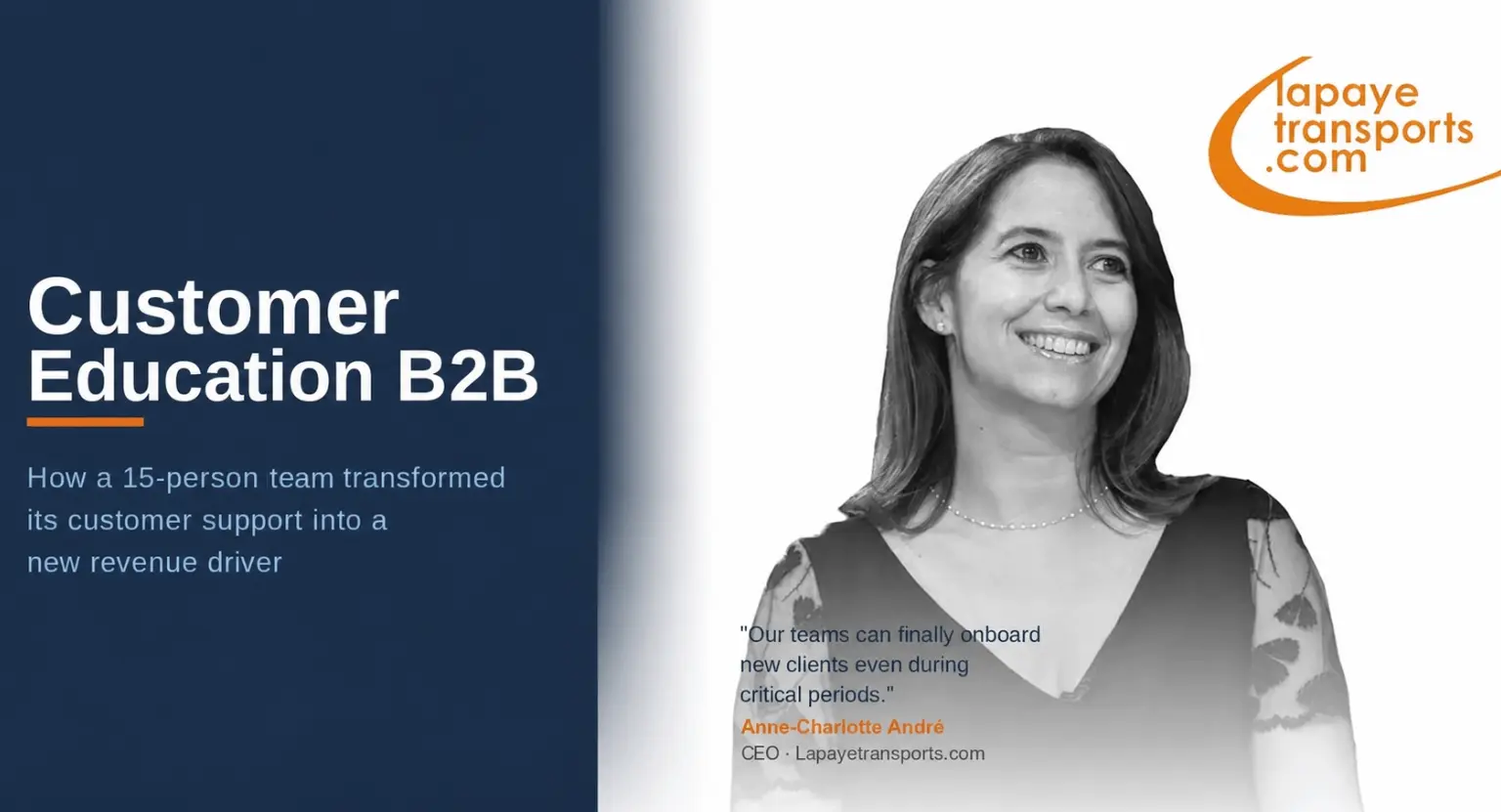
Turning Customer Education into a $65K new Revenue Stream
How a small business turned customer education into $65,000 in revenue in two months
Until two years ago, every January was a disaster waiting to happen for the Lapayetransports.com team:
Hundreds of customers stuck on a mandatory regulatory payroll configuration,
A support team completely overwhelmed,
Cases to resolve one by one, for hours on end...
And the complete inability to onboard new customers for two straight months!
Today, that same period has become a new source of profitability — a process that is repeatable, scalable, and genuinely appreciated by customers.
This turnaround didn't happen by accident. It's the result of a strategic shift that more and more B2B companies are starting to embrace: treating customer education as a business driver, not a cost center.
Here's how this 15-person company pulled it off — and why you should consider doing the same.
A structural problem that many B2B companies overlook
Lapayetransports.com specializes in payroll outsourcing for trucking companies.
Every January, their clients have to complete a mandatory year-end payroll compliance setup — a complex, highly technical step that is routinely done wrong.
The result was predictable: hundreds of clients trying to figure it out on their own, errors piling up... and a support team buried in tickets.
Fixing each incorrectly configured file took over four hours.
And during that time, the sales team was at a standstill — it was impossible to bring on new clients when every available resource was consumed by putting out fires.
This scenario — support systems overwhelmed with every spike in demand, onboarding turning into a constant firefighting operation — is one of the most common structural problems in B2B companies that sell technical solutions or complex services.
The Hidden Cost of Reactive B2B Customer Support
What most executives fail to calculate is the true cost of this reactive model — and it's not just support hours: it's lost opportunity.
Every hour spent fixing a configuration error is an hour not spent on acquisition, product development, or improving the customer experience.
According to a Forrester study commissioned by Intellum, companies that have formalized a customer education program see their support costs drop by an average of 6.1%.
65% of companies that have implemented these programs report a direct correlation between training completion and a reduction in support tickets.
Source: Forrester / Intellum, Customer Education Impact Report
The question Anne-Charlotte André asked herself
Faced with this reality, Anne-Charlotte André, CEO of Lapayetransports.com, asked herself a question that changed everything :
"How can we cut support tickets by 50% without sacrificing service quality?"
Not "how do we hire more support staff?"
But : how do we make sure customers stop calling about mistakes that were entirely preventable?
That's when everything changed.
The cultural shift: educating customers rather than fixing their mistakes
Anne-Charlotte André's answer wasn't a technical one. It was a cultural one.
The shift : moving away from a reactive support model — where you wait for a customer to have a problem before stepping in — toward a proactive customer education model: train the customer before the mistake ever happens.
Lapayetransports.com was already using LearnyBox to host a few standard webinars.
But this time, the goal was to go much further : building real, paid online training courses — structured step by step, walking customers through the compliance setup from start to finish.
Interactive live sessions, led by the team, with real-time error correction, a standardized methodology, and seamless management of registrations, payments, and replay access — all through a single platform.
Why "paid" was the right call
This is often where companies hesitate. Charging customers to train them on your own product — isn't that backwards?
Making the training paid delivered three simultaneous effects :
-
Perceived value : a paying customer is more engaged and gets better results.
-
A new revenue stream : direct, immediate, with virtually no marginal cost.
-
Enhanced credibility : the company no longer positions itself as just a service provider, but as a recognized subject matter expert.
According to data from the Customer Education Council, 45% of companies already monetize their customer education programs — and 61% of those that don't yet plan to. Monetizing customer training is no longer the exception. It's becoming the norm.
Source: Customer Education Council
The Operational Model They Built
The system deployed by Lapayetransports.com is built on a simple but effective structure :
-
Several live sessions run by the team, training dozens of customers at once.
-
An interactive format that allows for real-time error correction.
-
An identical outline for each session — ensuring consistent quality and reducing the facilitator's cognitive load.
-
Everything centralized in LearnyBox : registration, delivery, automated emails, and replay access.
No extra tools to manage.
No friction for the client.
And for next year : a planned shift to self-paced webinars to fully automate the process and make it 100% scalable.
The results: clear, immediate, repeatable, and scalable
The numbers speak for themselves — and they're specific enough to be worth sharing directly :
In January and February — historically the two toughest months — compliance-related support requests were cut in half. A 55% reduction in support tickets.
For a 15-person team, that's a fundamental shift in how the business operates day to day.
But the most striking result goes beyond cost savings : the paid online training generated $65,000 in revenue over the same period.
A brand-new revenue stream, built in just a few weeks, based on expertise the company already had — and had previously been giving away for free through support.
The cherry on top : for the first time in years, the team was able to keep onboarding 3 to 4 new clients per month even during the critical period.
The "dead season" no longer exists.
What $65,000 really means
$65,000 generated over two months by a 15-person company — with no ad spend, no new hires, and no product development — simply by structuring and monetizing expertise they already had.
Projected over a full year — with automation via self-paced webinars planned for the next cycle — the potential easily exceeds half a million dollars.
This is what's known, in customer education terms, as a scalable program : marginal costs don't grow with the number of customers trained — but revenue does.
The support team: the biggest winner
There's one result that dashboards don't easily capture — but that Anne-Charlotte André explicitly calls out : the impact on team well-being.
"Where our teams used to spend hours correcting incomplete configurations, we now have a clear, controlled, and — above all — repeatable process.
Our customers are becoming more proficient, our support team can finally breathe, and we can keep onboarding new customers even during our busiest periods."
Anne-Charlotte André, CEO of Lapayetransports.com
Fewer emergencies, fewer repetitive fixes — more time for work that actually moves the needle.
When done right, customer education also improves quality of life for your team — an argument that executives consistently underestimate.
You can replicate the Lapaye Transports model too
The Lapayetransports.com story isn't a one-off reserved for payroll specialists. It's a model that applies to any B2B company that meets three conditions :
-
It sells a product or service with a learning curve.
-
It has internal expertise that its customers don't.
-
It's currently absorbing significant support costs driven by recurring user errors.
In other words : virtually every B2B company.
Customer education: a fast-growing strategic function
Customer education is making the shift from "nice-to-have" to a core strategic function.
According to Forrester, 90% of companies that have invested in a customer education program have seen a positive return on investment.
Companies that have formalized these programs see, on average : +6.2% in revenue, +7.4% in retention rates, +7.1% in customer lifetime value.
Source: Forrester Research
These aren't projections. They're real metrics drawn from studies across hundreds of companies.
And yet, 28% of B2B customers are never offered any training by their vendors.
That's a massive blind spot — and a major opportunity for companies willing to act on it.
Three types of companies with the most to gain
Certain sectors are particularly well-positioned to replicate the Lapaye Transports model :
-
Software publishers and SaaS platforms : every update, every new feature is an opportunity to deliver training — and potentially charge for it.
-
Consulting firms and complex service providers : accounting, HR, legal, tax — their expertise can be packaged into high-value training programs.
-
B2B distributors and wholesalers : training their network to sell and use products more effectively directly drives their own top line.
In every case, the logic is the same : the expertise you give away for free today as support can become a paid, high-value offering tomorrow.
Customer onboarding as the foundation of customer education
The most natural starting point for a customer education program is onboarding.
That's when customers are most motivated, most attentive, and most likely to make the mistakes that will generate support tickets in the weeks ahead.
Structuring customer onboarding as an online training program — with progressive modules, hands-on exercises, and live Q&A sessions — has an immediate impact on two key metrics :
-
reducing time-to-value
-
reducing early churn (cancellations within the first 90 days).
And if that onboarding is paid — bonus : it also generates additional revenue the moment the contract is signed.
How to get started: the four-step model
Replicating the Lapaye Transports model doesn't require six months of planning or a digital transformation budget — it requires a clear method and the right tools.
Step 1 - Identify your customers' recurring pain points
Start by auditing your support tickets from the past six months :
-
What are the three to five most common errors?
-
What questions come up over and over in the first few days of use?
-
Which settings are consistently configured incorrectly?
These recurring pain points are your raw material.
They're exactly the topics your customers need training on — and for which they'll gladly pay for structured guidance, if it saves them time or prevents costly mistakes.
Step 2 - Package your expertise into structured training
Effective customer training isn't just a demo video posted online. It's a learning journey with a clear objective, progressive steps, hands-on exercises, and a way to measure understanding.
You don't need to be a professional instructional designer to build this kind of content — you need a clear structure and a platform that lets you deliver it easily, whether live, on-demand, or self-paced.
Step 3 - Choose the right monetization model
Several models work :
-
Training bundled into the subscription — as a differentiating value-add.
-
Pay-per-session training — like Lapaye Transports.
-
Paid certification — for clients who want to demonstrate their proficiency.
-
Annual training program — a training subscription separate from the core contract.
The pay-per-session model is often the fastest to test and validate — because it doesn't require changing your core offering, and it immediately tells you how much your customers value your expertise.
Step 4 - Automate to scale
This is the step Lapayetransports.com is preparing to take for the next cycle : moving from live sessions to self-paced webinars.
A high-quality recording, automatically delivered on a set schedule, with automated follow-up emails and replay access.
This is where customer education truly becomes scalable :
Revenue grows with the number of trained customers, while costs stay flat.
The story of Lapayetransports.com is, at its core, a story about perspective. Looking at a problem — a January support surge — not as a burden to endure, but as a signal of an opportunity to seize.
- Educate rather than fix,
- Monetize expertise rather than give it away for free,
- Build a repeatable process rather than constantly managing emergencies.
That shift in perspective generated $65,000 in revenue in two months, a 55% reduction in support tickets, and the ability to keep growing even during their most critical stretch of the year.
For a 15-person company, that's a genuine structural transformation.
And for your company? The question isn't whether you have the expertise to train your clients. You already do — you give it away for free every day, in the form of support.
The real question is : when will you decide to give it the value it deserves?
Learnybox is the ideal tool to turn your customer training into a real business lever :
Book your personalized demo with our Industry Expert
FAQ - Customer Education in B2B
1. What is B2B Customer Education?
B2B Customer Education is a strategy of systematically training customers on how to use a product or service — with the goal of reducing churn, lowering support costs, and increasing customer lifetime value.
Unlike reactive support — which kicks in after an error has already occurred — Customer Education is proactive : it trains the customer before they run into a problem.
According to Forrester, 90% of companies that have invested in a Customer Education program see a positive return on investment.
2. How does Customer Education reduce support tickets?
By training customers before they make usage errors, a Customer Education program directly eliminates the source of your most frequent tickets.
Lapaye Transports, a small business specializing in trucking payroll, cut support requests by 55% in two months — by replacing individual troubleshooting sessions with structured online training through LearnyBox.
According to Forrester, companies that have formalized a Customer Education program see their support costs drop by an average of 6.1%.
3. Should customer training be free or paid?
Both models work, but they produce different results. Free training maximizes adoption and reduces churn — it's ideal for basic onboarding bundled into the subscription.
Paid training generates a direct revenue stream, increases perceived value, and drives better participant engagement : a paying customer invests more and gets better results. Lapaye Transports went with the paid model and generated $65,000 in two months — during what had historically been their least productive stretch of the year.
According to the Customer Education Council, 45% of companies already monetize their Customer Education programs.
4. Which LMS platform should you choose to launch a B2B customer academy?
Choosing an LMS platform for B2B customer education comes down to three criteria : the ability to manage external learners (customers), support for live sessions and replay access, and centralized payment processing if the training is monetized.
LearnyBox covers all three in a single tool — no add-ons needed for registration, automated emails, or access management.
For small and mid-sized businesses looking to move fast without complex infrastructure, it's a strong alternative to enterprise platforms like Skilljar or LearnWorlds — at a fraction of the cost.
5. How long does it take to see a measurable impact on support after launching a Customer Education program?
The impact on support tickets is typically measurable within the first four to eight weeks — provided the program targets a specific, recurring pain point rather than acting as a general catch-all training.
Lapaye Transports saw a 55% reduction in tickets within two months by zeroing in on their most common customer error — the year-end payroll compliance setup.
The more specific the topic and the more directly it maps to existing support tickets, the faster you'll see results.
6. How do you calculate the ROI of a Customer Education program?
The ROI of a Customer Education program combines direct and indirect gains.
Direct gains include revenue from paid training and support time savings (hours × cost per hour).
Indirect gains include reduced churn and increased LTV for trained customers. A simple formula : ROI = (training revenue + support savings + avoided churn value) / program cost.
According to Forrester, companies that have implemented a Customer Education program see, on average, a 6.2% increase in revenue, a 7.4% increase in retention rates, and a 7.1% increase in customer lifetime value.

 How to Create a Course Refund Policy (Templates & Best Practices for 2026)
 How to Run a Beta Version of an Online Course (2026 Guide)
 How to Create a Cohort-Based Online Course (2026 Guide)
 How to Sell an Online Course With a Quiz Funnel (2026 Guide)
 How to Sell an Online Course Through a Sales Call (2026 Guide)