








 French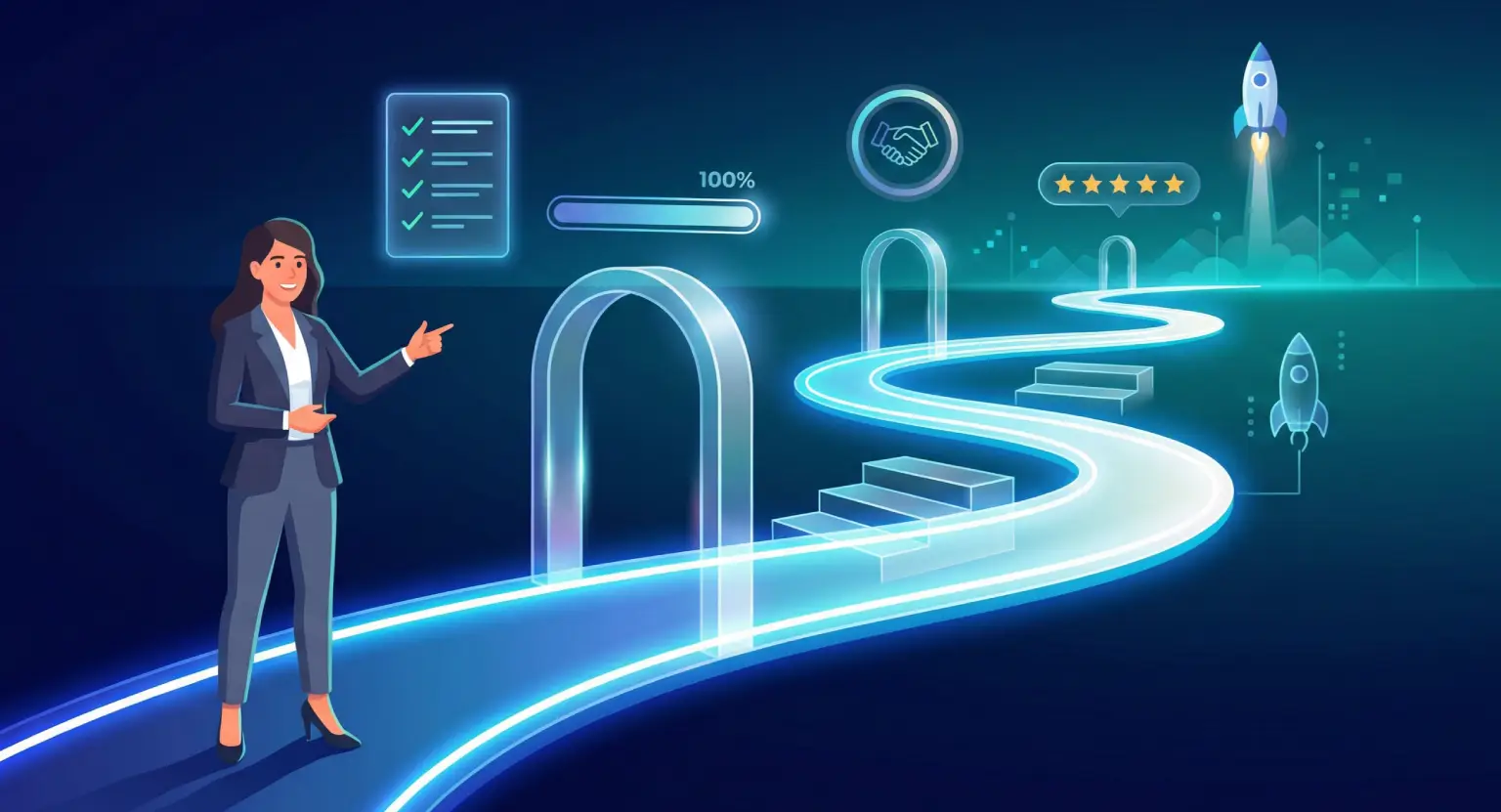
Customer Onboarding : The Complete Guide to Reduce Churn
How to Create an Effective and Cost-Efficient Customer Onboarding Process in 2026
74% of potential customers are ready to switch to a competitor if your onboarding process is too complicated.
Worse : 55% of your existing customers will stop using your product if they don't understand it quickly enough.
These figures aren't warnings - they're verdicts. In the subscription and service economy, customer onboarding is no longer an administrative formality.
It's a business priority and, for many companies, a matter of survival.
Poor customer onboarding isn't just a dissatisfied customer. It's a financial time bomb : rising churn rates, skyrocketing support costs, and a reputation that quietly erodes.
When you factor in that acquiring a new customer costs 5 to 7 times more than retaining one, every client lost to a poor start represents a significant compounding loss - not just on the initial sale, but on every future revenue opportunity that disappears with them.
So how do you turn what looks like a cost center into a genuine profit center?
How do you build a customer journey that drives loyalty, is measurable, and directly improves your bottom line?
This guide isn't a checklist. It's a comprehensive strategic method to turn your customer onboarding into your most powerful growth driver : definition, key metrics, instructional design, a 5-phase method, KPIs, essential tools, critical mistakes to avoid, and a detailed FAQ.
Let get into it !
What Is Customer Onboarding?
The strategic definition : from "welcome" to self-sufficiency
Forget the welcome email and the PowerPoint deck. Effective customer onboarding is far more than that.
It is the structured process that guides a new customer from their initial state of uncertainty to a state of genuine autonomy and success with your product or service.
The goal isn't to "present" your solution - it's to ensure your client reaches their first tangible result - the famous "Aha! Moment" - as quickly as possible.
That first success is what anchors perceived value and lays the foundation for a lasting relationship.
Onboarding vs. training vs. support vs. customer success
To fully grasp its scope, it helps to distinguish onboarding from related concepts :
| Concept | Main Objective | Timing | Approach |
|---|---|---|---|
| Customer Onboarding | Guiding toward initial success and self-sufficiency | First days / weeks | Proactive |
| Continuous Training | Deepening expertise over the long term | Ongoing | Proactive |
| Customer Support | Resolving specific issues | Ad hoc | Reactive |
| Customer Success | Maximizing value throughout the entire lifecycle | Ongoing | Proactive & reactive |
Onboarding is the first critical step in Customer Success - the initial sprint that determines the outcome of the marathon.
Why Effective Customer Onboarding Is Your Company's Most Profitable Investment
Investing in a structured customer onboarding process isn't an expense - it's a growth strategy in its own right. Here's the business case.
1. Drastic reduction in churn : retention through action
The most compelling data point : customers who achieve their first success within the first 10 days have an 87% retention rate after 4 years, compared to just 6% for those who don't.
Good onboarding doesn't just passively retain customers - it makes leaving feel irrational. It creates a value-based dependency built on real results delivered from day one.
2. Increasing Lifetime Value (LTV) : the virtuous cycle
A customer who quickly masters your solution sees its full value. They explore more features, discover advanced use cases, and become a natural candidate for upsells and cross-sells.
Effective customer onboarding is the best salesperson you have for future revenue.
3. Reduced support costs : self-sufficiency that pays off
Every support ticket asking "How do I...?" is a sign of incomplete onboarding.
By equipping customers with the fundamentals from the start, you free your team to focus on complex, high-value issues.
Customer Onboarding is the most effective support ticket filter you can build.
4. Accelerating Time to Value (TTV) : the "Aha! Moment"
Time to Value (TTV) is the time it takes for a customer to perceive the value your product promised.
The role of onboarding is to make that time as short as possible - to engineer the moment when the customer thinks, "I'm glad I bought this."
The sooner that moment arrives, the faster engagement and satisfaction follow.
The 5-Phase Method for Building Your Ideal Customer Onboarding Journey
Profitable customer onboarding isn't a series of improvised actions. It's a clearly defined, structured, and repeatable journey.
Here is the 5-phase method that works for most B2B companies.
Phase 1 : Preparation (before signing)
Customer onboarding starts before Day 1. This "pre-boarding" phase signals immediately that you're organized and ready.
-
Information gathering : as soon as the contract is signed, use a form to collect key contacts, objectives, and technical context.
-
Welcome kit : send an email with a link to documentation, a team introduction video, and a schedule for the first few weeks.
-
Kick-off scheduling : don't wait for the client to take the initiative. Immediately suggest time slots for the kick-off meeting.
Phase 2 : Launch (the kick-off meeting)
This is the official starting point - the moment you transition from a commercial relationship to a genuine partnership.
-
Alignment : jointly validate the client's business objectives and how your solution will contribute to them.
-
Defining success : ask the pivotal question: "At the end of this onboarding, what will make you say it's been a success?" Define 2 or 3 clear KPIs together.
-
Journey walkthrough : present the 5 phases so the client knows exactly what to expect and when.
Phase 3 : Activation (guided first steps)
This is the most critical phase - the "doing" phase. The goal is to get the client to take their first meaningful action.
-
Interactive checklist : provide a list of the first 3 to 5 actions to complete (importing data, creating a first project, inviting a colleague, etc.).
-
Contextual guidance : integrate interactive walkthroughs or short videos directly inside your application - learning by doing, in context.
-
Day 7 check-in : schedule a short call (15-30 min) to celebrate the first completed actions and resolve any friction points before they become blockers.
Phase 4 : Adoption (toward regular use)
The client has taken their first steps. Now the goal is to help them build consistent habits around your product.
-
Themed webinars : organize group sessions on advanced features or specific use cases relevant to your audience.
-
Best practice sharing : send a monthly newsletter with practical tips and success stories from other customers.
-
Usage monitoring : identify clients who aren't engaging with key features and reach out proactively - before disengagement turns into churn.
Phase 5 : Transition (handing the baton)
Customer Onboarding has a defined end. Formalizing this transition marks the beginning of a long-term relationship - not the end of your involvement.
-
Onboarding review : conduct a formal session to confirm the objectives defined at the kick-off have been met.
-
CSM introduction : organize a clear handover so the customer knows exactly who their ongoing point of contact will be.
-
Business Review cadence : establish the frequency of future strategic check-ins (quarterly or semi-annual).
How to Measure the ROI of Your Customer Onboarding
Profitable onboarding is measurable onboarding. Gut instinct isn't a strategy - you need a dashboard built around the right metrics.
Leading indicators
These metrics let you monitor the health of your onboarding process in real time.
-
Customer Onboarding completion rate : the percentage of customers who complete all steps.
A low rate points to a journey that's too long, too complex, or not engaging enough. -
Time to Value (TTV) : the average time it takes a customer to reach their "Aha! Moment." Your goal is to continuously shorten this window.
-
Key feature activation rate : the percentage of customers actively using your three most critical features.
Lagging indicators
These metrics measure the downstream business impact of your customer onboarding over the medium and long term.
-
Retention rate / churn rate : compare the churn rate of customers who completed onboarding versus those who didn't. This is your most direct measure of ROI.
-
Post-onboarding NPS : measure satisfaction at the end of the process. A strong score is a reliable predictor of long-term loyalty.
-
Support tickets per customer : a high volume of basic "how do I?" tickets in the first 90 days is a diagnostic signal - your onboarding has gaps.
The ideal customer onboarding ROI dashboard
Build a simple, focused dashboard rather than tracking everything at once :
| Category | KPI | Target | Current result |
|---|---|---|---|
| Activity | Completion rate | > 80% | 65% |
| Activity | Time to Value (TTV) | < 48 hours | 72 hours |
| Result | 90-day churn | < 2% | 5% |
| Result | Post-onboarding NPS | > 50 | 35 |
Essential Tools : Choosing a Platform for Customer Onboarding
Manual processes have limits. To scale your customer onboarding, you need tools - but remember : the tool doesn't make the strategy.
LMS / e-learning platforms : the backbone
To build a structured training program, an enterprise LMS (Learning Management System) is essential.
Platforms like LearnyBox let you create training modules, video tutorials, and knowledge checks to measure learning, while tracking each client's progress in one centralized place.
This is the foundation of your customer onboarding content.
Digital Adoption Platforms (DAP) : in-app guidance
DAPs let you create interactive walkthroughs, tooltips, and task checklists directly inside your own software.
The customer learns by doing, in their actual work environment - which is an effective way to accelerate Time to Value and reduce early drop-off.
Communication and tracking tools
Don't overlook the essentials : a CRM to track all client interactions (natively integrated in LearnyBox), a ticketing platform (Zendesk, Intercom) to centralize support requests, and a reliable video conferencing tool (Zoom, Teams) for the human touchpoints that automation can't replace.
The 4 Fatal Mistakes That Drive Your New Customers Away
Sometimes, success is simply about not making the mistakes everyone else makes.
Mistake 1 : one-size-fits-all customers onboarding
The worst enemy of effectiveness. A large enterprise doesn't have the same needs as an SME. An admin user doesn't share the same goals as a standard user.
Segment your onboarding journeys by customer profile and role.
Personalization isn't a nice-to-have - it's the foundation of results.
Mistake 2 : information overload
Trying to show everything on day one is the most reliable way to overwhelm and lose your customer.
Customer Onboarding isn't a product showcase - it's a guided journey. Apply the just-in-time principle : give only the information needed for the next step.
Everything else comes later.
Mistake 3 : failing to celebrate milestones
People are wired to respond to recognition. When a customer completes a key step, acknowledge it. Gamification (badges, challenges...) can also be an option to improve engagement.
An automated congratulatory email, a virtual badge, a personal message from the CSM - these small gestures create powerful emotional momentum and reinforce the feeling that your product actually works.
Mistake 4 : absence of human touchpoints
Automation is your ally - but it doesn't replace human connection. A fully automated customer onboarding reads as cold and impersonal.
Build in strategic human touchpoints : the kick-off, the Day 7 check-in, and the final review. That's where trust is actually built.
Key Takeaway : Customer Onboarding Isn't a Cost - It's Your First Promise Kept
Customer onboarding is much more than a formality. It's the moment of truth - the point where marketing promises give way to demonstrated value.
It directly shapes your retention, your profitability, and the long-term satisfaction of every customer you acquire.
By building a structured journey, measuring the right metrics, and sidestepping the most common pitfalls, you transform an often-overlooked process into your strongest competitive advantage.
Effective customer onboarding is an act of respect for your customer's investment. It's the first and most important promise you keep - and the foundation of healthy, sustainable growth.
Ready to launch an automated and effective customer onboarding process?
Book your free custom demo with an expert
FAQ : Everything You Need to Know About Customer Onboarding
How long should customer onboarding take?
There's no universal answer - it depends on the complexity of your product :
For simple software, a few days may be enough,
For a complex platform, it can span 6 to 8 weeks.
What matters is defining a clear endpoint: the moment your customer is self-sufficient on the core features.
That's your finish line.
Who is responsible for customer onboarding within a company?
In smaller organizations, it's often the founder or a sales representative.
As the company scales, the role typically belongs to the Customer Success Manager (CSM) - who coordinates internal teams and guides the client throughout the process.
Sales team involvement during the kick-off is also critical for a clean handover.
How do you onboard a customer for a service rather than software?
The logic is the same, but the tools differ. For an agency or consulting firm, onboarding means clarifying working methods, introducing key contacts, agreeing on communication channels (Slack, project management tools), and locking in the schedule for initial deliverables.
The kick-off meeting carries even more weight here, as it sets the entire framework for human collaboration.
Should you charge for customer onboarding?
For self-service software, onboarding is typically included and automated.
For complex solutions or large accounts requiring custom configuration, charging for starter packs or implementation fees is increasingly standard.
It puts a fair price on your team's time and signals to the client that their active involvement matters.
How do you handle a client who isn't following the customer onboarding process?
This is a major red flag. Contact them personally to understand what's happening : lack of time, a technical issue, a shift in priorities? Don't wait.
A client who disengages during onboarding has a 90% chance of churning.
Sometimes you need to be direct : their success genuinely depends on their engagement in these early weeks.
What is the difference between customer onboarding and employee onboarding?
The goal is similar - making someone self-sufficient and effective - but the context is fundamentally different.
Employee onboarding happens internally, within a reporting relationship where you have direct authority.
Customer onboarding happens on the client's side, where you have no authority, only influence.
You must demonstrate value at every step to keep them engaged - nothing can be assumed.
How should you adapt onboarding for large enterprises versus SMEs?
For SMEs, prioritize standardized, scalable, and largely automated customer onboarding : videos, group webinars, and self-service documentation.
For large accounts, go high-touch : a dedicated CSM, customized workshops, weekly check-ins, and personalized documentation.
The level of investment should always be proportional to the contract value.
At what stage should you start structuring your onboarding process?
From your very first client. Even if your "process" starts as a simple checklist, write it down.
Each new client will help you improve it. Waiting until you have 50 clients to formalize your onboarding is a reliable way to end up with 50 poorly onboarded clients - and a churn rate to match.




 How to Create a Course Refund Policy (Templates & Best Practices for 2026)
 How to Run a Beta Version of an Online Course (2026 Guide)
 How to Create a Cohort-Based Online Course (2026 Guide)
 How to Sell an Online Course With a Quiz Funnel (2026 Guide)
 How to Sell an Online Course Through a Sales Call (2026 Guide)