








 French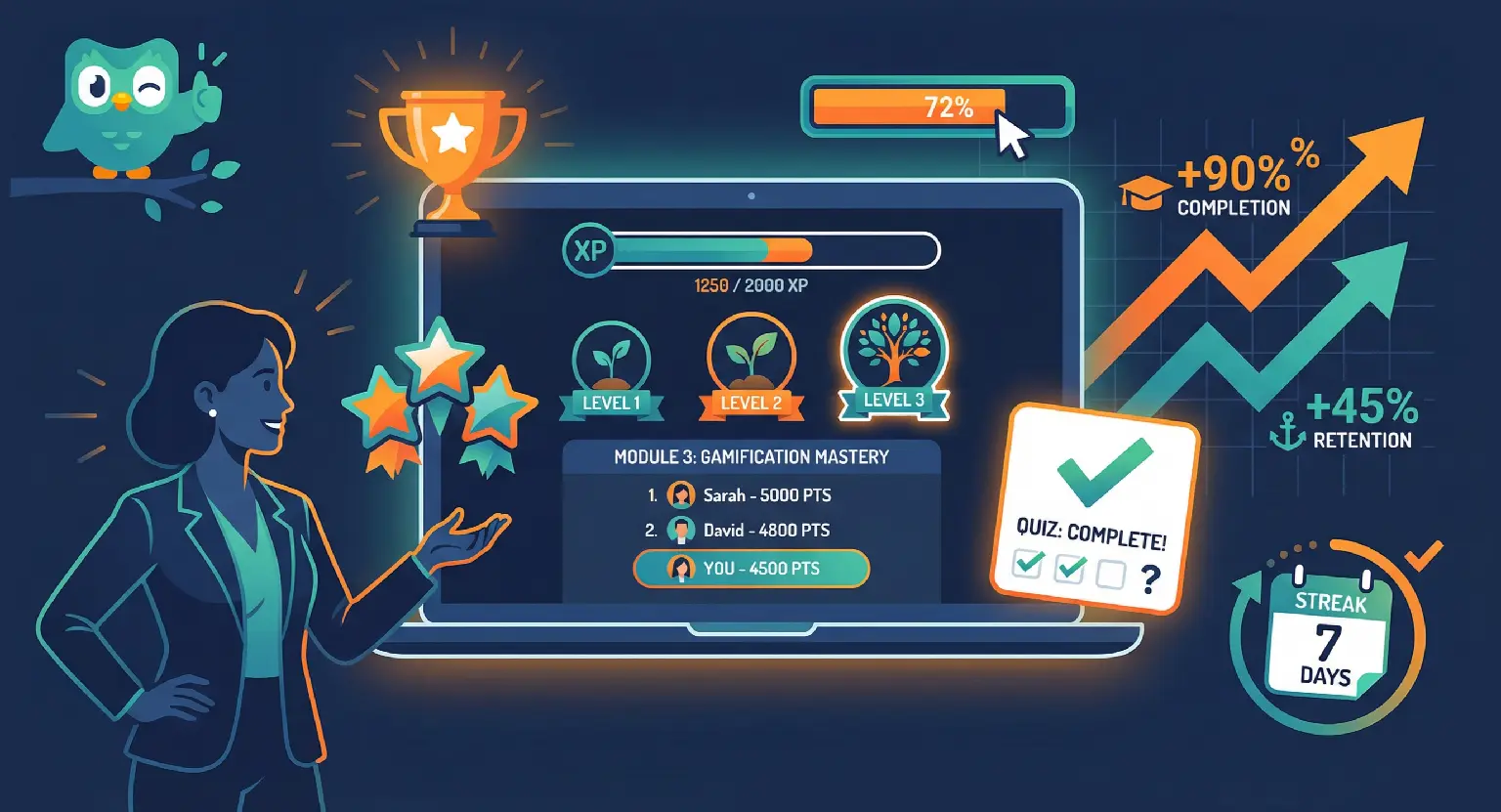
Gamification and eLearning: The Science, the Stats, the Method
Gamifying Online Courses: The Secret to Tripling Your Completion Rate
Duolingo. You know it - the language app with the green owl that sends you guilt-inducing notifications at 10 p.m.
What you might not know is that Duolingo achieves a 90% completion rate across its online courses.
Meanwhile, the global average for non-gamified online courses tops out at around 25%.
Three out of four learners abandon a traditional course before finishing it...
That's not a motivation problem.
It's not a content problem. It's an instructional design problem - and gamification is the tool that bridges the gap between the intention to learn and the act of completing.
This article covers: why gamification works (the real reason - the one neuroscience explains), which mechanics produce the best results, how independent trainers use it to build more engaging online courses, how companies are transforming their L&D with measurable outcomes, and a step-by-step method to apply it to your own training.
What is gamification in online courses?
The exact definition
Gamification refers to the application of video game mechanics to non-gaming contexts.
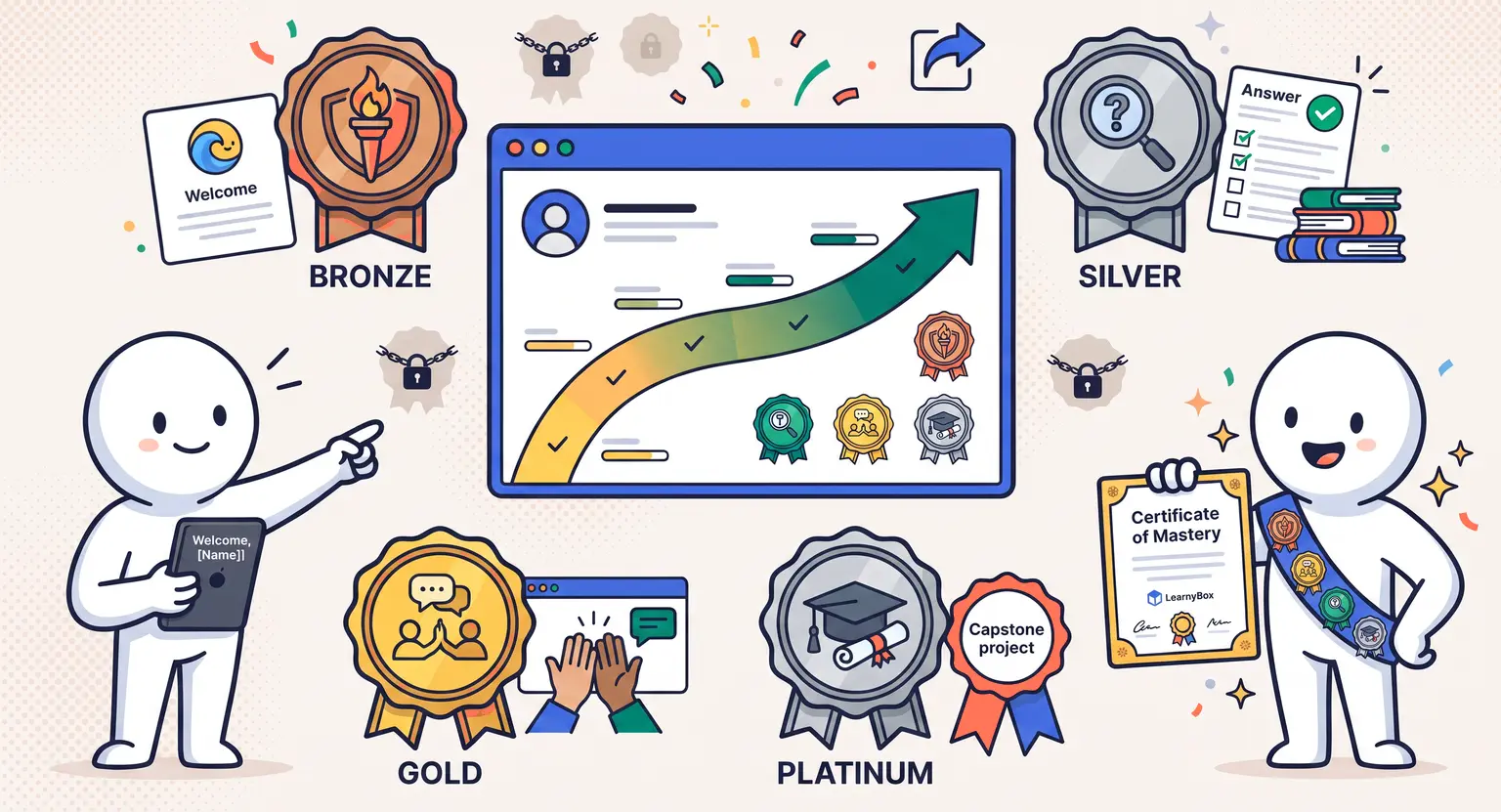
In online courses, this means integrating elements such as points, badges, leaderboards, levels, challenges, or progressive storytelling into a learning path.
But here's the thing: the goal of gamification isn't simply to "make training fun." It isn't about sticking stars on PowerPoint slides or adding a quiz at the end of a module.
It's a structured approach that fundamentally changes how learners interact with content.
Most people stop at a surface-level understanding of this - which is precisely why 80% of gamification programs fail when they rely on generic point systems with no real pedagogical intent behind them.
Gamification, serious games, educational games : the differences
These three terms are frequently confused, but they point to distinct concepts.
A serious game is a game designed entirely for educational or professional purposes - a complete game with its own rules, universe, and narrative, whose primary objective is learning.
A flight simulator used to train pilots is a serious game.
An educational game is an existing game - board, card, or video - repurposed for learning.
Using Minecraft to teach architecture is an educational game.
Gamification doesn't create a game. It borrows game mechanics and injects them into what remains, fundamentally, a training program.
Your online course stays an online course - but it incorporates elements that trigger the same psychological mechanisms as a game.
This distinction determines the investment required, the tools to use, and the results to expect.
Why gamifying online courses works: the science
You may have heard that gamification is "for kids" or a marketing trend without scientific grounding.
Skepticism about poorly implemented programs is reasonable. But the neurological reality is solid.
Dopamine and the reward-effort loop
When a learner earns a badge after completing a challenging module, their brain releases dopamine.
This neurotransmitter isn't just linked to pleasure - it's primarily associated with the anticipation of pleasure.
This is why you keep scrolling through a feed even when you've stopped enjoying it - your brain is anticipating the next reward.
Gamification in online courses uses this exact mechanism. By creating short, frequent reward-effort loops - a point earned here, a level unlocked there, a progress bar that moves - it keeps the brain in a state of positive anticipation that drives persistence.
Neuroscientists call this the variable reward schedule : variable rewards - sometimes small, sometimes large, always somewhat unpredictable - create the strongest engagement.
It's the principle behind slot machines... And, transparently, behind Duolingo.
Self-determination theory: autonomy, competence, relatedness
Self-determination theory (Deci & Ryan, 1985) is one of the most robust motivational frameworks in psychology. It identifies three fundamental needs that, when met, generate lasting intrinsic motivation:
-
Autonomy - feeling that you control your own progress.
Gamification addresses this through non-linear paths, selectable modules, and adjustable difficulty.
-
Competence - feeling that you're making measurable progress and mastering something.
Progress bars, levels, and immediate feedback directly serve this need.
-
Relatedness - feeling part of a group.
Leaderboards, challenges between learners, and community forums address this need.
When a gamified online course is well-designed, it satisfies all three simultaneously.
A learner whose three needs are met doesn't need to be "motivated" from the outside - they naturally want to continue.
The numbers : what the data says about gamification in online courses
The data available for 2025-2026 is consistent - not anecdotal, but systemic.
Online courses incorporating gamification elements achieve a 90% completion rate, versus 25% for traditional courses. For a cohort of 100 learners, that's 65 more people who actually finish your course.
Knowledge retention increases by 45% in gamified training environments (Global Growth Insights 2025).
At the same time, training time is reduced by 50% - learners absorb information faster because they're more engaged.
On the organizational side, companies using gamification in their programs report a 50% increase in productivity and a 60% increase in employee engagement. And 83% of employees in gamified training say they feel motivated, compared to 61% in traditional programs.
The global market for gamified online courses reached $19.42 billion in 2025 and is projected to reach $92.5 billion by 2030 - 26% annual growth.
This isn't a trend. It's a structural transformation of the industry.
The 7 Most Effective Gamification Mechanics in online courses
Not all gamification mechanics are equal. Some create superficial, short-term engagement; others build lasting behaviors.
Here are the mechanics that produce the most durable results - with, for each, a note on what works in B2C (independent trainers, infopreneurs) versus B2B (internal L&D, client onboarding).
Points, badges, and leaderboards (PBL) - the foundation, but not the whole story
The best-known mechanism - and the most misused. Points, badges, and leaderboards create visible progress and social recognition.
They work well for competitive audiences and short courses. But a global leaderboard can demotivate learners who find themselves near the bottom.
In B2C, opt for personal progress comparisons or friends-only leaderboards.
In B2B, team rankings rather than individual ones preserve cohesion.
Narrative and progressive storytelling
This is where gamification becomes genuinely powerful.
Transforming a course into a story - with a character, obstacles, and a narrative arc - activates identification and immersion that a list of modules simply cannot achieve.
Imagine a digital marketing course where the learner plays an entrepreneur who must "save their business" by applying the concepts they're learning.
Each module is a mission; each skill mastered unlocks the next chapter.
This is exactly what the best gamified courses do - and it's accessible even with a platform like LearnyBox.
Challenges, quests, and missions
Challenges are short-term goals that create frequent micro-victories :
"Complete this module by Friday and unlock the exclusive bonus."
"Answer 8 out of 10 questions correctly to advance."
These micro-goals keep learners in a state of flow - the state of total concentration described by Mihaly Csikszentmihalyi, where difficulty is perfectly calibrated to skill : not too easy (boredom), not too hard (anxiety).
Just right.
Immediate feedback and the right to make mistakes
One of the most underrated mechanics. In traditional training, the learner takes a quiz and may wait days for results.
In gamified training, feedback is immediate - and mistakes aren't penalized but built into the learning process.
"Wrong answer - here's why. Try again." This simple loop significantly improves retention.
The brain encodes correct information better when it has first actively processed an incorrect answer.
Visible progress bars and levels
The progress bar is perhaps the simplest and most effective mechanic. Visually seeing that you're 67% through a module creates the endowment effect - we value more what we've already invested in.
A learner at 67% is far less likely to drop out than one at 0%.
Levels add an extra dimension: they create symbolic milestones that reinforce learner identity. "I'm at Level 3 in digital marketing" is a statement, not just a metric.
Gamification for B2C online courses : how independent trainers use it
If you're a coach, independent trainer, or infopreneur creating online courses, you might wonder whether gamification is something for large companies with dedicated L&D budgets - or whether it applies to you.
Spoiler : It applies to you.
Duolingo has already proven the template.
The Duolingo example - and what you can take from it
Duolingo is the most studied gamification case in online learning worldwide. The app transformed language learning - widely perceived as a chore - into a daily habit for 500 million users. The mechanics it systematically applied:
-
a daily streak that builds habit and creates the fear of "breaking" progress
-
XP that accumulate visibly
-
leagues that introduce light social competition
-
lives that add a playful constraint
-
rewards unlocked at specific milestones
None of these are technically complex. All can be replicated in an online course built on a platform like LearnyBox.
What makes the difference is the consistency of implementation and alignment with your learning objectives.
A personal development trainer can create a "practice streak" - 7 consecutive days of exercises to unlock a bonus module.
A business coach can create "weekly missions" with collectible badges.
A language trainer can create cohort leaderboards among learners in the same group.
Applying gamification to an online course on LearnyBox
Here's what an independent trainer can set up without advanced technical skills:
-
Progression by levels: structure your course into clearly named levels - "Beginner," "Intermediate," "Expert" - rather than "Module 1, Module 2, Module 3."
This simple naming change creates a sense of personal progression.
-
Validation quizzes: each module ends with a quiz whose results display immediately.
Not to grade the learner - but to give instant feedback and unlock access to the next level once a threshold is reached.
-
Unlocked bonus content: prepare additional resources (templates, case studies, exclusive Q&A sessions) that unlock at specific progress milestones.
This creates anticipation and tangible reward.
-
Community with leaderboards: a private group where learners share progress, badges, and results. Social learning amplifies individual engagement.
The expected outcome: learners who actually complete your course rather than dropping off halfway. And satisfied customers who recommend you - because they finished and got the result they came for.
B2B e-learning gamification: turning mandatory training into an engaging experience
In a corporate context, the challenge is different: learners don't always choose their training.
They take it because a manager requires it, a regulation mandates it, or a skills development plan includes it.
Intrinsic motivation is often absent at the outset.
This is precisely where gamification is most transformative.
Companies that have transformed their L&D with gamification
SAP integrated an AI-driven gamification module into its SuccessFactors suite in 2024.
Result: a 48% increase in training completion rates and a 36% rise in participation in skill development programs within 60 days.
Salesforce added progress badges and gamified performance analytics to Sales Cloud.
Result: a 42% increase in engagement and a 33% improvement in training task completion.
Google and IBM reported a 20% increase in training retention rates after integrating gamification elements into their internal development programs.
These results are not exceptions. They reflect a consistent pattern: when training becomes an engaging experience rather than a compliance obligation, performance follows.
The 3 mistakes that cause 80% of gamification programs to fail
80% of corporate gamification programs fail. Not because gamification doesn't work - but because it's poorly implemented.
-
Mistake #1: Gamifying for the sake of gamifying.
Adding badges and points without defining which behaviors you want to encourage.
Gamification must serve a specific learning objective.
Without one, no mechanic will help.
-
Mistake #2: Ignoring learner profiles.
"Competitive" learners love leaderboards,
"Explorer" learners want unlockable content,
"Social" learners engage through group challenges.
Effective gamification accounts for this diversity rather than applying the same mechanics to everyone.
-
Mistake #3: Neglecting feedback.
Gamification without immediate, relevant feedback is an empty shell.
A badge earned without explanation of why it was earned has no educational value.
Feedback is the heart of the system - not decoration.
How to integrate gamification into your online courses: the 5-step method
Here's a concrete method to move from theory to practice - applicable whether you're an independent trainer or a corporate L&D manager.
Step 1 - Define the educational objective before choosing the mechanics
This is the step everyone skips - and the most important one. Before choosing any mechanic, ask : what specific behavior do you want to encourage?
-
Completing all modules (completion rate)?
-
Applying concepts between sessions (learning transfer)?
-
Interacting with other learners (community engagement)?
-
Returning regularly (long-term retention)?
Each objective calls for different mechanics. The answer determines everything that follows.
Step 2 - Know your audience: competitor, social, explorer, or achiever?
Researcher Richard Bartle identified four player profiles that map directly onto gamified learners :
-
Competitors (motivated by leaderboards),
-
Social players (motivated by peer interactions),
-
explorers (motivated by discovering hidden content),
-
achievers (motivated by completing everything and collecting badges).
Your audience is likely a mix of all four - but by identifying the dominant profile, you can prioritize the mechanics most likely to land.
Coaches and independent trainers tend to attract achievers and explorers.
Corporate sales teams tend to be dominated by competitors.
Step 3 - Choose two or three mechanics suited to your format
Once the objective and profile are clear, choose two or three mechanics - not ten. Overloading a course with gamification is just as damaging as using none at all. It creates confusion and dilutes the impact of each mechanic.
-
For asynchronous courses: level progression + validation quizzes + unlocked bonus content is an effective, simple-to-implement trio.
-
For synchronous training (webinars, virtual classrooms): real-time polls + inter-session challenges + weekly leaderboards work well.
-
For hybrid programs: combine both approaches, ensuring online and in-person mechanics reinforce each other rather than creating friction.
Step 4 - Choose a platform with built-in gamification features
Platform choice determines what you can actually implement. Not all LMS platforms offer the same gamification capabilities.
Key criteria : badge and certificate management, quizzes with immediate feedback, visible progress bars, integrated community spaces, and the ability to make module access conditional on completing previous ones.
LearnyBox natively integrates all of these - letting an independent trainer build a genuinely gamified experience without technical skills and without stitching together third-party tools.
Step 5 - Measure and adjust: the metrics that matter
Gamification is not a "set and forget" deployment. It requires continuous measurement and adjustment.
The key metrics to track are: completion rate (the primary indicator), engagement rate (time per session, number of interactions), retention rate (how many learners return after the first session), and satisfaction score (NPS or post-course evaluation).
If completion remains flat after gamification, the mechanics likely don't match your audience profile - or learning objectives weren't defined clearly enough at the outset.
Adjust,
Test,
Measure again.
Gamification is an iterative process, not a one-time solution.
Gamification in online courses is not a passing trend. It's a structural response to a structural problem : learner disengagement in formats designed to transfer information rather than create an experience.
-
90% completion rate vs. 25%
-
45% higher knowledge retention
-
50% reduction in training time
-
A market heading toward $92.5 billion by 2030
These figures don't describe a fad - they describe a paradigm shift in how people learn.
Gamification is not reserved for large corporations or game studios. It's accessible to anyone willing to think of their educational content as an experience rather than a list of modules.
The question is no longer "does gamification work?" It's: when are you going to start?
✨ Gamify Your online courses with LearnyBox ✨
Independent creator: Create my free account
Enterprise: Book a demo with a specialist
FAQ - Gamification of online courses
Is gamification suitable for all types of online courses?
Gamification is effective across the vast majority of educational contexts - technical training, soft skills, languages, marketing, personal development.
It is particularly powerful for courses over 3 hours where dropout risk is highest.
It delivers less incremental value for very short courses under 30 minutes, where simplicity is the priority.
Do you need technical skills to gamify an online course?
No. Modern LMS platforms like LearnyBox natively integrate the most effective gamification mechanics - quizzes, level progression, badges, conditional content - without requiring any development skills.
The challenge isn't technical; it's pedagogical. Defining clear objectives and understanding your learner profiles is where the real work lies.
Doesn't gamification risk distracting learners from the actual content?
This is the most common concern - and the most unfounded when gamification is well-designed.
Poorly designed gamification (mechanics disconnected from learning objectives) can create distraction.
Well-designed gamification increases concentration and retention.
The principle that prevents distraction: every mechanic must serve a specific educational objective, not exist for its own sake.
How long does it take to gamify an existing online course?
For a course with 5 to 10 modules, basic gamification (level progression, validation quizzes, bonus content) takes approximately 2 to 4 days.
Advanced gamification with storytelling and challenge sequences takes 2 to 3 weeks.
The investment pays off quickly through improved completion rates and learner satisfaction scores.
What is the difference between gamification and microlearning?
Microlearning breaks content into small units of 5 to 10 minutes.
Gamification adds engagement mechanics to those units.
The two are highly complementary - and particularly effective when combined.
Microlearning modules with gamified elements achieve completion rates between 70% and 82% according to Market Data Forecast 2025.
Does gamification work as well for adult learners as for younger learners?
Yes - with calibration. Adults respond poorly to very childlike mechanics (cartoon characters, game sound effects) and better to mechanics focused on professional progression and peer recognition.
Challenges, certifications, peer rankings, and exclusive bonus content work particularly well with adult learners in professional contexts.




 How to Create a Course Refund Policy (Templates & Best Practices for 2026)
 How to Run a Beta Version of an Online Course (2026 Guide)
 How to Create a Cohort-Based Online Course (2026 Guide)
 How to Sell an Online Course With a Quiz Funnel (2026 Guide)
 How to Sell an Online Course Through a Sales Call (2026 Guide)