







AI for Course Research and Fact-Checking: 2026 Guide
AI for Course Research and Fact-Checking
Key Takeaways
-
AI is an incredible research assistant, but you must act as the chief editor to maintain credibility.
-
Use a dedicated course creation checklist to structure your lessons logically before feeding prompts into AI.
-
Always cross-check dates, statistics, and academic citations ; LLMs frequently manufacture sources.
-
Combine retrieval-augmented models with static data queries for the ultimate fact-checking system.
-
Create high-quality learning materials by figuring out how to create engaging course content that goes beyond surface-level AI summaries.
If you are building a course in 2026, you already know the stakes are incredibly high. Students do not just want information anymore. They want accurate, deeply researched, and transformational insights.
So, how do you keep up without spending three months buried under academic papers?
Enter artificial intelligence. It feels like magic when you ask an LLM to outline a topic and it spits out ten pages of structured text in seconds…
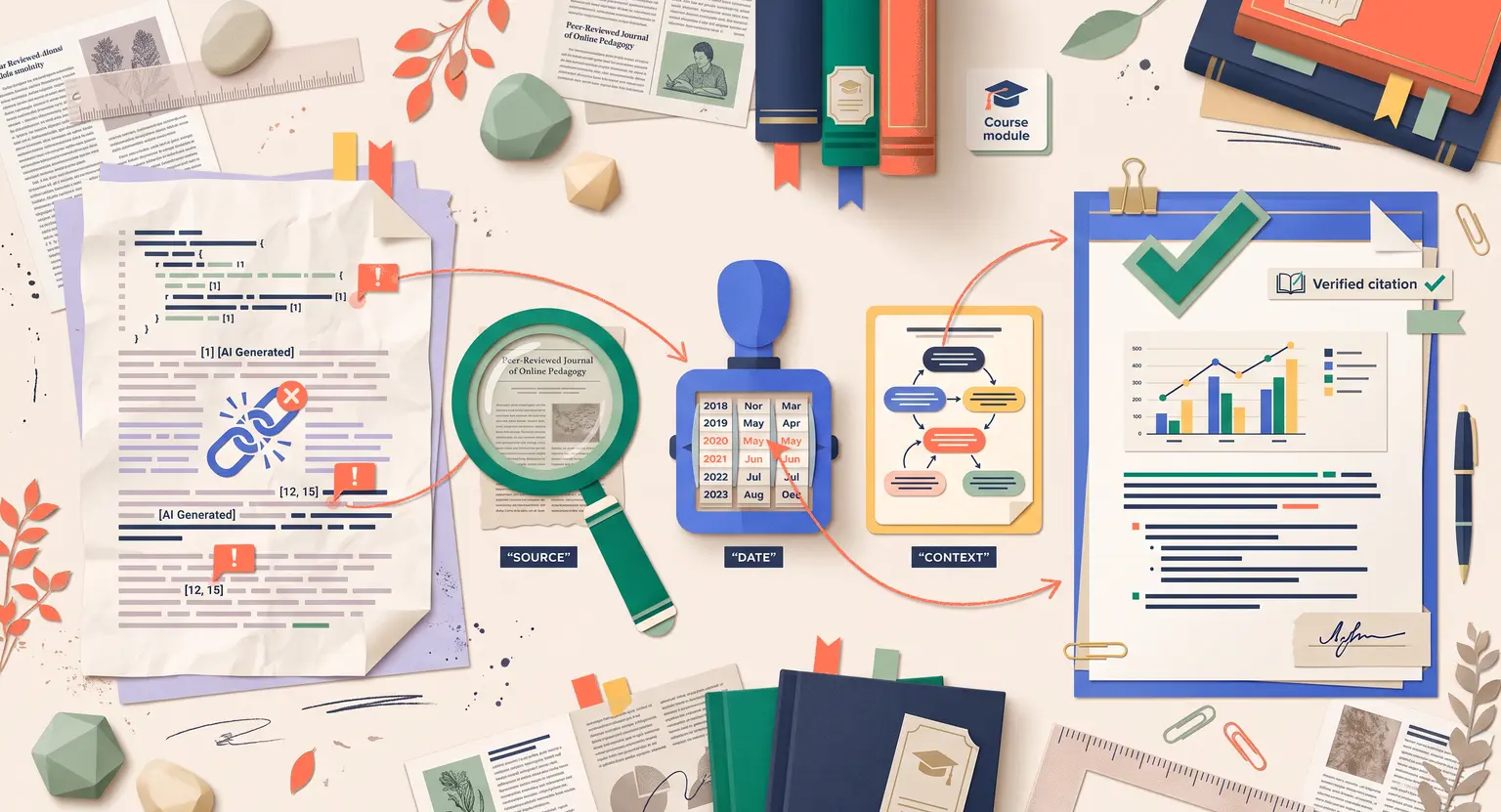
But here is the catch : AI can be a massive liar. It hallucinates statistics, makes up quotes, and cites non-existent books with absolute confidence.
So, how do we use these tools safely?
In this guide, we are looking at how to build a bulletproof research pipeline that leverages AI for speed while ensuring your content remains 100 % accurate.
Before you get started, check out our guide on how to validate an online course idea so you do not waste time researching topics that will not sell.
Step 1 : The Research Phase (Uncovering Hidden Gems)
Think of AI as a brilliant but slightly distracted graduate assistant. If you ask general questions, you will get boring, generic answers. To get deep, high-value insights, you have to push the model.
Instead of asking, "Tell me about digital marketing," ask it to identify counter-intuitive trends. You could prompt : "What are the three most debated topics in organic marketing right now, and what do the critics say about each?" This forces the machine to pull binary opinions and complex arguments rather than basic definitions.
Another incredible strategy is historical roleplaying.
If you are teaching a course on philosophy or business strategies, ask the model to analyze a decision from a specific historical perspective. This gives your curriculum a level of depth that a standard Google search simply cannot touch.
But do not stop at theoretical concepts. Use AI to scan long PDFs, academic papers, and industry studies. You can upload an eighty-page whitepaper and ask for a breakdown of the core methodologies. This saves you dozens of hours.
So, what about keeping your existing courses fresh? You can easily find ways on how to use AI to update outdated course content to make sure your student cohort always gets the absolute latest industry shifts.
Using specific prompts changes everything. It turns a superficial chat session into a targeted, deep-dive research laboratory that feeds directly into your curriculum outline.
Step 2 : The Fact-Checking Protocols
Now, let's talk about the ugly truth : AI models are trained to predict the next most likely word, not to tell the truth. That distinction matters. They will create plausible-sounding facts because plausible-sounding facts are what their algorithms love.
If you ask an AI model for a source, it will often generate a URL that looks perfectly real but leads to a 404 page. Or it might attribute a genuine statistic to the completely wrong research group.
To protect your brand, you need a strict validation checklist.
First, verify every single statistic manually. If the AI says "78 % of people prefer video over text", do not write that down until you can trace that exact number to a reputable primary source. Use tools like Perplexity or Google Scholar to track down the original study.
Second, watch out for outdated data. AI models have training cut-off points. Even with live search capabilities, they often fall back on older historical information. If you are building a course in 2026, relying on data from 2022 will make your content look stale.
Third, design specific "cross-examination" prompts. When an AI gives you an answer, feed that same answer back into a different model.
Ask : "Check the following statement for historical accuracy, bias, and potential falsehoods." You will be amazed at how quickly one model will call out another's mistakes. This friendly rivalry between LLMs is one of your best defensive assets.
Using these simple rules keeps your courses incredibly accurate. Your students are paying for expert-level knowledge, and keeping your lessons verified builds trust that money cannot buy.
Structuring Your Verified Data
Once you have compiled your raw research and double-checked the facts, the next hurdle is organization. It is easy to feel overwhelmed by hundreds of pages of corrected notes. This is where AI excels yet again.
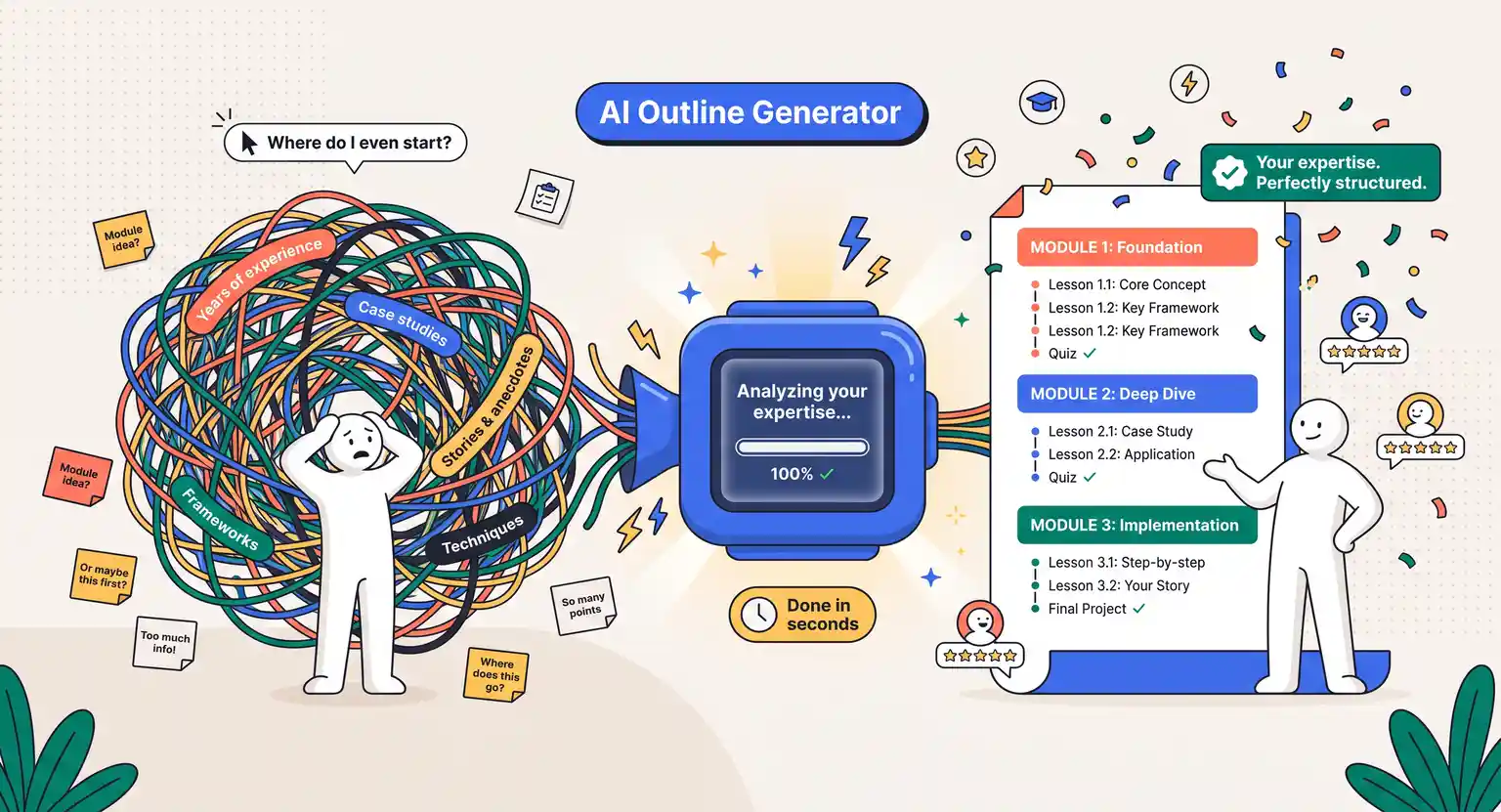
You can feed your verified notes back into the model and ask it to design a logical learning flow. Ask it to build a master syllabus based on modern instructional design principles. This saves you from staring at a blank document for hours.
But you must keep an eye on how everything fits together. You must understand how to structure an online course blueprint for student success. This ensures your students do not get overwhelmed by too much information at once.
As you organize your material, think about how to keep your learners active. Static slides are boring. You can learn how to use AI to create course quizzes that test your students' knowledge after every chapter. By feeding your double-checked research notes directly into quiz generators, you create highly contextual questions that reinforce the main learning points.
Comparing the Top AI Tools for Research and Validation
Not all AI tools are built for the same tasks. Some are stellar at brainstorming ideas, while others excel at retrieving real-time information from the web. Here is how the top players stack up for course creators.
| AI assistant | Primary strength in course creation | Fact-checking reliability | Crucial limitation |
|---|---|---|---|
|
Perplexity AI |
Real-time web research, finding academic sources, and retrieving up-to-date market statistics. |
Very high (always provides visible source links). |
Less creative; struggles with long-form storytelling or human-like voice formatting. |
|
Claude (Anthropic) |
Analyzing massive PDFs, structuring complex course curricula, and spotting logical inconsistencies in text. |
High (rational reasoning is excellent). |
Can occasionally hesitate to give definitive answers if a topic is deemed sensitive. |
|
ChatGPT (OpenAI) |
Rapid brainstorming, creative outline generation, and translating concepts into friendly analogies. |
Moderate (requires steady supervision and manual prompt restrictions). |
Prone to confident hallucinations when asked for obscure academic papers. |
|
Google Gemini |
Integrating live search trends and linking directly to primary Google products or videos. |
Moderate to high (great direct integration with Google's search index). |
Can draft overly clinical, dry responses that require extensive rewriting. |
Keeping the Human Touch in an AI-Driven World
AI only knows what has already been written. It cannot share your unique personal stories, your specific framework, or your real-world failures. If you let artificial intelligence do 100 % of the thinking, your course will feel generic.
So, use AI to build the bones of your class, but use your voice to flesh out the soul. Your students are registering because they trust your unique perspective.
If they wanted a sterile AI summary, they could have just prompted the chatbot themselves for free.
Make sure your own practical experiences, screenshots, and custom frameworks are front and center. That is the secret to building high-value, high-ticket curricula that students rave about.
Your Three-Step Action Plan
To help you get started right now, here is a quick action checklist that you can implement today :
-
Choose one lesson from your existing curriculum and run it through Perplexity to see if there are any updated statistics.
-
Use Claude to read a dense PDF industry report and draft a five-question summary quiz based on the key takeaways.
-
Rewrite any slide that sounds too clinical, inserting a personal story from your own career to anchor the core concept.
Explore Further : Elevate Your Course Setup
Ready to elevate your online academy? Explore these handpicked guides :
-
Discover the best tools to promote your curriculum : AI marketing tools for creators.
-
Boost your learning outcomes with smart tactics : AI for online course personalization.
-
Save hours grading and communicating with learners : how to use AI for student feedback.
-
Host your course on peak infrastructure : best all-in-one course platform options available today.
Frequently Asked Questions
How can I guarantee my AI-assisted course research remains entirely accurate?
You must double-check every single statistic and citation.
Never copy-paste numbers, graphs, or academic claims directly from an AI chat interface.
Always search for the original source paper, article, or website to verify the facts before adding them to your student lectures.
Does using AI for course drafting violate intellectual property laws?
No, using artificial intelligence tools to brainstorm, outline, or format your custom research notes is completely legal.
However, publishing raw AI text might cause plagiarism warnings or lower your credibility.
Always rewrite the final draft to inject your unique professional experience and lived stories.




 How to Create a Course Refund Policy (Templates & Best Practices for 2026)
 How to Run a Beta Version of an Online Course (2026 Guide)
 How to Create a Cohort-Based Online Course (2026 Guide)
 How to Sell an Online Course With a Quiz Funnel (2026 Guide)
 How to Sell an Online Course Through a Sales Call (2026 Guide)