







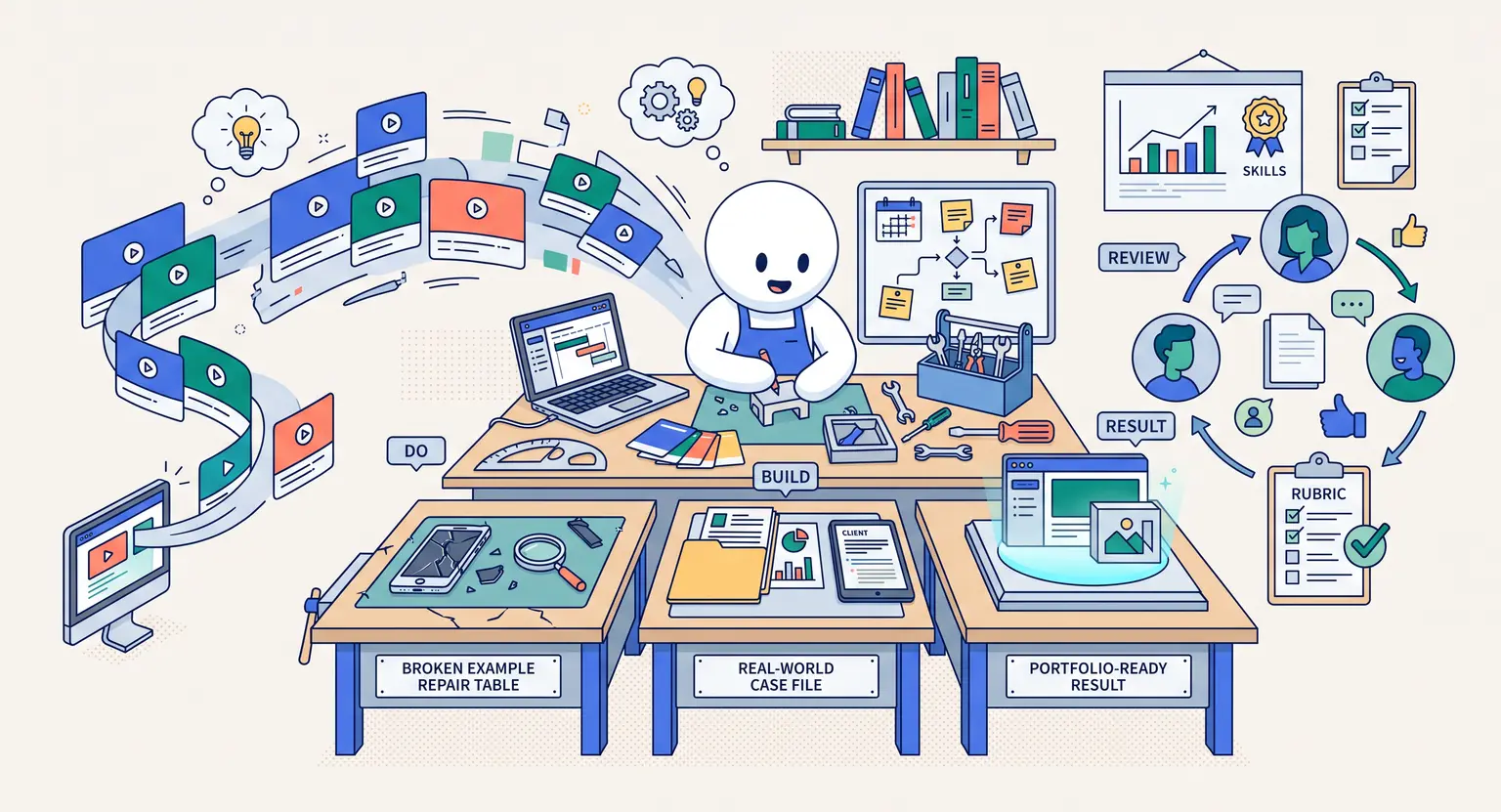
How to Create Practical Assignments for Online Courses (2026)
How to Create Practical Assignments for Online Courses
Key Takeaways
-
Practical tasks turn passive video consumption into tangible student capability.
-
Milestone-based assignments prevent procrastination and reduce mid-course abandonment.
-
Pair exercises with structured resources like a guided course workbook to give learners clear action steps.
-
Rubrics simplify expectations, streamline grading, and eliminate student confusion.
Most online courses suffer from the exact same silent killer : binge-watching without doing. Students buy your program with genuine excitement, watch five video modules in a single weekend, nod along enthusiastically, and then produce absolutely nothing.
Three months later, they remember almost nothing you taught them.
That disconnect is not because your lessons are bad. It happens because watching someone explain a skill feels like learning, but true competence only develops when a learner puts their own hands on the keyboard, canvas, or spreadsheet.
When you incorporate well-designed practical exercises, you shift your entire offer from mere information to genuine transformation.
Designing effective assignments does not mean assigning tedious academic essays or arbitrary busywork. It means building frictionless checkpoints that let students practice what you teach, validate their understanding, and build an asset they can use in real life.
Why Passive Learning Fails in Online Education
Passive watching creates a false sense of mastery known as the fluency illusion. When an instructor makes a complex task look smooth on screen, the student assumes they can duplicate the outcome effortlessly.
The moment they attempt it alone, frustration sets in, motivation collapses, and they abandon the course.
Structured assignments bridge that gap by forcing active recall and application. Instead of asking students to recall facts, you challenge them to solve a realistic scenario.
When learners produce tangible work at every stage, their confidence compounds. Moreover, practical deliverables give students evidence of progress.
That sense of accomplishment fuels retention, boosts completion rates, and directly generates raving reviews that help you sell more seats in the future.
Four Practical Assignment Frameworks That Deliver Real Skills
Different subjects demand different practical tasks.
A coding bootcamp requires a completely different exercise than a photography workshop or a management masterclass.
Here are four versatile formats you can adapt immediately :
-
The cumulative capstone : break down a massive end goal into small, sequential deliverables.
If your course teaches how to build an e-commerce brand, Module 1 produces a validated niche, Module 2 sets up the store template, and Module 3 launches the first ad. By the end, the student owns a finished project.
-
The "Fix This Broken Example" challenge : give students an intentionally flawed asset - a poorly written sales page, a buggy code snippet, or an inefficient budget spreadsheet.
Ask them to diagnose three mistakes and submit the corrected version.
-
The real-world roleplay or case study : present a messy, realistic scenario involving competing priorities.
Ask learners to outline their exact action plan, justify their choices, and submit their strategic brief.
-
The "Show Your Work" micro-submission : require a quick two-minute screen recording or screenshot demonstrating tool setup, audio configuration, or workflow implementation before moving forward.
To keep learners engaged throughout long modules, you can naturally integrate these activities right after introducing core concepts in your engaging course content to maintain high energy.
Comparing Assignment Types : Choosing the Right Match
Selecting the right format depends heavily on your subject matter, cohort size, and whether your program runs live or fully self-paced.
Use this quick comparison to pick the best vehicle for each lesson :
| Assignment type | Primary goal | Best suited for | Grading effort |
|---|---|---|---|
|
Milestone capstone |
Builds a portfolio-ready asset over time. |
Complex professional skills, business setups, and creative design. |
Moderate to high (rubrics help streamline reviews). |
|
Diagnostic / tear-down |
Tests critical analysis and problem detection. |
Copywriting, marketing audits, code review, and UX design. |
Low to moderate (ideal for peer reviews). |
|
Tool sandbox exercise |
Builds muscle memory inside dedicated software. |
Video editing, data analytics, CRM management, and 3D modeling. |
Low (can use checklists or automated checks). |
|
Interactive quiz checkpoint |
Quick comprehension check before deeper project work. |
Foundational theories, vocabulary, compliance, and regulations. |
Zero effort when using automated interactive quizzes. |
How to Write Clear Assignment Briefs That Prevent Support Tickets
Vague prompts produce confused students and an inbox flooded with repetitive questions.
If an assignment says "Write a short marketing plan," half of your class will submit a two-sentence paragraph, while the other half will submit a thirty-page dissertation.
Every assignment prompt needs four explicit components :
-
The precise objective : state what the student is building and why it matters in one direct sentence.
-
The exact scope and constraints : specify file format, length limits, required tools, and acceptable file extensions. Setting clear boundaries relieves pressure.
-
The step-by-step execution plan : break the task into 3 to 5 clear sub-steps so learners never wonder where to start.
-
The success criteria / benchmark : include an annotated sample of an exemplary submission alongside a common rookie mistake to avoid.
When you map this out systematically while designing your course curriculum outline, each assignment slots naturally into the overall learning pathway without creating bottlenecks.
Streamlining Feedback Without Burning Out
If you run a self-paced course with hundreds of students, manually reviewing every single document is a fast track to severe creator fatigue. You need scalable review systems that still make students feel supported.
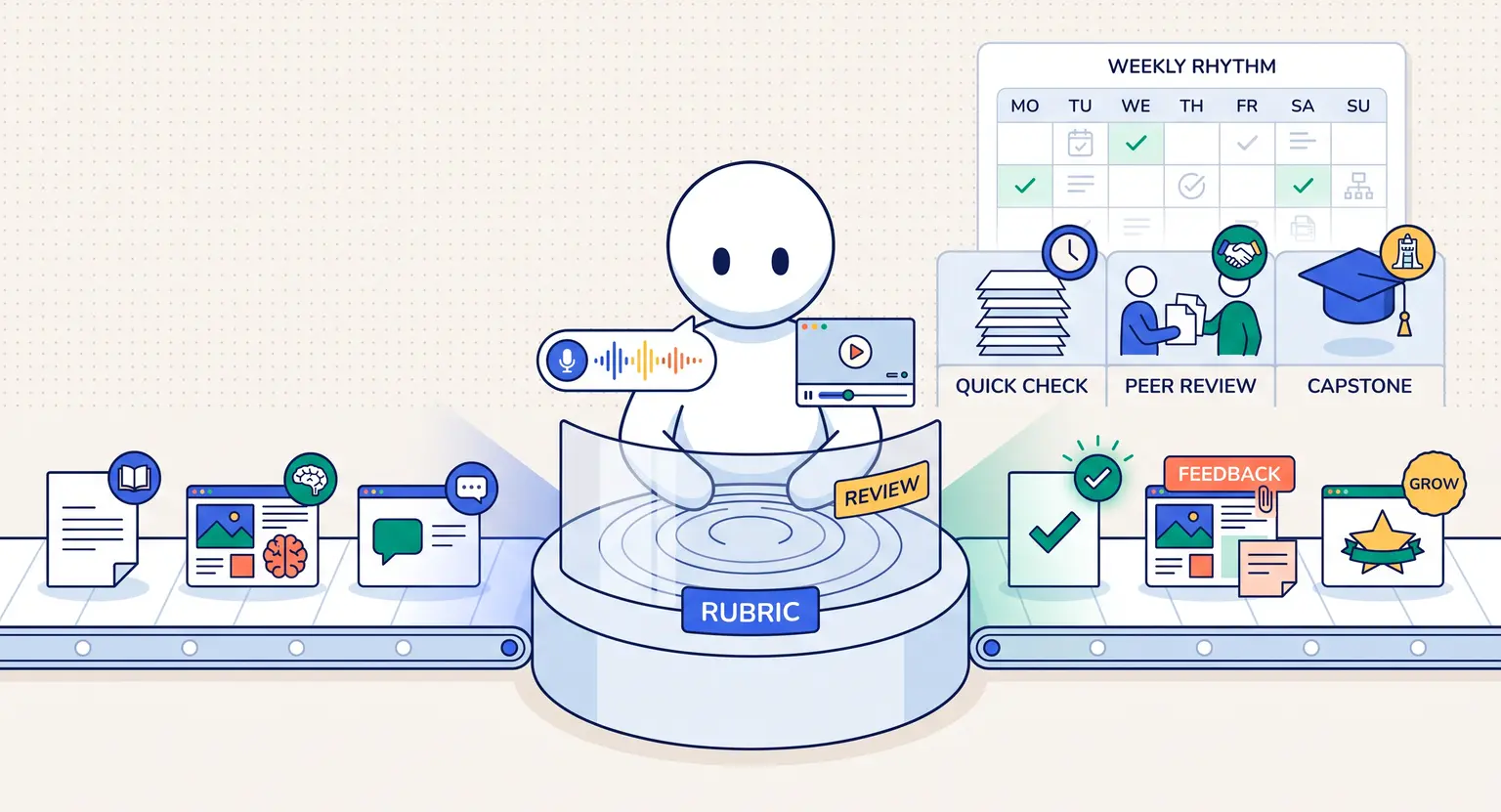
Start by providing clear scoring rubrics. A simple four-point scoring rubric breaks down expectations into transparent tiers : Needs Revision, Competent, and Exemplary. When learners know exactly how work is evaluated, they self-correct before submitting.
You can also implement structured peer feedback loops. Have students post their work in your community space and require them to leave constructive feedback on two peers' submissions before receiving feedback on their own.
This sparks vibrant community conversations while lifting the grading burden off your shoulders.
For high-ticket cohorts or accredited programs where grading requires strict verification, you can establish clear protocols for grading assignments efficiently to keep turnaround times under forty-eight hours.
Explore Further Resources
-
Discover the full architectural blueprint in our guide to structuring an online course for student success.
-
Keep your launch organized step-by-step with our comprehensive course creation checklist.
-
Maintain high academic integrity by learning how to verify student identity for accredited certifications.
-
Host your assignments, videos, and communities seamlessly using the tools to sell online courses with LearnyBox.
Frequently Asked Questions
How many practical assignments should I include in an online course?
Aim for one actionable assignment per core module.
Breaking a single overarching capstone project into three to five bite-sized milestones prevents student overwhelm while keeping momentum steady.
What is the best way to handle grading for self-paced courses?
Self-assessment checklists combined with peer review boards and automated rubric submissions work best for asynchronous programs.
You can also provide reference benchmark answers so students can evaluate their own work immediately.
How do I prevent students from relying completely on AI to finish tasks?
Design assignments around personal case studies, raw audio or video reflections, or custom datasets.
Ask students to document their decision-making process rather than merely submitting a generic text answer.
Should assignments be mandatory to unlock subsequent lessons?
Gating lessons behind assignment submissions works well for certification tracks or high-touch coaching programs.
For general consumer courses, keep them optional or soft-gated to avoid unnecessary drop-offs.







 How to Create a Course Refund Policy (Templates & Best Practices for 2026)
 How to Create a Cohort-Based Online Course (2026 Guide)
 How to Sell an Online Course With a Quiz Funnel (2026 Guide)
 How to Sell an Online Course Through a Sales Call (2026 Guide)