







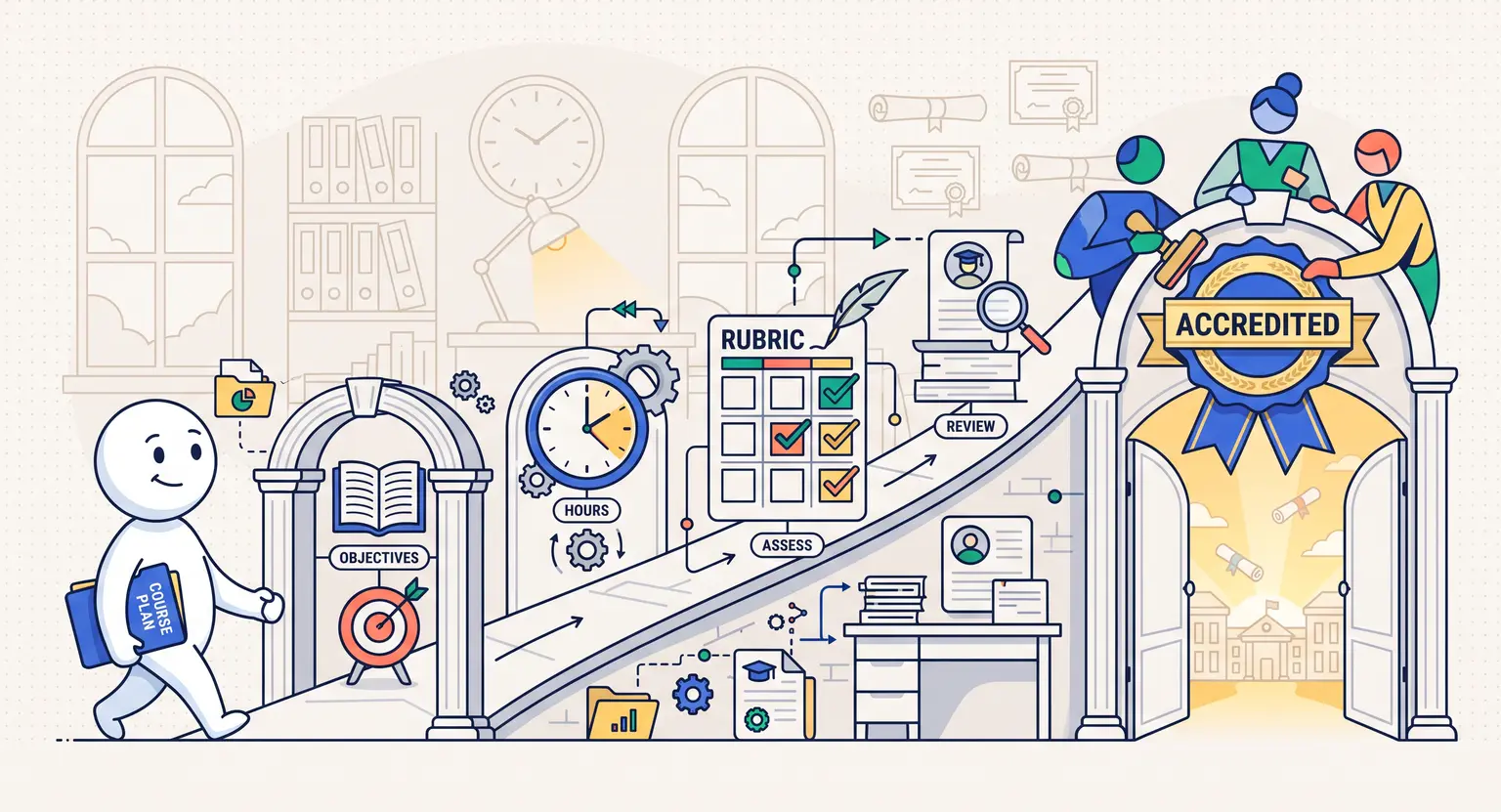
How to Get an Online Course Accredited (Step-by-Step 2026 Guide)
How to Get an Online Course Accredited
Anyone with a microphone and a slide deck can launch a digital workshop these days. The internet is overflowing with certificates of completion that do little more than sit on a hard drive.
If you want students to trust your program, justify premium pricing, and help professionals earn tangible career credit, formal accreditation changes everything.
Accrediting a course turns your personal knowledge into an authorized educational asset, but the process has a reputation for being buried under bureaucratic jargon, strict audits, and confusing acronyms.
The good news? Securing recognized credentials for an online program in 2026 is completely achievable once you understand what evaluation panels actually look for.
Key Takeaways
-
Accreditation equals quality assurance : it proves an independent external authority vetted your curriculum, learning objectives, and testing methods.
-
Pick the right target : independent creators should focus on CPD, specialized industry boards, or non-degree continuing education standards rather than traditional regional degree charters.
-
Audit trails are mandatory : your learning platform must prove learner identity, track module completion time, and record test attempts reliably using an integrated all-in-one course platform.
-
Document everything early : transparent rubrics, verifiable instructor bios, and clear lesson objectives speed up board reviews dramatically.
What Course Accreditation Actually Means (and Why It Matters)
Accreditation is a formal seal of approval issued by a recognized third-party governing body. When an agency accredits your program, they verify that your content meets established educational benchmarks, produces measurable outcomes, and delivers what it promises.
There is a massive difference between issuing your own branded certificate and issuing an accredited credential. Self-made certificates confirm that a student clicked through your videos. Accredited certificates prove that the student met rigorous criteria established by an external industry standard.
This distinction changes your market position instantly. When corporate HR departments or licensing boards evaluate training budgets, they prioritize programs backed by recognized oversight.
Accreditation allows your students to submit their completed coursework for continuing education units, employee tuition reimbursements, or professional license renewals.
You can also charge significantly higher tuition. When you can show how continuing education credits add value to an online course, your price tag reflects genuine career advancement rather than casual self-help.
Choosing the Right Type of Accreditation for Your Program
Not all accreditation pathways look the same. Attempting to pursue the wrong category wastes months of administrative work and thousands of dollars in review fees. Here is how the landscape breaks down :
-
CPD (Continuing Professional Development) Certification : the most popular and accessible route for independent creators. Global bodies like The CPD Certification Service or the CPD Standards Office evaluate workshops, masterclasses, and digital modules for working professionals.
-
Industry-specific board recognition : if your course teaches HR, project management, accounting, or medical coding, you will apply directly to the governing authority in that niche (such as SHRM, PMI, or NASBA).
-
Non-formal continuing education (IACET) : the International Association for Continuing Education and Training sets the gold standard for Continuing Education Units (CEUs) globally.
-
Formal higher-education accreditation : regional or national institutional accreditation for degree-granting colleges. Independent creators rarely need this unless building a formal degree or diploma institution.
If you run a practical course on leadership, software design, clinical documentation, or technical marketing, pursuing CPD or specialized industry recognition gives you maximum credibility with minimal red tape.
A Step-by-Step Roadmap to Accredit Your Online Course
Getting your course approved requires structured preparation. Follow these sequential steps to move through the evaluation process smoothly without getting stuck in revision loops.
Step 1 : Map Clear, Measurable Learning Objectives
Accreditation reviewers reject vague claims like "learn how to be a great manager." They require measurable competencies grounded in Bloom's Taxonomy. Every module must state what the student will be able to demonstrate upon completion.
Use active verbs. Replace "understand marketing strategy" with "formulate a multi-channel acquisition campaign and calculate expected customer lifetime value." This gives auditors concrete proof that your lessons can be assessed accurately.
Step 2 : Align Content with Contact Hours
Accreditation bodies calculate credit value based on structured learning hours. This includes video lectures, mandatory reading, practical exercises, and quizzes. A standard CEU, for instance, represents 10 contact hours of participation.
You must provide an itemized syllabus showing exact time estimates for every piece of content. If you claim a lesson takes 45 minutes, auditors will evaluate whether the video length, reading density, and exercise difficulty realistically match that timeframe.
Step 3 : Build Robust Assessments and Scoring Rubrics
Multiple-choice quizzes with obvious answers will not pass muster. Accreditation requires secure, meaningful assessments that test both recall and practical application.
Create clear passing thresholds (typically 70% to 80%) and detailed grading rubrics for open-ended assignments. You should also build randomized question banks to prevent cheating and limit maximum exam attempts before requiring module review.
Step 4 : Prepare Instructor and Subject-Matter Expert Dossiers
Auditors evaluate who is teaching just as thoroughly as what is being taught. Compile detailed professional CVs, academic degrees, industry licenses, and practical accomplishments for every instructor listed in your program.
If your course features guest speakers or co-instructors, include their bios and professional qualifications in your initial submission binder.
Step 5 : Choose an Accrediting Body and Submit Your Application
Once your syllabus, learning objectives, assessments, and teacher credentials are organized, complete the formal application package with your chosen body.
Most agencies require an initial application fee, your digital curriculum package, and temporary administrative access to your learning management system.
Step 6 : Complete the Audit and Implement Required Adjustments
Expect feedback. Review panels almost always suggest small adjustments before issuing final approval. They might ask you to lengthen an assessment, clarify a learning objective, or add accessibility features like closed captions.
Treat their notes as a roadmap to polish your offer, update your files, and secure your final certificate of accreditation.
Accreditation Frameworks & Requirements Comparison
To help you choose the best route for your curriculum, here is a breakdown of the primary accreditation paths available to modern educators.
| Accreditation type | Primary target audience | Typical review time | Key prerequisites |
|---|---|---|---|
|
CPD Certification (e.g., CPD UK) |
Corporate professionals, consultants, skills training. |
4-8 weeks. |
Syllabus with verified hours, clear objectives, student feedback system. |
|
IACET (Standard CEUs) |
Global workforce, enterprise training, technical trades. |
3-6 months. |
Full instructional design audit, verified assessment metrics, instructor credentials. |
|
Industry bodies (SHRM, PMI, NASBA) |
Licensed specialists (HR, PMP, CPA). |
2-4 months. |
Direct alignment with body of knowledge (BOK), strict identity verification. |
|
University co-branding / articulation |
Degree seekers, academic transfer students. |
6-18 months. |
Institutional partnership agreement, faculty oversight, proctored exams. |
|
State / regional licensing boards |
Real estate agents, healthcare staff, contractors. |
3-9 months. |
State-mandated lesson plans, seat-time enforcement, biometric/timed logins. |
LMS Infrastructure and Technical Compliance
Creating great slides is only half the battle. Accreditation bodies care deeply about how your course is delivered and tracked. They will evaluate your learning management platform to ensure learners cannot simply skip through the lessons or fake their progress.
Your delivery system must support several core compliance features :
-
Pacing and sequence control : you must be able to lock advanced modules until prerequisite lessons and quizzes are completed. Evaluating whether to deliver modules sequentially or give full access upfront often comes down to choosing between drip content vs all-at-once delivery models to fulfill minimum seat-time mandates.
-
Time tracking and video completion : the LMS must record exact time spent on learning activities to confirm students fulfill all mandated contact hours.
-
Secure certification generation : upon passing final exams, the system should generate certificates featuring unique verification IDs, student names, completion dates, and approved accreditation provider badges.
-
Accessibility standards : your content must offer readable typography, alt text on images, and closed captions on video assets to satisfy basic digital accessibility rules.
If you need structured releases to ensure students absorb content at an approved pace, understanding how to configure a custom drip course strategy keeps your program compliant without frustrating busy professionals.
Common Reasons Course Accreditation Applications Get Rejected
Most rejections stem from preventable administrative oversights rather than poor teaching. Knowing what triggers a red flag will save you weeks of back-and-forth communication.
The number one mistake creators make is submitting vague or unmeasurable learning outcomes. Saying students will "appreciate modern coding practices" gives evaluators nothing to grade. Rewriting that objective to specify "build and deploy an automated unit testing pipeline" satisfies their criteria instantly.
Another frequent pitfall is insufficient assessment security. If an auditor finds that a student can take an exam an unlimited number of times without questions changing, or if the correct answers are revealed immediately after a failed attempt, they will reject the application.
Ensure your testing engine randomizes questions and limits retakes appropriately.
Finally, do not overlook student feedback mechanisms. Accrediting organizations want to see that you actively gather course evaluations, track completion metrics, and update materials regularly based on learner input.
Explore Further Course Delivery Resources
-
Discover the best setup by testing the complete features of a modern online course creation platform.
-
Deep dive into credit structures with our guide on how to offer continuing education credits with an online course.
-
Refine your educational pacing with our comparison of drip courses vs all-at-once models.
-
Set up strict lesson scheduling step-by-step using our tutorial on how to create a drip course.
Frequently Asked Questions
How long does it take to get an online course accredited?
The timeline ranges from 6 to 16 weeks for specialized industry and CPD providers, while formal institutional or regional college accreditation takes 12 to 24 months.
Gathering your syllabus documentation, rubric files, and assessment data usually accounts for the first month of preparation.
How much does online course accreditation cost?
Accreditation costs vary widely depending on the certifying body. Independent CPD or professional training provider approvals often cost between $800 and $3,500 annually.
Formal IACET accreditation or higher-ed regional evaluations can cost between $4,000 and $15,000, including initial application fees, audits, and periodic renewal checks.
Can an individual creator get a course accredited without a university?
Yes. Individual instructors and independent course creators can secure accreditation through third-party bodies such as CPD UK, the CPD Standards Office, or specialized industry boards (like NASBA for accountants or SHRM for HR specialists) without needing a university charter.
Do I need to renew my course accreditation every year?
Most recognized accreditation agencies require annual renewal fees, along with periodic curriculum audits every 2 to 3 years.
These reviews confirm that your training material remains accurate, updated, and aligned with current industry standards.
Is accreditation different from certification for individual students?
Yes. Accreditation validates the institution or program quality. Certification validates the individual learner's demonstrated skills.
Both can co-exist in the same course ecosystem, but they operate through separate governing frameworks and serve different career purposes.




 How to Create a Course Refund Policy (Templates & Best Practices for 2026)
 How to Run a Beta Version of an Online Course (2026 Guide)
 How to Create a Cohort-Based Online Course (2026 Guide)
 How to Sell an Online Course With a Quiz Funnel (2026 Guide)
 How to Sell an Online Course Through a Sales Call (2026 Guide)