







How to Structure a Coaching Offer in 2026 That Sells Itself
How to Structure a Coaching Offer in 2026 That Sells Itself
Key Takeaways
-
Focus on outcomes, not hours. Clients pay for the bridge from where they are to where they want to be.
-
Offer tier structures to cater to different budget and accessibility levels.
-
Implement structured content and template repositories to scale your time while delivering exceptional value.
-
Set up reliable payment setups and support channels to maintain professional boundaries.
-
Create a flawless onboarding process to minimize buyer's remorse immediately post-purchase.
Selling coaching is a strange thing. You aren't selling a physical widget. You are selling a promise of change, a path from frustration to freedom. Yet, too many talented coaches make a classic, painful mistake. They sell their time by the single hour.
Think about it. Selling session blocks forces you into a dangerous trap. You must constantly hunt for new clients just to pay the bills. And your clients? They view your help as a transaction, like buying a coffee. If they feel slightly better next week, they drop off.
In 2026, the coaching market is highly mature. People are tired of vague, endless conversations. They want structured solutions. They want to know exactly how you will take them from point A to point B.
Let us look at how you can design and package a compelling coaching offer. This blueprint will keep your clients committed, maximize your revenue, and reclaim your free time.
Start with the Destination, Not the Delivery
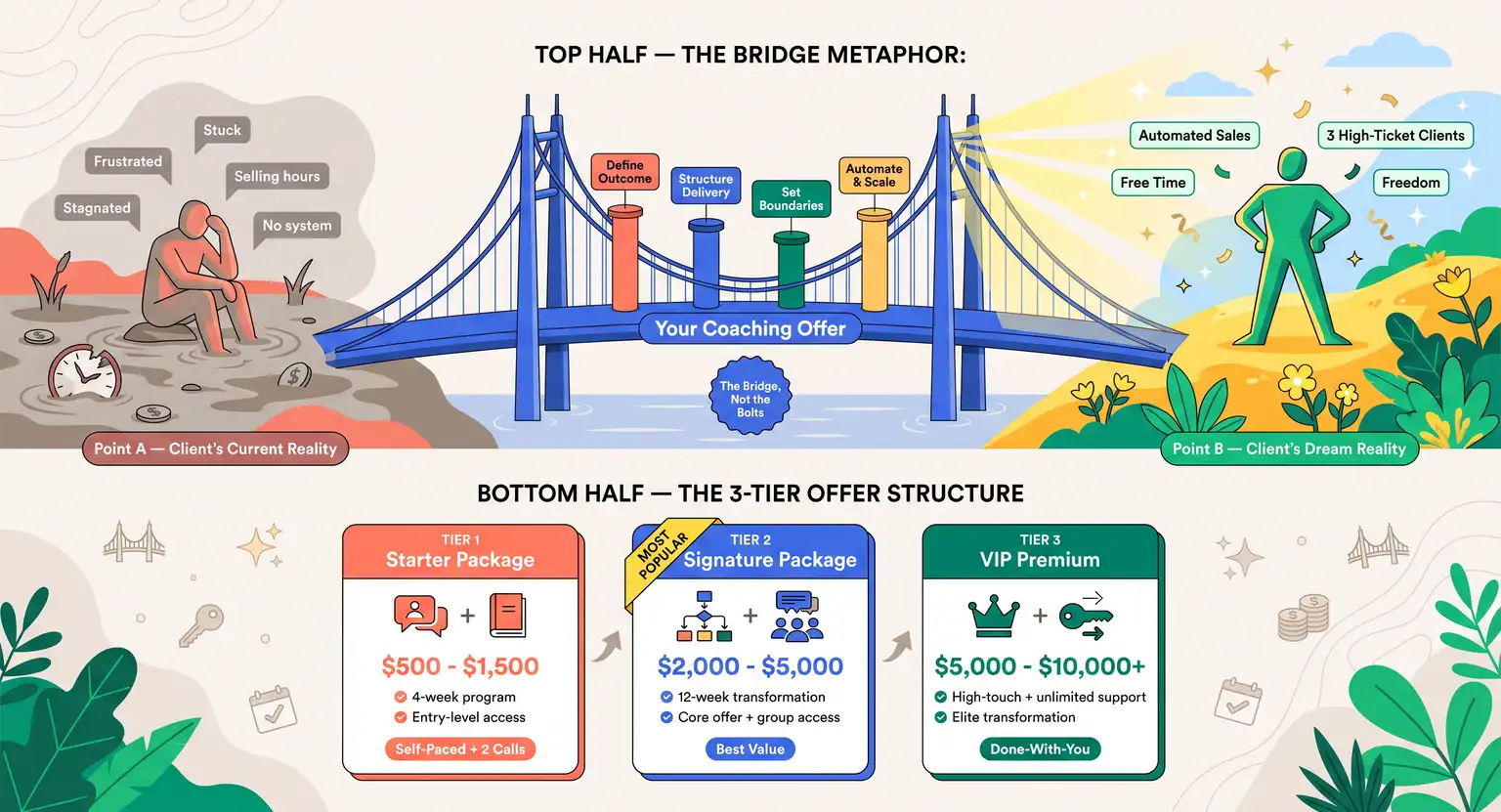
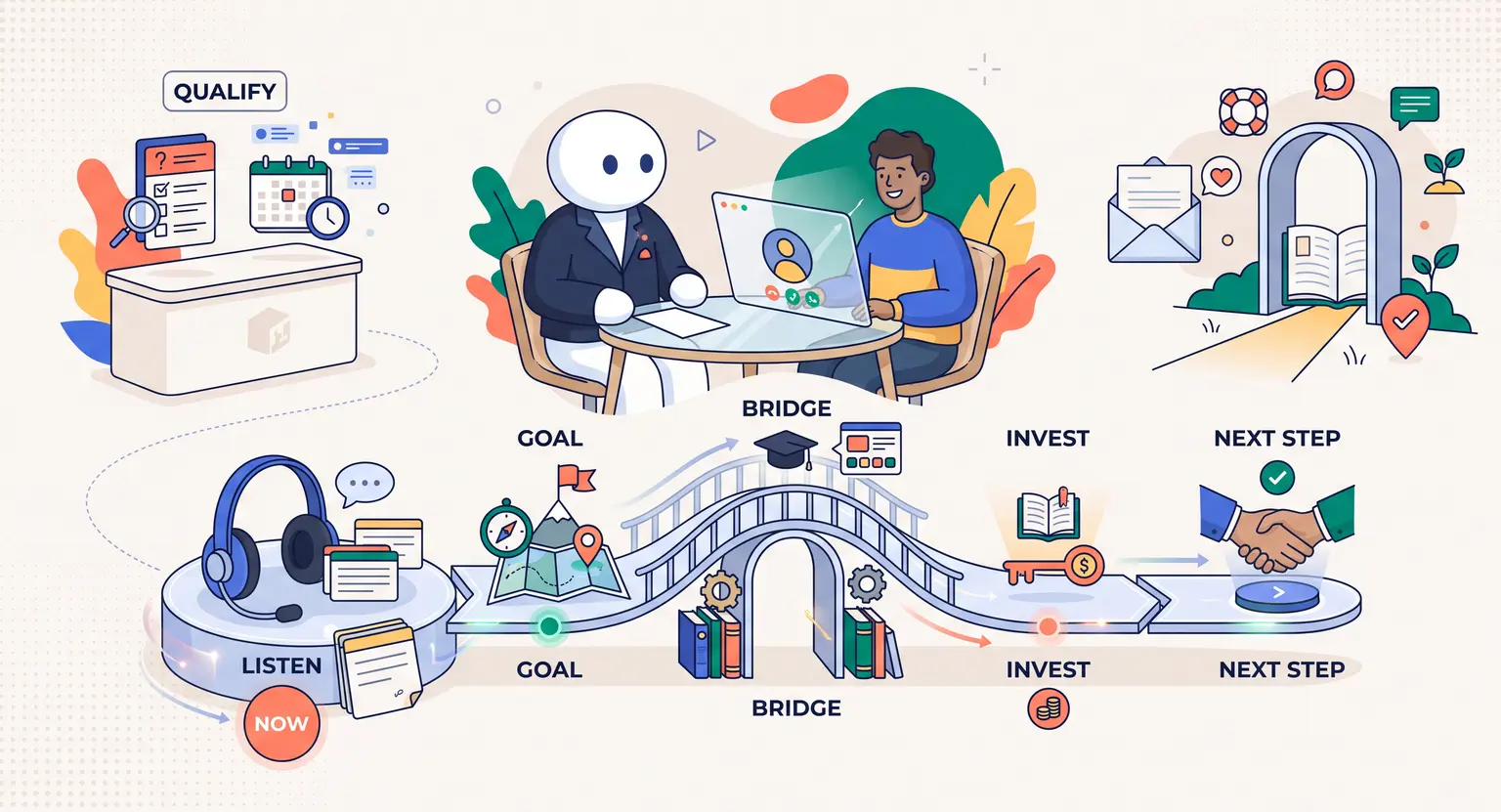
Before you think about whether to offer weekly video calls or daily messaging support, you must define the transformation. Your coaching program is a bridge.
On one side of the river is your client's current reality : frustrating, stuck, and painful.
On the other side is their desired future : free, automated, and successful.
Your offer is the bridge. But too many coaches spend all their energy talking about the steel and bolts of the bridge rather than the beautiful city on the other side.
So, focus on the result. Ask yourself what concrete, measurable goal your client will achieve by the end of your time together.
Is it landing three high-ticket clients?
Is it saving their relationship?
Is it running a marathon?
When you describe your offer, anchor it to this outcome. If you are a business coach, don't promise eight weekly session blocks - instead, package it as a system to construct an automated sales pipeline that brings in qualified leads.
By shifting the spotlight to the outcome, you immediately justify a premium price. You are no longer selling sixty minutes of talking. You are selling a new reality.
The Three Pillars of a High-Value Offer
Every coaching offer requires a balanced blend of three core components. If you offer too much of one, you burn out. If you offer too little, your clients fail to get results.
The first pillar is access. This represents the amount of direct contact your client has with you.
It could mean 1-on-1 Zoom sessions, group masterminds, or asynchronous support via email and Slack. In your early days, you might offer high access. But as you grow, you must look at a premium pricing strategy guide to ensure your time is heavily valued.
The second pillar is curriculum. This contains the educational assets that help clients learn independently.
Think of templated tools, video lessons, and step-by-step PDF resources. This material does the heavy lifting of teaching basic theories so your face-to-face time is spent solving unique, high-level issues.
The third pillar is accountability. This is the glue. It includes weekly tracking documents, peer groups, or regular progress check-ins.
Many clients do not need more information; they need the discipline to execute the steps.
Let us look at how to balance these elements :
-
High-ticket packages must include private, fast-response access and deep personal feedback loops.
-
Mid-tier programs rely heavily on group peer systems coupled with solid modular content.
-
Low-touch programs emphasize pre-recorded curriculum and occasional community group QA calls.
When you look at your schedule, ensure you are not trading late nights for tiny paychecks. If you structure these pillars correctly, your coaching program actually becomes easier to run as it scales.
Designing Your Offer Tier Framework
To serve different segments of your audience, you should structure your offers into clear tiers. This prevents leaving money on the table. It also allows potential clients to entry-point their way into your ecosystem.
Let's break down how this works using a cohesive structure. Here is how a typical modern coach structures their portfolio :
| Offer tier | Core focus | Delivery level | Typical duration | Ideal for |
|---|---|---|---|---|
|
Self-paced core |
DIY learning of foundational strategy and tools. |
Zero 1-on-1 contact; standard community support dashboard. |
Lifetime access. |
Beginners with limited budget but high individual drive. |
|
Hybrid group |
Peer interaction, structured worksheets, and live Q&A. |
Weekly group coaching video calls with shared templates. |
8 to 12 weeks. |
Professionals wanting team validation and shared learning. |
|
Elite 1-on-1 |
Deep personalized strategy, custom reviews, and direct advice. |
Bi-weekly private Zoom meetings plus daily chat support. |
3 to 6 months. |
High-level business owners demanding immediate results. |
|
VIP intensives |
Rapid, hyper-focused problem solving and strategy build-out. |
Full-day deep dive session plus a 30-day follow-up. |
1 to 2 days. |
People with a critical roadblock requiring fast resolution. |
|
Retainer support |
Long-term preservation of achieved results and ongoing counsel. |
Monthly advisory check-ins with emergency message triage. |
Ongoing monthly. |
Alumni of intensive and high-level 1-on-1 programs. |
By presenting these options, you let the market guide itself. If a premium client wants speed, they select the Intensive or private elite option.
If they are tight on budget, they opt for the group or self-paced tier. This multi-gateway strategy also allows you to nurture leads through different phases of their growth.
Boundaries Keep Your Business Alive
Let's talk about the hard reality of offering coaching. If you don't build fences around your coaching offer, your clients will happily overrun your life.
They will text you at 10 PM demanding feedback on a landing page. They will email you five times a day with minor questions. Soon enough, you will look at your coaching roster and feel a wave of dread.
And who is to blame? It is not your clients. It is you. You failed to set constraints inside the offer structure itself.
To avoid this, define your boundaries in black and white before anyone gives you a credit card. Decide exactly how support works.
Do you answer messages on weekends? No? Then state clearly that chat support runs Monday through Thursday, with a 24-hour response window.
Will you review their documents? Outstanding. But limit it to one document review per week, capped at three pages.
These small rules don't push clients away. In fact, they make you look more professional. They show you respect your time, which teaches clients to respect their own time too.
To run this professionally, you need the right tools under the hood. Using an all-in-one platform to store your materials and organize clients avoids messy email chains. When all documents, schedules, and materials are in one central hub, confusion disappears entirely.
Executing Your Operations with Automation
Once your coaching offer is structured, you must automate the tedious administrative tasks. You shouldn't spend your weekends manually sending PDF contracts, chasing late payments, or sharing calendar links.
First, secure your cash flow. Set up an efficient, trustworthy system to process your revenue. This ensures payments are clear on time, whether they are upfront setup fees or monthly subscription charges.
Next, leverage structured automated messaging cycles to guide new clients through their journey. The moment they sign up, they should immediately get a welcome sequence that coordinates scheduling, requests baseline information, and gets them excited about the work ahead.
This is how you run a professional coaching outfit that scales easily.
But you don't need a messy pile of expensive tools to achieve this. With LearnyBox, you have everything integrated into one dashboard : landing pages, checkout flows, community channels, and course delivery frameworks.
It makes the tech simple so you can focus entirely on your coaching zone of genius. You can browse our expert marketing resources to explore strategies for setting up these processes smoothly.
Ready to build?
Structuring your service with clear tiers and robust delivery frameworks transforms your talent into an asset. It lets you step away from exhausting hourly trade and step into a scaling, highly professional business machine.
Frequently Asked Questions About Offer Structure
How long should my coaching offer package be?
A standard coaching agreement ranges between three to six months.
This timeframe allows enough runway to observe concrete behavioral changes and actual results. Shorter periods rarely give enough time for sustained transformation, while anything over nine months can lead to client fatigue.
Should I display pricing on my website?
Yes, for lower and mid-level program options.
Showing pricing acts as an efficient barrier that weeds out casual buyers who cannot afford your service.
However, for elite, custom premium packages, you may want to prompt a discovery call first to establish the immense value before detailing the technical financial setup.
How many clients can I manage simultaneously?
If you only offer intensive private coaching, your sustainable limit is likely between ten to fifteen active clients.
If you try to carry more, your energy will quickly drop. However, by adding automated content components and group hybrid models, you can easily guide fifty or more active students concurrently.
What are the biggest delivery formats you recommend?
We highly recommend utilizing a hybrid model that blends live coaching sessions with a central repository of video digital modules.
This delivery setup saves you from repeating basic instructions weekly, allowing live interactions to focus on advanced blockages, immediate feedback, and strategic customization.
Do I need legal agreements signed?
Absolutely. You must establish clear legal standards regarding refunds, intellectual property ownership, and cancellation policies before launching.
This simple contract protects your creative structural coaching assets and ensures excellent alignment from day one.




 How to Create a Course Refund Policy (Templates & Best Practices for 2026)
 How to Run a Beta Version of an Online Course (2026 Guide)
 How to Sell an Online Course With a Quiz Funnel (2026 Guide)
 How to Sell an Online Course Through a Sales Call (2026 Guide)