







How to Create Online Compliance Training for Employees (2026 Guide)
How to Create Online Compliance Training for Employees
Mention "mandatory compliance training" in any company chat, and you can practically hear the collective groan echo through the building.
Most of us have suffered through those ancient, painful training modules. You sit there waiting for a grayed-out "Next" button to turn blue while an automated robotic voice reads a 400-word block of legal disclaimers.
Nobody reads it.
People put the video on mute in a hidden browser tab, check their emails, and guess their way through the final quiz until they score 80%.
That is not training. That is an expensive digital checkbox designed to appease an insurance auditor. And when a real cybersecurity incident, harassment claim, or regulatory breach hits, that generic training offers zero protection.
In 2026, building effective online compliance training means respecting your team's time, designing for genuine memory retention, and connecting company rules to daily decisions. Here is the step-by-step roadmap to get it right.
Quick Takeaways for 2026
-
Shift from liability to behavior : modern compliance is about everyday decision-making, not memorizing legal code.
-
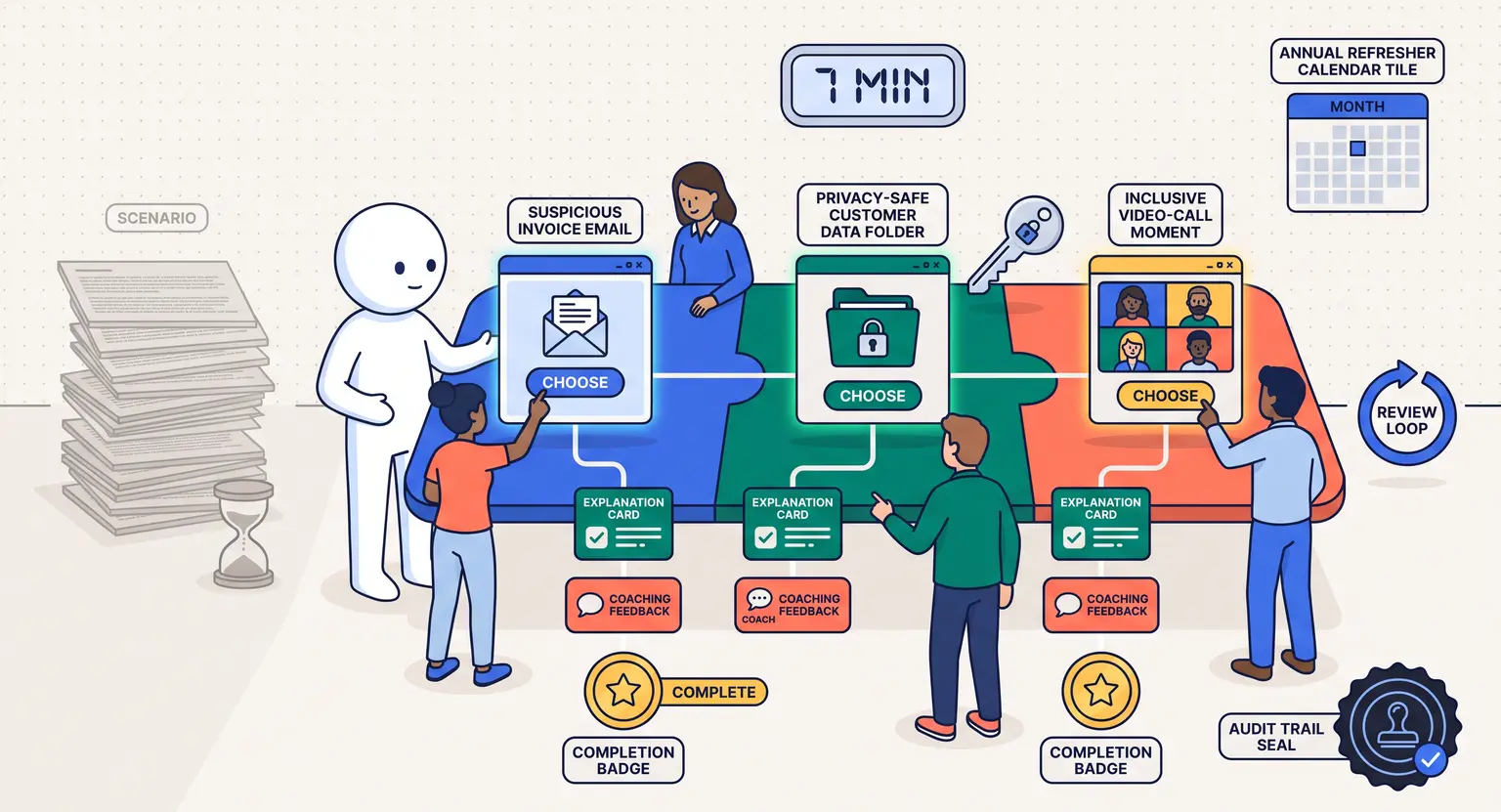
Embrace microlearning : 7-minute scenario-driven modules beat annual 2-hour marathon presentations every single time.
-
Test via decision paths : swap predictable true/false quizzes for realistic ethical dilemmas.
-
Plan your structure early : follow a solid online course blueprint for student success to keep learning paths logical and manageable.
1. Define Behavioral Outcomes (Skip the Legalistic Jargon)
Every compliance initiative starts with a mountain of regulations : GDPR, HIPAA, OSHA, anti-bribery policies, or internal harassment standards. The instinct of most HR and legal teams is to dump that exact statutory text straight into slide decks. Resist that urge with everything you have.
Your employees are not studying to pass the bar exam. They do not need to cite section 404 of a federal code. What they actually need to know is simple : what does this rule look like when I am sitting at my desk, talking to a vendor, or handling client records?
Start by converting dry legal rules into observable workplace actions. Ask yourself : what specific decision should a sales rep make when a prospect sends sensitive personal data over unencrypted email?
How should a team lead react within 15 minutes of noticing uncomfortable banter during a video conference? What red flags should an accountant spot before wiring funds to a revised vendor bank account?
When you define the goal as concrete workplace behavior rather than abstract legal recall, your instructional design becomes much easier to map out.
2. Chunk Knowledge into Scenario-Based Microlearning
Attention spans in 2026 are heavily fragmented. Pulling employees away from their day jobs for a single, unbroken three-hour compliance sprint ruins productivity and causes mental fatigue.
Instead, carve your syllabus into bite-sized units that take between 5 and 10 minutes to complete. This format allows staff to tackle one discrete concept during a brief coffee break or before their morning standup.
Every bite-sized lesson should follow a simple three-part story arc :
the Tension (introduce a realistic scenario involving two colleagues facing an ambiguous gray-area choice),
The Fork in the Road (give the learner three plausible ways to respond, showing how tempting shortcuts create hidden risks),
And the Resolution (break down the consequences of each choice and clearly explain company policy without preaching).
When people see colleagues in believable situations, they stop viewing compliance as corporate red tape and start recognizing how the rules protect their own day-to-day work.
3. Select the Right Infrastructure and Delivery Engine
Even the most brilliant compliance script will flop if your delivery platform feels clunky, requires endless password resets, or fails on mobile devices.
Modern organizations require seamless digital hubs that automate reminders and maintain bulletproof completion logs for auditing purposes.
Deploying your material through an enterprise LMS eLearning platform simplifies automated provisioning, tracks individual progress by department, and produces verifiable certificates the instant an employee wraps up their assessment.
Ensure that whatever platform you choose offers these non-negotiable features : automated user onboarding synced with your HR directory, time-stamped audit trails proving when each module was opened and completed, frictionless single sign-on (SSO) so employees never get locked out, and automated re-certification triggers scheduled 11 months down the road.
4. Build Meaningful Assessments Instead of Predictable Quizzes
We all know the standard compliance quiz formula. The question asks : "Is it okay to share your admin password with a stranger who calls claiming to be IT support?" The answers are A) No, never, or B) Yes, immediately. That tests basic literacy, not critical thinking.
To ensure real comprehension, your quizzes need genuine nuance. Create branching decision trees where every option seems defensible on the surface, but only one option follows established best practices.
For instance, present an email from a supposed executive requesting an urgent invoice payment while traveling.
Rather than asking a simple multiple-choice question, present the full email header, ask the employee to highlight the three suspicious markers, and prompt them on the exact verification protocol to follow next.
If someone answers incorrectly, do not simply flash a red "Try Again" box. Use that moment as an instant coaching opportunity. Explain specifically why that choice exposes the company to risk, and let them retry with an alternate scenario.
Comparing Compliance Training Formats
Choosing the best delivery format depends on your workforce distribution, your industry risk profile, and the complexity of the subject matter.
Here is how modern approaches compare :
| Training method | Best used for | Engagement level | Key resource to explore |
|---|---|---|---|
|
Microlearning modules |
Annual refresher courses and high-frequency policy updates. |
High (quick, focused sessions). |
Review online course formats explained. |
|
Interactive scenarios |
Harassment prevention, ethics, and data handling. |
Very high (active decision trees). |
|
|
Role-based cohorts |
Management obligations, HR protocols, and finance controls. |
Moderate to high (peer discussions). |
|
|
Live virtual workshops |
Complex legal overhauls and post-incident remediation. |
High (direct Q&A access). |
Scheduled quarterly or ad-hoc. |
|
Static slide presentations |
Legacy archival documentation only. |
Extremely low (passive skimming). |
Phase out in favor of active formats. |
5. Continuously Measure and Iterate on Your Course
Publishing your online compliance course is not the finish line. The true test of your program is how your workforce performs months after they receive their completion badge.
Monitor your LMS analytics closely during the first 60 days after release.
Look for specific friction points :
Are 40% of learners failing a particular question on phishing recognition?
Are users dropping off halfway through module three?
Are remote staff reporting audio or mobile sync glitches?
Gather anonymous feedback at the end of each module. Ask employees one straightforward question : "Did this lesson give you clear clarity on what to do in your daily routine?"
Their honest replies will highlight exactly where your training succeeds and where it needs revision.
Explore More Training Architecture Guides
-
Discover tailored solutions for enterprise academies with our LMS training organization portal.
-
Broaden your training scope by reading how to build a customer education program with online courses.
-
Explore all course authoring and delivery features available at LearnyBox today.
Frequently Asked Questions
How long should an online compliance course typically take?
Rather than forcing staff through a monolithic three-hour lecture, break the program into 5-to-10-minute micro-lessons.
You can evaluate mastery smoothly by mastering how to create quizzes for online courses that reinforce critical lessons without overwhelming your team's busy work schedules.
Can mobile access improve compliance completion rates?
Yes, enabling mobile-friendly or app-based learning significantly raises completion velocity, particularly for deskless workers, field technicians, and remote teams.
Check out our guide on how to turn an online course into a mobile app to discover how pocket-sized accessibility transforms employee participation.
What is the biggest mistake companies make with compliance training?
The most damaging mistake is treating compliance as a generic legal liability checkmark instead of a culture-building initiative.
Read our breakdown on the mistakes to avoid when creating online courses to steer clear of boring slide dumps, confusing user navigation, and unrealistic quiz scenarios.
How often should compliance content be updated?
Review your core training modules at least once a year, and perform mini-updates whenever workplace laws, data privacy standards, or industry regulations change.
Outdated scenarios immediately destroy employee trust in the training, signaling that leadership is merely going through the motions rather than prioritizing safety and integrity.
How do I prove ROI on compliance training to company leadership?
Track incident reduction rates, failed assessment retake percentages, audit pass rates, and time-to-completion trends quarter over quarter.
Presenting concrete before-and-after metrics tied to specific modules gives leadership tangible proof that the investment is reducing real operational and legal risk.





 How to Create a Course Refund Policy (Templates & Best Practices for 2026)
 How to Create a Cohort-Based Online Course (2026 Guide)
 How to Sell an Online Course With a Quiz Funnel (2026 Guide)
 How to Sell an Online Course Through a Sales Call (2026 Guide)